






How Karnataka’s Coffee Cooperative in Coorg Exports to Starbucks Without Losing Farmer Control

How Karnataka's Coffee Cooperative in Coorg Exports to Starbucks Without Losing Farmer Control

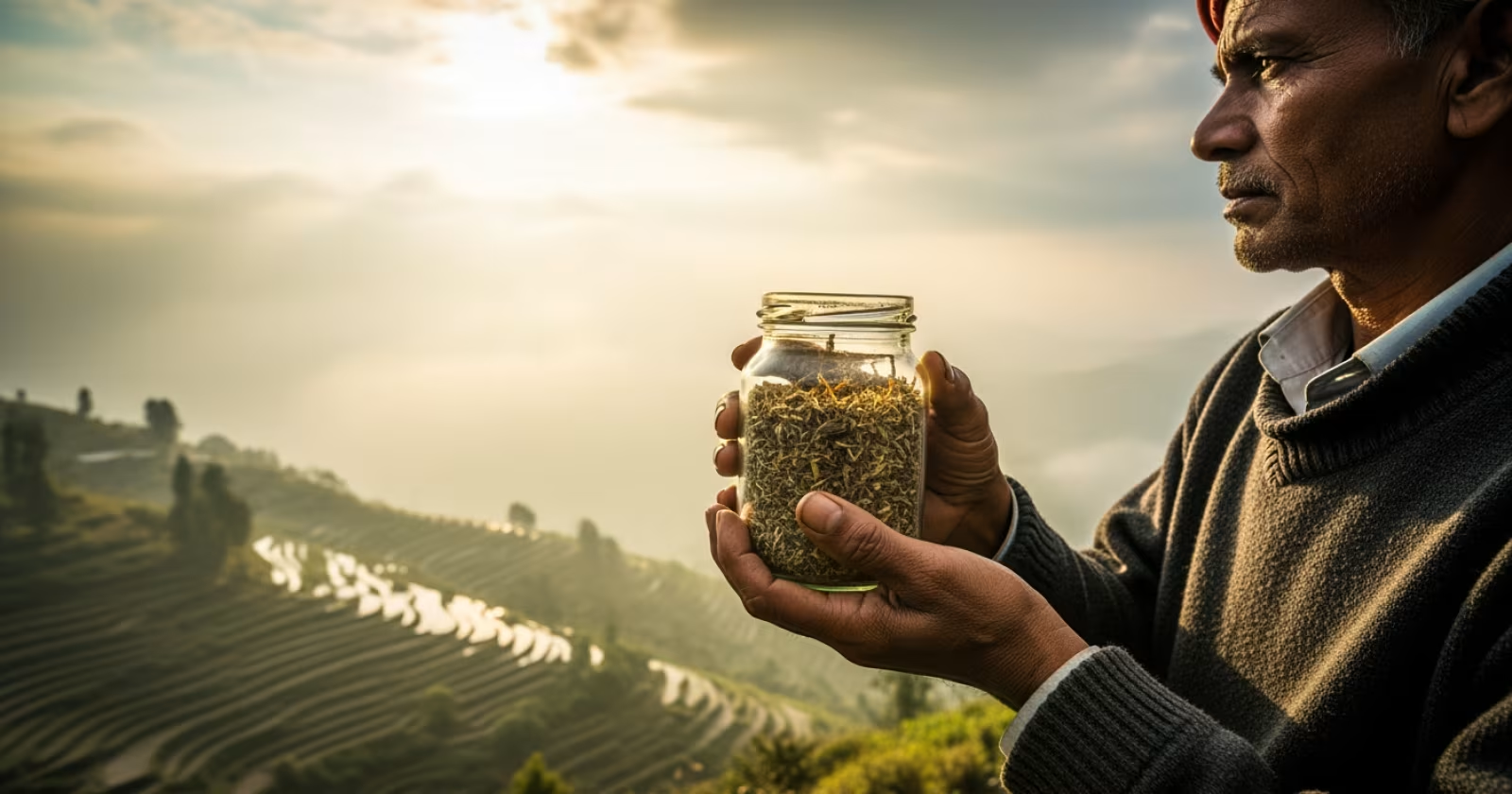
In the mist-wrapped hills of Kodagu district, a 62-year-old grower named Suresh Ponnappa tends to four acres of Arabica coffee that his grandfather first planted in the 1940s. His entire annual harvest — roughly 1,200 kilograms of cherry — now travels from his small estate to a Starbucks Reserve counter in Mumbai. Yet Suresh has never spoken to a single Starbucks buyer. His cooperative did that for him, negotiating a price nearly ₹40 per kilogram higher than what the local trader offered last season. I travelled to Coorg in early 2026 to understand how this arrangement actually works, and what I found challenged almost everything I assumed about Indian cooperatives.

This is not just a feel-good story about farmers and fair trade. It is a structural lesson in how a cooperative coffee model in Karnataka has cracked the export supply chain to one of the world’s largest coffee brands — without surrendering governance to corporate intermediaries or government bureaucrats. At a time when the Ministry of Cooperation is pushing to modernise India’s 8.5 lakh cooperative societies, Kodagu’s coffee growers offer a rare working blueprint.

Read more

How Andhra’s Cooperative Aquaculture Sector Made Krishna District the Shrimp Capital of India

How Andhra's Cooperative Aquaculture Sector Made Krishna District the Shrimp Capital of India

In Nagayalanka mandal, at the southern tip of Krishna district where the river meets the Bay of Bengal, a 62-year-old farmer named Ramaiah tends to 12 acres of shrimp ponds that earn him more than his rice paddies ever did. His cooperative society — one of over 400 fishermen cooperatives scattered across Andhra Pradesh — negotiated a collective input price for Vannamei shrimp seed that saved each member approximately ₹15,000 per acre per cycle in 2026. I first heard about Nagayalanka’s transformation from a colleague covering rural Andhra, and the numbers stunned me enough to dig deeper.

What I found was not a single success story but an entire economic ecosystem — one where cooperative aquaculture has quietly turned a coastal district into the engine room of India‘s ₹52,000 crore shrimp export industry. Krishna district alone accounts for an estimated 30-35% of Andhra Pradesh’s total shrimp output, and the state itself produces roughly 70% of India’s farmed shrimp. Those are not small numbers. They represent a cooperative-driven revolution that most of India has barely noticed.

Read more

UP’s Sugar Belt Has 100+ Cooperative Mills — Most Are Sick, A Few Are Thriving — Here’s the Difference

UP's Sugar Belt Has 100+ Cooperative Mills — Most Are Sick, A Few Are Thriving — Here's the Difference

In Shamli district, barely two hours from Delhi, a rusted padlock hangs on the gates of a cooperative sugar mill that once crushed 2,500 tonnes of cane daily. Weeds push through the concrete yard. The boiler house, silent since the 2019-20 season, looks like an industrial ruin. Seven kilometres east, another cooperative mill — similar vintage, similar capacity — hums through the crushing season, pays farmers within fourteen days, and posted an operating surplus of approximately ₹11 crore last year. I have spent months trying to understand what separates the dead from the living in Uttar Pradesh’s cooperative sugar sector, and the answer is far more uncomfortable than “poor management.”

Uttar Pradesh produces more sugar than any other Indian state — over 12 million tonnes in the 2026-26 season by most estimates. Yet its cooperative sugar mills, once envisioned as farmer-owned engines of rural prosperity, are overwhelmingly sick. Of the 100-plus cooperative mills established across the sugar belt spanning Muzaffarnagar, Shamli, Meerut, Saharanpur, Bijnor, and parts of Rohilkhand, only a fraction operate at viable capacity today. The rest are closed, partially functional, or surviving on government lifelines.

Read more

The Cooperative That Employs 80,000 People With No CEO — Mondragón vs IFFCO Explained

The Cooperative That Employs 80,000 People With No CEO — Mondragón vs IFFCO Explained

In the rain-soaked hills of Basque Country, Spain, a factory worker casting engine parts earns no less than one-sixth of what the highest-paid manager takes home — and that manager was elected by the very workers on the shop floor. Meanwhile, in Kalol, Gujarat, a marginal farmer holding two bighas of land collects his subsidised bag of Nano Urea from the local society, blissfully unaware that his purchase traces back to one of the world’s largest fertiliser cooperatives headquartered over a thousand kilometres away in New Delhi. Two cooperatives. Two continents. Two radically different answers to the same question: can ordinary people govern an enterprise worth billions?

I have spent years covering India‘s cooperative sector for IICTF, and no comparison sharpens the ideological fault lines of the movement quite like placing Mondragón Corporation beside IFFCO (Indian Farmers Fertiliser Cooperative Limited). One has no CEO and lets workers vote on salaries. The other has a Managing Director, a government-linked board, and serves over 35,000 member cooperatives across India. Both are wildly successful. Both claim the cooperative identity. Yet their DNA could not be more different.

Read more

How Sikkim’s Organic Cooperative Became the World’s First 100% Organic State’s Backbone

How Sikkim's Organic Cooperative Became the World's First 100% Organic State's Backbone

In a cardamom field tucked above Rhenock town in East Sikkim, a farmer named Dawa Lepcha watched his neighbours across the border in Darjeeling spray synthetic pesticides on their tea gardens. It was 2014, and Sikkim’s state government had just told him — along with approximately 66,000 other farming families — that chemical fertilisers were … Read more

KMF — Karnataka’s Milk Cooperative Federation That Quietly Became Amul’s Biggest Rival

KMF — Karnataka's Milk Cooperative Federation That Quietly Became Amul's Biggest Rival

In Mandya district, roughly 120 kilometres southwest of Bengaluru, a 54-year-old farmer named Rangaswamy pours approximately 18 litres of milk every morning into a stainless steel can at his village collection centre. He has done this for over two decades. The board above the centre reads “Mandya District Co-operative Milk Producers’ Societies Union” — one of 14 district unions feeding into a machine most Indians outside Karnataka barely know about. That machine is the Karnataka Milk Federation (KMF), and its flagship brand, Nandini, outsells every dairy brand inside the state — including Amul. Rangaswamy earns roughly ₹32 per litre at the procurement point, a figure that has climbed steadily over the past five years. For him, KMF is not a corporate entity. It is the reason his two daughters went to college.

I have tracked India’s cooperative dairy sector for over a decade, and KMF’s story remains one of the most underreported success narratives in the country. While Amul commands national headlines and advertising budgets, KMF has quietly assembled a turnover exceeding ₹22,000 crore, making it India’s second-largest dairy cooperative. What makes this even more remarkable is that KMF operates almost entirely within one state.

Read more

Bikaner’s Cooperative Spinning Mills: The Thread Connecting Desert Farmers to Global Textile Markets

Bikaner's Cooperative Spinning Mills: The Thread Connecting Desert Farmers to Global Textile Markets

In the dusty outskirts of Bikaner district, a shepherd named Bhoma Ram shears wool from his flock of 120 Magra sheep every winter — and for decades, middlemen paid him barely ₹15-20 per kilogram for it. That changed when a cooperative spinning mill offered him ₹45 per kilogram, nearly triple the rate, and suddenly the … Read more

What Silicon Valley Can Learn From a Cooperative Society in Tamil Nadu

What Silicon Valley Can Learn From a Cooperative Society in Tamil Nadu

When I first encountered Co-optex — the Tamil Nadu Handloom Weavers’ Cooperative Society, founded in 1935 — I expected a story of dignified decline. What I found instead was an organization that today connects more than 65,000 weavers across Tamil Nadu, operates its own national retail network, and has never filed a venture capital term … Read more

How India’s Cooperative Insurance Movement Quietly Shaped the Way LIC Was Built

How India's Cooperative Insurance Movement Quietly Shaped the Way LIC Was Built

In 1944, a cotton farmer in Satara district, Maharashtra, paid three annas into a village mutual fund that promised his family a payout if he died before harvest. He never filed a claim, but the ledger recording his contribution still exists — yellowed, hand-ruled, stored in a district cooperative office that most people walk past … Read more

How Audit Grade Determines the Financial Health of Your Cooperative Society

How Audit Grade Determines the Financial Health of Your Cooperative Society

Last March, a dairy cooperative in Sangli district, Maharashtra, with over 1,200 member-farmers, was denied a ₹45 lakh working capital loan by the district central cooperative bank. The reason wasn’t low revenue or shrinking membership — it was a single letter on a government document: audit grade “C.” That one classification, buried in an annual … Read more