
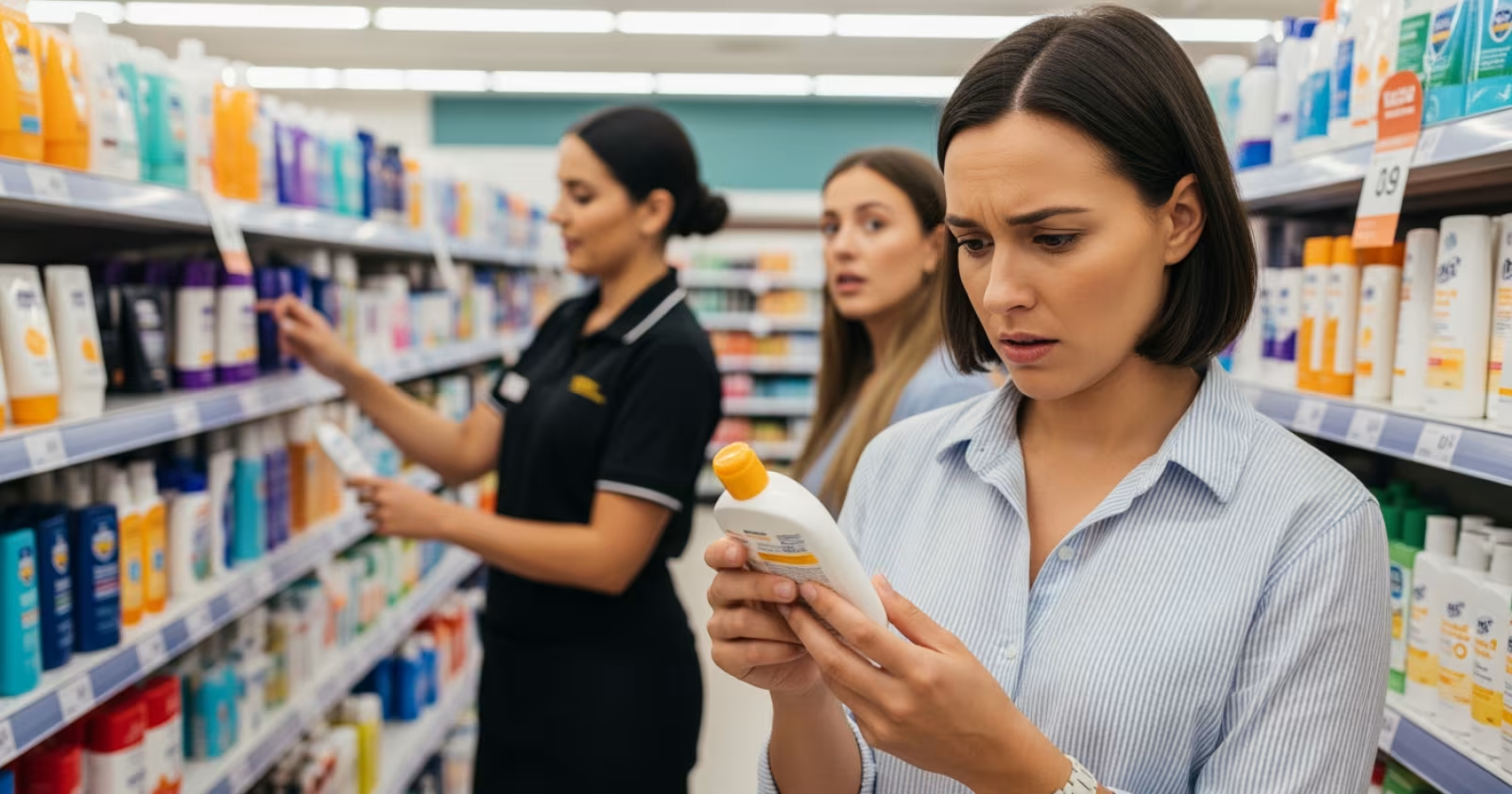
Woolworths kids sunscreen is now facing a regulatory probe that goes beyond a single own-label product. The complaint asks whether a children’s claim can stand when the formulation appears to differ from the adult version in a way that raises safety questions.
For FMCG teams, this matters because own-brand trust lives or dies on the gap between marketing language and product reality. If the claim cannot be backed cleanly, the risk does not stop at one sunscreen SKU.
What Is Woolworths Kids Sunscreen and Why It Matters for FMCG
The issue sits at the intersection of private label, regulated health goods and shopper trust. Woolworths sells a Kids SPF50+ Roll On alongside its SPF50+ Everyday Lotion, and the complaint argues the children’s product is not specially formulated for children in any meaningful sense.
That matters because retailers now use own-label ranges to defend margin and secure shelf space in categories where branded lines once dominated. In a category like sunscreen, though, a child-specific claim can carry more weight than a standard value cue. If that claim is challenged, it can quickly become a broader test of how far retailers can stretch product naming before regulators intervene.
ACCC Review of Woolworths Kids Sunscreen Complaint
The Australian Sunscreen Council has lodged a complaint with the Australian Competition and Consumer Commission asking it to use its powers to compel Woolworths to provide evidence supporting the kids’ product. The council says the only difference between Woolworths’ Kids SPF50+ Roll On and its adult Everyday Lotion is that the children’s product contains 4-MBC at 4 per cent.
According to the council, 4-MBC is a heavily scrutinised UV filter that is under safety review by the Therapeutic Goods Administration and has been banned or refused approval in 78 countries. The council also pointed to the TGA’s January evaluation, which it said found there is no safe dose for 4-MBC.
The ACCC has acknowledged the complaint and said it is assessing the matter. Woolworths said all sunscreen products in its own-brand range meet current regulatory requirements set by the TGA.
The commercial tension is obvious. If a retailer markets a product specifically for children, it needs a defensible formulation rationale, not just a softer label or different packaging. That is especially true when the product sits in a regulated category where parents expect the product itself to justify the claim.
| Product | Claimed position | Issue raised by complaint |
|---|---|---|
| Woolworths Kids SPF50+ Roll On | Marketed for children | Contains 4-MBC at 4 per cent, which the council says is under scrutiny |
| Woolworths SPF50+ Everyday Lotion | General-use sunscreen | Appears similar, with the key difference said to be the 4-MBC ingredient |
| Regulatory backdrop | TGA oversight | 4-MBC remains under safety review and is not approved in many markets |
How the Claim Challenge Works in Practice
In practical terms, this is a product substantiation problem. The ACCC can seek evidence where a business makes claims that may influence purchase decisions, and the complaint argues the kids’ positioning needs proof that the formulation is genuinely more suitable for children.
For supermarkets and suppliers, that distinction is not academic. A parent shopping for a child’s sunscreen is buying on reassurance, not just price or pack design. If the formulation is identical in substance to another line, or if the difference cuts across safety concerns, the claim can become hard to defend in front of a regulator or a shopper.
The Australian Sunscreen Council drew a comparison with the Nurofen case, where Reckitt Benckiser was fined $6 million after products sold for different pain types were found to be identical inside. The point is not that the cases are the same, but that packaging claims can create legal exposure when they imply a tailored product that does not exist.
Why This Matters Beyond One Own-Label SKU
What the ACCC review does not do is declare Woolworths guilty, or decide the safety of 4-MBC. It also does not automatically change the TGA position on the ingredient, which remains under review. The complaint is still being assessed, and that limits how far anyone can read across from this one case.
It also does not rewrite the broader economics of private label. Woolworths still controls the shelf, the range architecture and the margin logic. But if the claim fails the test, the retailer may need to tighten how it describes sensitive products across health and personal care.
Brands and suppliers in regulated FMCG categories will be watching closely. Own-label teams could face more scrutiny on ingredient claims, child-specific positioning and the evidence held behind pack language. The most immediate pressure will fall on retailers that rely on broad family-friendly claims without equally clear formulation support.
The Bigger Picture for Private Label and Regulated Categories
This is part of a wider shift in FMCG where private label no longer gets a pass on trust just because it sits under a supermarket banner. As own brands move deeper into health, wellness and personal care, the evidentiary standard rises with them. Supermarkets want the economics of scale, but they also inherit the compliance risk that comes with category-specific claims.
For Australian grocery, that means more pressure on product governance, more careful language on pack and a lower tolerance for fuzzy differentiation. If regulators start leaning harder on child-focused and safety-adjacent claims, own-label teams will need stronger documentation before the product ever reaches shelf.
I would be treating this as a signal to review claim substantiation across any own-brand health, baby or personal care line where the packaging promise does more work than the formula itself.
If the ACCC decides to push for documents, Woolworths Kids sunscreen could become a useful benchmark for how far supermarket own-label claims can stretch before the evidence has to catch up.