


How Gujarat’s Fishermen Cooperatives Along the Saurashtra Coast Are Fighting Chinese Fish Imports

How Gujarat's Fishermen Cooperatives Along the Saurashtra Coast Are Fighting Chinese Fish Imports

In Veraval’s crowded fish auction yard in Junagadh district, a kilogram of locally caught ribbonfish fetched ₹85 last monsoon season. Three years ago, the same fish commanded ₹140. I spoke to cooperative members along this stretch of Gujarat who told me the culprit isn’t overfishing or a bad season — it’s containers of frozen Chinese … Read more

The Nilgiris Cooperative That Sells Tea, Coffee and Spices to 14 Countries — Without a Single Middleman

The Nilgiris Cooperative That Sells Tea, Coffee and Spices to 14 Countries — Without a Single Middleman

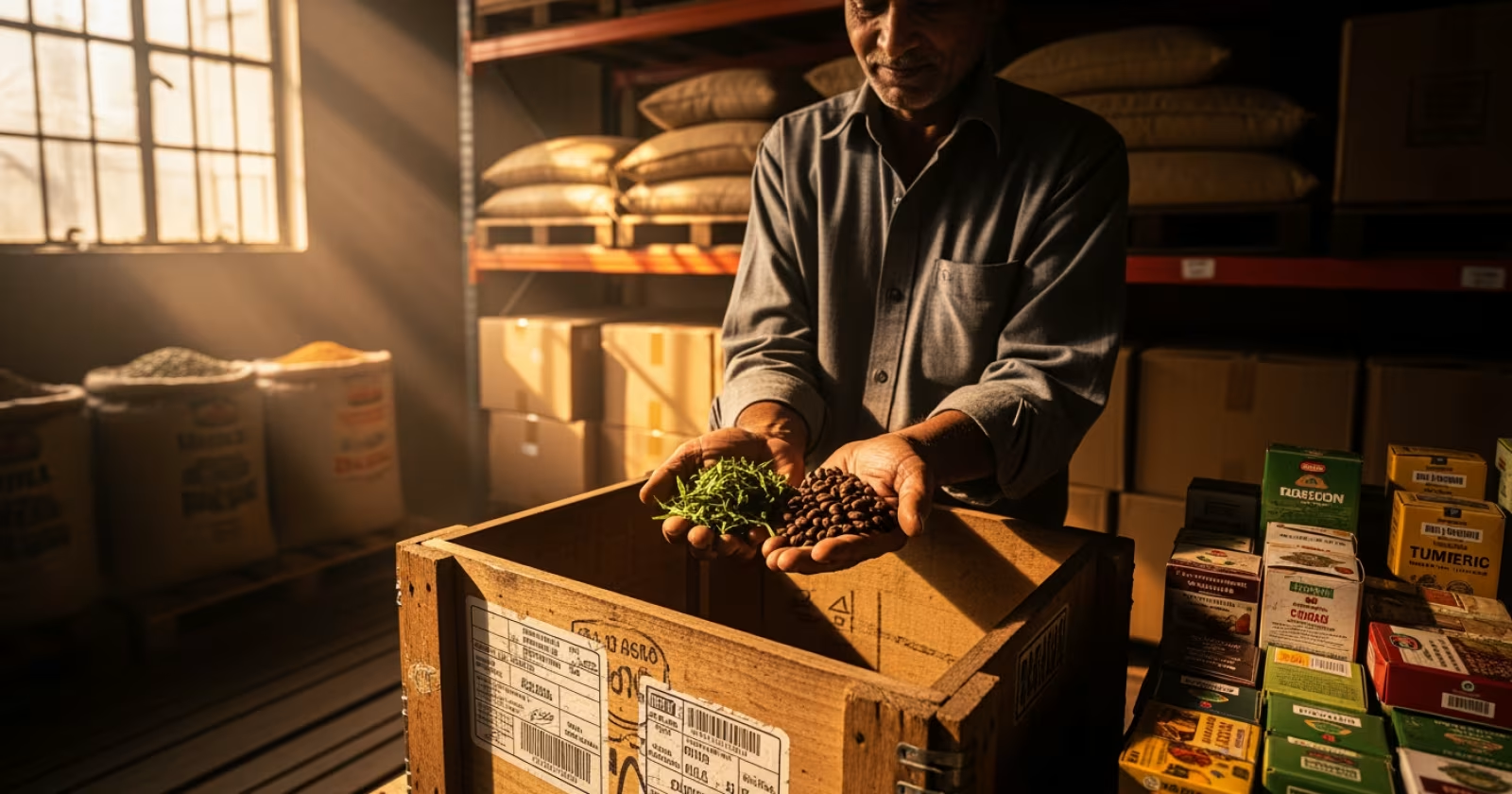
At 6,200 feet above sea level, in the mist-wrapped slopes above Coonoor, a 62-year-old Toda tribal woman named Lakshmi picks the season’s second flush of orthodox tea — two leaves and a bud, repeated hundreds of times before noon. Two decades ago, a private buyer would have paid her roughly ₹8 per kilogram of green … Read more

How Tamil Nadu’s Cooperative Spinning Mills Created an Entire Industrial Town in Coimbatore

How Tamil Nadu's Cooperative Spinning Mills Created an Entire Industrial Town in Coimbatore

On a damp morning in Singanallur, a suburb that bleeds into Coimbatore’s sprawling industrial belt, I watched Ramasamy Gounder, a 72-year-old retired mill worker, point at a row of concrete buildings stretching along the Noyyal River. “Every one of those structures,” he told a local reporter in 2023, “was built with money that belonged to … Read more

UP’s Sugar Belt Has 100+ Cooperative Mills — Most Are Sick, A Few Are Thriving — Here’s the Difference

UP's Sugar Belt Has 100+ Cooperative Mills — Most Are Sick, A Few Are Thriving — Here's the Difference

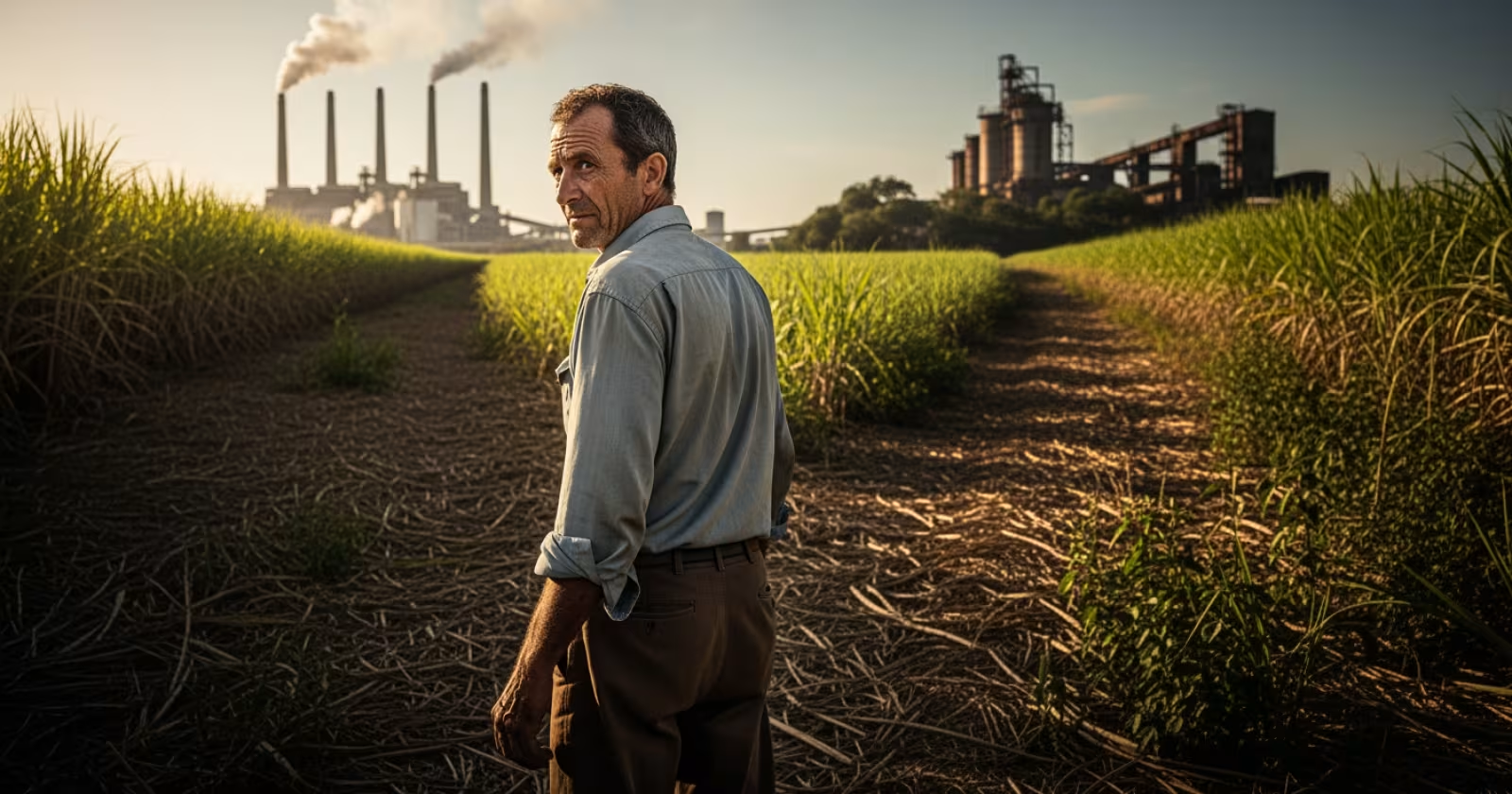
In Shamli district, barely two hours from Delhi, a rusted padlock hangs on the gates of a cooperative sugar mill that once crushed 2,500 tonnes of cane daily. Weeds push through the concrete yard. The boiler house, silent since the 2019-20 season, looks like an industrial ruin. Seven kilometres east, another cooperative mill — similar vintage, similar capacity — hums through the crushing season, pays farmers within fourteen days, and posted an operating surplus of approximately ₹11 crore last year. I have spent months trying to understand what separates the dead from the living in Uttar Pradesh’s cooperative sugar sector, and the answer is far more uncomfortable than “poor management.”

Uttar Pradesh produces more sugar than any other Indian state — over 12 million tonnes in the 2026-26 season by most estimates. Yet its cooperative sugar mills, once envisioned as farmer-owned engines of rural prosperity, are overwhelmingly sick. Of the 100-plus cooperative mills established across the sugar belt spanning Muzaffarnagar, Shamli, Meerut, Saharanpur, Bijnor, and parts of Rohilkhand, only a fraction operate at viable capacity today. The rest are closed, partially functional, or surviving on government lifelines.


Read more

How Karnataka’s Coffee Cooperative in Coorg Exports to Starbucks Without Losing Farmer Control

How Karnataka's Coffee Cooperative in Coorg Exports to Starbucks Without Losing Farmer Control

In the mist-wrapped hills of Kodagu district, a 62-year-old grower named Suresh Ponnappa tends to four acres of Arabica coffee that his grandfather first planted in the 1940s. His entire annual harvest — roughly 1,200 kilograms of cherry — now travels from his small estate to a Starbucks Reserve counter in Mumbai. Yet Suresh has never spoken to a single Starbucks buyer. His cooperative did that for him, negotiating a price nearly ₹40 per kilogram higher than what the local trader offered last season. I travelled to Coorg in early 2026 to understand how this arrangement actually works, and what I found challenged almost everything I assumed about Indian cooperatives.

This is not just a feel-good story about farmers and fair trade. It is a structural lesson in how a cooperative coffee model in Karnataka has cracked the export supply chain to one of the world’s largest coffee brands — without surrendering governance to corporate intermediaries or government bureaucrats. At a time when the Ministry of Cooperation is pushing to modernise India’s 8.5 lakh cooperative societies, Kodagu’s coffee growers offer a rare working blueprint.

Read more

Fonterra vs Amul: One Dairy Cooperative Made Farmers Rich, the Other Didn’t — Here’s Why

Fonterra vs Amul: One Dairy Cooperative Made Farmers Rich, the Other Didn't — Here's Why

In the village of Kuha, roughly forty kilometres from Anand in Gujarat, a woman named Ramaben pours eight litres of buffalo milk into a steel canister every morning. She earns approximately ₹57 per litre — deposited directly into her bank account within days. Halfway across the planet, in the Waikato region of New Zealand, a Fonterra shareholder-farmer checks a global commodity index before breakfast, knowing that his annual payout depends not on local consumers but on the price Chinese importers are willing to pay for whole milk powder. Two cooperatives, both claiming to serve farmers first — but only one has consistently delivered on that promise.

I have spent years tracking the cooperative dairy sector across continents, and this comparison haunts me because it reveals something fundamental: structure determines destiny. The way a cooperative is designed — who controls it, where its revenue comes from, how decisions flow — matters more than scale, technology, or even geography. And the Amul-Fonterra divergence is the sharpest case study I know.

Read more

The Cooperative That Employs 80,000 People With No CEO — Mondragón vs IFFCO Explained

The Cooperative That Employs 80,000 People With No CEO — Mondragón vs IFFCO Explained

In the rain-soaked hills of Basque Country, Spain, a factory worker casting engine parts earns no less than one-sixth of what the highest-paid manager takes home — and that manager was elected by the very workers on the shop floor. Meanwhile, in Kalol, Gujarat, a marginal farmer holding two bighas of land collects his subsidised bag of Nano Urea from the local society, blissfully unaware that his purchase traces back to one of the world’s largest fertiliser cooperatives headquartered over a thousand kilometres away in New Delhi. Two cooperatives. Two continents. Two radically different answers to the same question: can ordinary people govern an enterprise worth billions?

I have spent years covering India‘s cooperative sector for IICTF, and no comparison sharpens the ideological fault lines of the movement quite like placing Mondragón Corporation beside IFFCO (Indian Farmers Fertiliser Cooperative Limited). One has no CEO and lets workers vote on salaries. The other has a Managing Director, a government-linked board, and serves over 35,000 member cooperatives across India. Both are wildly successful. Both claim the cooperative identity. Yet their DNA could not be more different.

Read more

A Dalit Cooperative in Marathwada Did What No Government Scheme Could — Broke the Moneylender’s Grip

A Dalit Cooperative in Marathwada Did What No Government Scheme Could — Broke the Moneylender's Grip

In Kaij taluka of Beed district, a landless Dalit sugarcane cutter named Bhimrao Waghmare once paid ₹60,000 in interest on a ₹25,000 loan he had taken three years earlier from a local moneylender. By the time I visited this corner of Marathwada in early 2024 while reporting on agrarian credit, Bhimrao had not only cleared that debt — he had a savings account, a crop loan at 4% interest, and a small poultry unit financed entirely through a Dalit-led cooperative credit society. No government scheme had managed to reach him. A cooperative run by his own community did.

This is not an isolated anecdote. Across Marathwada’s eight districts, a quiet revolution in cooperative credit has been unfolding among Dalit communities — one that challenges everything we assume about who gets to participate in India‘s cooperative movement. I have spent months tracking these stories, and what I found deserves far more attention than it has received.

Read more

How Andhra’s Cooperative Aquaculture Sector Made Krishna District the Shrimp Capital of India

How Andhra's Cooperative Aquaculture Sector Made Krishna District the Shrimp Capital of India

In Nagayalanka mandal, at the southern tip of Krishna district where the river meets the Bay of Bengal, a 62-year-old farmer named Ramaiah tends to 12 acres of shrimp ponds that earn him more than his rice paddies ever did. His cooperative society — one of over 400 fishermen cooperatives scattered across Andhra Pradesh — negotiated a collective input price for Vannamei shrimp seed that saved each member approximately ₹15,000 per acre per cycle in 2026. I first heard about Nagayalanka’s transformation from a colleague covering rural Andhra, and the numbers stunned me enough to dig deeper.

What I found was not a single success story but an entire economic ecosystem — one where cooperative aquaculture has quietly turned a coastal district into the engine room of India‘s ₹52,000 crore shrimp export industry. Krishna district alone accounts for an estimated 30-35% of Andhra Pradesh’s total shrimp output, and the state itself produces roughly 70% of India’s farmed shrimp. Those are not small numbers. They represent a cooperative-driven revolution that most of India has barely noticed.

Read more

Nobody Told Cooperative Society Members This About the 97th Constitutional Amendment

Nobody Told Cooperative Society Members This About the 97th Constitutional Amendment

In the summer of 2012, a dairy farmer in Anand district, Gujarat, was told by a local cooperative officer that his society’s board could no longer have more than 21 directors. The farmer — a member of his village milk cooperative for over fifteen years — had never heard of the 97th Constitutional Amendment. Nobody explained what it meant for his voting rights, his access to audited accounts, or the five-year election cycle that was now supposedly guaranteed by the Constitution itself. A decade later, most cooperative society members across India still do not know what this amendment promised them, and fewer still know that the Supreme Court struck down its most critical provisions.

I have spent years covering India’s cooperative movement, and this remains one of the most consequential — yet least discussed — legal developments affecting over 29 crore cooperative members nationwide. Let me walk you through what actually happened, why it matters in 2026, and what every cooperative member deserves to understand.

Read more