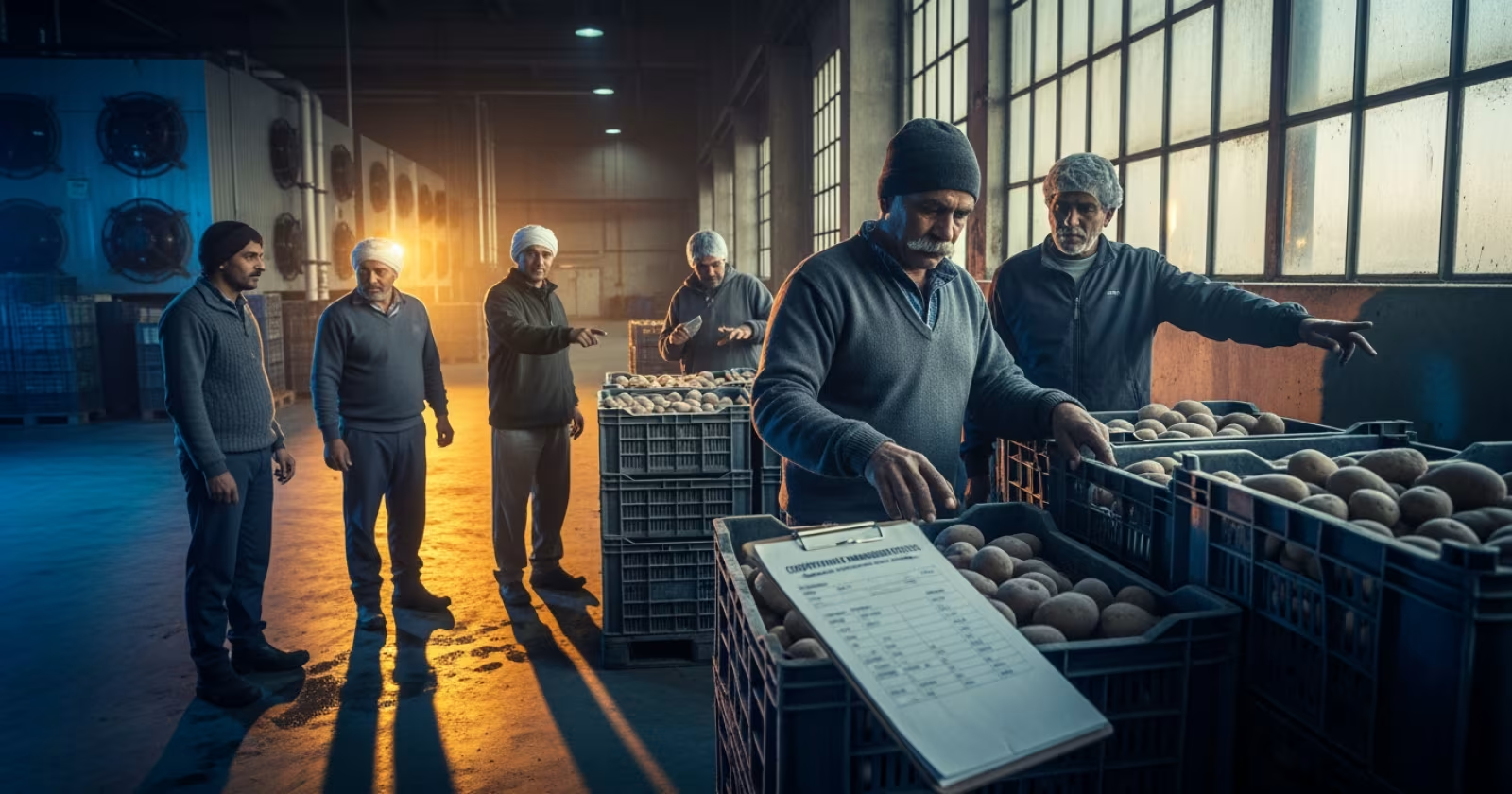

The Cooperative Model That’s Teaching India the True Meaning of Profit Sharing

The Cooperative Model That's Teaching India the True Meaning of Profit Sharing

In Karimnagar, Telangana, a cotton farmer named Ramaiah once walked away from a government procurement centre with ₹18,000 less than he expected — the difference swallowed by middlemen, commission agents, and processing fees he never fully understood. Three years later, after joining a primary agricultural cooperative society, he received not just a fair price at … Read more

₹10 Lakh Government Loan Scheme for Farmers in 2026 (Full Process)

₹10 Lakh Government Loan Scheme for Farmers in 2026 (Full Process)

The problem is not that schemes don’t exist — it’s that most farmers never fully understand how to access them. In 2026, multiple government-backed loan options allow eligible farmers to borrow up to ₹10 lakh, yet lakhs of applications get rejected every year simply due to paperwork errors or wrong bank approach. I want to … Read more

Jaipur’s Carpet Weavers Are Disappearing — A Cooperative Might Be the Only Thing That Can Save Them

Jaipur's Carpet Weavers Are Disappearing — A Cooperative Might Be the Only Thing That Can Save Them

In a narrow lane behind Jaipur’s Sanganer bypass, Ramlal Meena sits before a wooden loom that his grandfather built in 1971. His fingers move mechanically, knotting wool into a pattern he has repeated for thirty years. But the order pinned to his wall — a single 6×9 carpet for a Delhi exporter — is the … Read more

India’s Cooperative Fisheries Sector Is Worth ₹28,000 Crore and Nobody Is Talking About It

India's Cooperative Fisheries Sector Is Worth ₹28,000 Crore and Nobody Is Talking About It

On a grey monsoon morning in Alappuzha, Kerala, a woman named Leela pulls the day’s catch tally from a worn register. Her Thanneermukkom Fisherwomen Cooperative Society — 340 members strong — collectively earned ₹1.7 crore last financial year. That figure would be unremarkable for a dairy cooperative in Gujarat. But for a fisheries cooperative in … Read more

Meet the Women-Run Cooperatives Changing the Face of Indian Agriculture

Meet the Women-Run Cooperatives Changing the Face of Indian Agriculture

Women perform roughly 80 percent of agricultural labor across rural India, yet fewer than 13 percent of them legally own the land they cultivate. That gap between effort and ownership has quietly fueled one of the most consequential shifts in Indian rural economics — the steady, determined rise of women-run agricultural cooperatives that are rewriting … Read more

How Kerala’s Kudumbashree Cooperative Network Became the Largest Women-Run Cooperative in Asia

How Kerala's Kudumbashree Cooperative Network Became the Largest Women-Run Cooperative in Asia

In a small rented room in Alappuzha district, a woman named Sreelatha once counted ₹47 in weekly savings collected from nine neighbours. That was 2001. Today, that same neighbourhood group manages a catering micro-enterprise turning over ₹12 lakh annually. I find her story remarkable not because it is unique — but because it has been replicated approximately 3.06 lakh times across every single ward in Kerala. This is the quiet, staggering mathematics of what cooperative mobilisation can achieve when women hold the ledger.

I have spent years covering India‘s cooperative sector for IICTF, and no model has fascinated me more than Kudumbashree — a name that translates to “prosperity of the family” in Malayalam. With over 4.5 million women members as of 2026, it is not merely Kerala’s pride; it is the single largest women-run cooperative network anywhere in Asia. Yet most Indians outside Kerala have only a vague sense of what it actually does or how it works. That gap deserves closing.

Read more

The Coconut Cooperative of Thrissur That Took on Multinational FMCG Companies — and Won

The Coconut Cooperative of Thrissur That Took on Multinational FMCG Companies — and Won

In the summer of 2019, a coconut farmer named Rajan in Irinjalakuda, Thrissur district, sold his entire seasonal harvest — roughly 12,000 coconuts — to a local copra trader for ₹5.80 per nut. After deducting transport and labour, he pocketed about ₹58,000 for six months of work. Forty kilometres away, a bottle of virgin coconut oil carrying a cooperative label from his own district was retailing at ₹430 per litre in a Kochi supermarket. The arithmetic was cruel and simple: the farmer who grew the coconut earned a fraction of what the processor who branded it took home. That gap — between the palm and the shelf — is what one cooperative federation in Thrissur decided to collapse.

I first encountered this story while reporting on Kerala’s cooperative ecosystem for IICTF, and what I found challenged nearly every assumption I had about cooperatives being slow, bureaucratic, and incapable of competing in modern FMCG markets. This is the account of how a network of coconut producer societies in Thrissur built a supply chain, launched branded products, entered supermarket shelves dominated by Marico’s Parachute and Dabur, and actually grew market share — all without a single venture capital rupee.

Read more

Co-optex Has 65,000 Weavers and Zero Venture Capital — Tamil Nadu’s Cooperative That Silicon Valley Can’t Explain

Co-optex Has 65,000 Weavers and Zero Venture Capital — Tamil Nadu's Cooperative That Silicon Valley Can't Explain

In a small cement-floored shed in Kanchipuram district, a woman named Lakshmi operates a pit loom that is older than most startups’ founding documents. She earns approximately ₹9,000 a month weaving silk sarees — each one taking four to twelve days — and she has never heard the phrase “series A funding.” Yet the organisation that buys her fabric, markets it across India, and deposits money into her bank account operates at a scale that would make many venture-backed D2C brands envious. I find that irony impossible to ignore.

That organisation is Co-optex — formally known as the Tamil Nadu Handloom Weavers’ Co-operative Society — and it connects roughly 65,000 weavers across the state to consumers through a network of showrooms, exhibitions, and increasingly, digital channels. It has no equity investors, no cap table, and no Silicon Valley pitch deck. It runs on membership fees, government support, and the sheer stubbornness of a model that was born in 1935.

Read more

Forget Unicorns — India’s Most Resilient Businesses Are Called Cooperatives

Forget Unicorns — India's Most Resilient Businesses Are Called Cooperatives

When Byju’s valuation collapsed from $22 billion to near-worthlessness and Paytm’s stock shed over 70% of its market cap within a few years of its IPO, the startup world scrambled for explanations. Meanwhile, a dairy cooperative founded in 1946 by farmers in Anand, Gujarat quietly crossed ₹72,000 crore in annual revenue — and not a … Read more

Digital Cooperatives Are Rising in India and Most People Have Already Used One Without Knowing

Digital Cooperatives Are Rising in India and Most People Have Already Used One Without Knowing

The last time you ordered groceries through a government-backed e-commerce network or checked fertiliser prices on a farming app, there’s a reasonable chance a cooperative was sitting quietly on the other side of that transaction. I’ve been tracking India‘s cooperative sector for years now, and the thing that strikes me most in 2026 isn’t a … Read more