
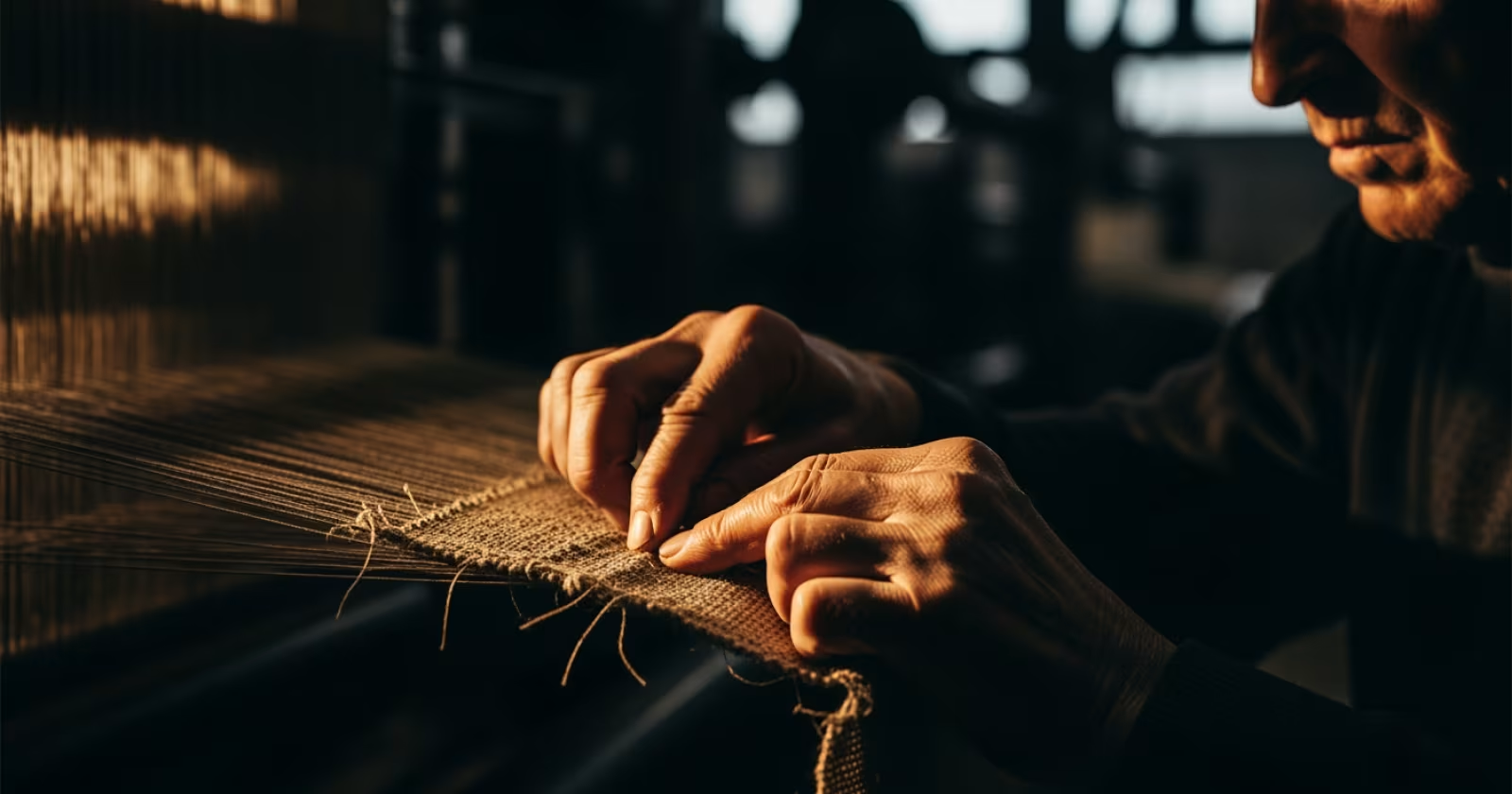
In a narrow lane off Madanpura in Varanasi, a pit loom clacks at a rhythm that has not changed in three centuries — but the man operating it earns less in a month than a food delivery rider earns in a week. I travelled to this ancient ghaat city in early 2026 to understand why Varanasi’s handloom weavers cooperative — once the backbone of a ₹3,000 crore Banarasi silk economy — is now locked in what members call an existential fight against powerloom duplicates and the ruthless economics of fast fashion.
Mohammed Irfan, a third-generation weaver in the Lohta cluster, showed me a kadhua brocade saree he spent 22 days weaving. His cooperative pays him approximately ₹8,500 for it. An almost-identical powerloom copy, produced in Surat in under four hours, retails on e-commerce platforms for ₹1,200. That single statistic tells you everything about the crisis — and the courage it takes to keep the loom running.
Why This Story Matters Beyond Varanasi
India’s handloom sector employs over 31 lakh weavers directly, making it the second-largest employer after agriculture, according to the Fourth All India Handloom Census. Yet between 2010 and 2024, the number of active weaver households dropped by nearly 30 percent. Varanasi sits at the epicentre of this decline. The district once had an estimated 1.5 lakh active looms; today, local cooperative leaders put the working figure closer to 40,000. The rest have gone silent — sold for scrap wood, or simply abandoned as families migrated to construction work and petty trade. What is happening in Varanasi is not just a textile story. It is a test case for whether India’s cooperative model can protect artisan livelihoods against industrial-scale disruption.
A Cooperative Born From Colonial Exploitation
The roots of weaver cooperatives in Varanasi trace back to the early twentieth century, when middlemen — known locally as gaddidar mahajans — controlled every aspect of the silk trade. Weavers had no access to raw materials at fair prices, no collective bargaining power, and no say in the final selling price of their own creations. The first formal weaver cooperative societies in the district were registered under the Cooperative Societies Act in the 1930s and 1940s, inspired by Gandhian economic thought and the Swadeshi movement.
After Independence, the Banaras Handloom Weavers Cooperative Society and several primary weaver cooperative societies (PWCS) were established under state government patronage. By the 1970s, Varanasi had a dense network of over 200 registered primary cooperatives linked to the apex body, National Handloom Development Corporation (NHDC). These cooperatives supplied raw silk yarn on credit, provided design inputs, and marketed finished sarees through government emporia. For decades, the system worked — not perfectly, but well enough to keep lakhs of families in the trade.
How the Cooperative Functions in 2026
I spent time with the office-bearers of three active PWCS in Varanasi to understand the current working model. Here is a simplified breakdown of the cooperative structure as it operates today:
| Aspect | Details |
|---|---|
| Membership | Approximately 12,000 active weaver members across Varanasi district cooperatives |
| Raw Material Supply | Silk yarn procured via NHDC and state agencies at subsidised rates |
| Average Monthly Earning (Weaver) | ₹6,000–₹12,000 depending on product complexity |
| Marketing Channels | Government emporia, Handloom House outlets, cooperative exhibitions, and emerging online platforms |
| Government Support | National Handloom Mission subsidies, NABARD credit linkage, GI Tag enforcement |
| Key Challenge | Powerloom imitations, delayed payments, declining youth participation |
The cooperative procures mulberry silk yarn — primarily from Karnataka — at rates subsidised by the Ministry of Textiles and distributes it to member weavers. The finished sarees are collected, quality-graded, and sold through a mix of government retail outlets, cooperative exhibitions like the National Handloom Expo, and increasingly through digital storefronts. Members also receive design cards and technical guidance from the Weavers’ Service Centre in Varanasi, which operates under the central government.
The revenue model is straightforward: after deducting raw material costs and a small cooperative margin (typically 5–8 percent), the weaver receives a piece-rate wage. The problem is that this wage has not kept pace with inflation. A weaver told me his father earned ₹150 per saree in the mid-1990s. Today, he earns ₹400–₹800 for comparable work — barely a threefold increase over three decades, while costs of living in Varanasi have risen tenfold.
What Is Actually Broken
The threats are layered. The most visible one is powerloom replication. Surat-based powerloom units can now reproduce Banarasi-style brocade patterns using jacquard machines and synthetic thread at a fraction of the cost. Despite the Geographical Indication (GI) tag granted to Banarasi sarees in 2009, enforcement remains weak. A 2023 investigation by the Textiles Committee found that over 60 percent of sarees sold online as “Banarasi” had no legitimate GI certification. The cooperative has neither the legal budget nor the institutional muscle to fight thousands of counterfeit sellers.
Fast fashion compounds the damage. Major Indian e-commerce platforms aggressively promote machine-made ethnic wear at ₹999 flash sales, conditioning an entire generation of consumers to see silk sarees as interchangeable commodities rather than artisan-made heirlooms. Meanwhile, NABARD credit linkages that should flow to weaver cooperatives are often delayed by months, forcing weavers to borrow from informal lenders at 36–48 percent annual interest. Political interference in cooperative elections further hollows out governance. Several PWCS in Varanasi have not held proper elections in over a decade, I was told by multiple members.
A Lesson From Chanderi — And From Abroad
Contrast Varanasi with what has happened in Chanderi, Madhya Pradesh. The Chanderi weavers’ cooperative worked with design institutes like NID Ahmedabad and non-profits like WomenWeave to reposition handloom Chanderi fabric as a contemporary fashion material — not just a saree cloth. They developed stoles, dress fabrics, and home furnishing lines. Exports grew. Young weavers stayed. The cooperative added a digital ordering system and reduced middleman dependence. The model is not perfect — earnings are still modest — but the trajectory is upward.
Internationally, Japan’s Nishijin textile cooperative in Kyoto faced a similar powerloom crisis decades ago. They responded by branding Nishijin-ori as a luxury heritage product, securing strict trademark protections, and diversifying into interior design and fashion collaborations. Varanasi cooperatives could study both models carefully.
What the Next Five Years Could Look Like
There are reasons for cautious optimism. The Ministry of Cooperation, established in 2021, has signalled intent to computerise and professionalise primary cooperative societies, including weaver PACS. The PM Mega Integrated Textile Region (PM MITRA) scheme, while primarily targeting large-scale manufacturing, includes provisions for handloom integration parks that could give cooperatives better finishing and packaging infrastructure.
Blockchain-based GI verification — piloted in 2026 for Darjeeling tea — could eventually be extended to Banarasi sarees, making it far harder for counterfeits to thrive on e-commerce. And a younger generation of cooperative leaders in Varanasi is experimenting with Instagram marketing, direct-to-consumer saree sales, and collaborations with independent fashion designers. If these efforts scale — and if cooperative governance is cleaned up — the handloom economy of Varanasi could stabilise, even grow modestly. If they do not, I believe we will lose another 30 percent of active looms by 2030.
Back to the Loom in Lohta
Before I left Varanasi, I visited Mohammed Irfan again. He had just submitted the finished kadhua saree to his cooperative’s collection centre. Payment would come in four to six weeks, he was told. His eldest son, aged 19, works at a mobile repair shop. He has no intention of weaving. Irfan did not seem angry about this — just quietly resigned. The cooperative, he said, is all that stands between weavers like him and complete dependence on private traders who would pay even less. It is not enough, but it is something.
That tension — between “not enough” and “something” — defines the cooperative movement in places like Varanasi in 2026. If you care about India’s artisan heritage and the cooperative model’s ability to protect the most vulnerable, I urge you to follow this story closely, support genuine handloom products, and demand better GI enforcement. The clack of that pit loom should not go silent on our watch.