






Pune’s Cooperative Housing Societies Are Quietly Becoming India’s Most Powerful Real Estate Force

Pune's Cooperative Housing Societies Are Quietly Becoming India's Most Powerful Real Estate Force

Last monsoon, a retired schoolteacher named Meena Kulkarni in Kothrud received a notice that shook her entire apartment block. The Sahyadri Cooperative Housing Society, where she had lived for 32 years, was sitting on land now valued at approximately ₹185 crore — and a private developer wanted to redevelop the entire plot. The 144 member-families … Read more

Powerloom Cooperative vs Independent Weaver: Income Comparison

Powerloom Cooperative vs Independent Weaver: Income Comparison

I’ve spent years studying the economics behind India‘s decentralized textile sector, and one question keeps surfacing among weavers, policymakers, and cooperative advocates alike — does joining a powerloom cooperative actually put more money in a weaver’s pocket than working independently? The answer is more nuanced than most people assume, and the income gap between these … Read more

How Cooperative Healthcare Is Making Hospitals Affordable in Rural India

How Cooperative Healthcare Is Making Hospitals Affordable in Rural India

When a seasonal farm worker in Bilaspur, Chhattisgarh needed an appendectomy in 2023, the nearest district government hospital had no surgeon available that week. The private clinic nearby quoted ₹75,000 — roughly five months of his annual income. What saved him was a community-owned health cooperative that performed the same procedure, including post-operative care, for … Read more

Meghalaya’s Farmers Cooperative Is Exporting Organic Turmeric to the EU Without Any Government Help

Meghalaya's Farmers Cooperative Is Exporting Organic Turmeric to the EU Without Any Government Help

In a small drying yard in Laskein block, West Jaintia Hills, I watched a woman named Rikynti Suchiang spread freshly boiled turmeric rhizomes across bamboo mats, the late-March sun turning each finger-shaped piece into something almost golden enough to be currency. She told me her cooperative had shipped 3.2 tonnes of organic Lakadong turmeric to … Read more

The Cooperative Petrol Pump Model That HPCL and BPCL Don’t Advertise

The Cooperative Petrol Pump Model That HPCL and BPCL Don't Advertise

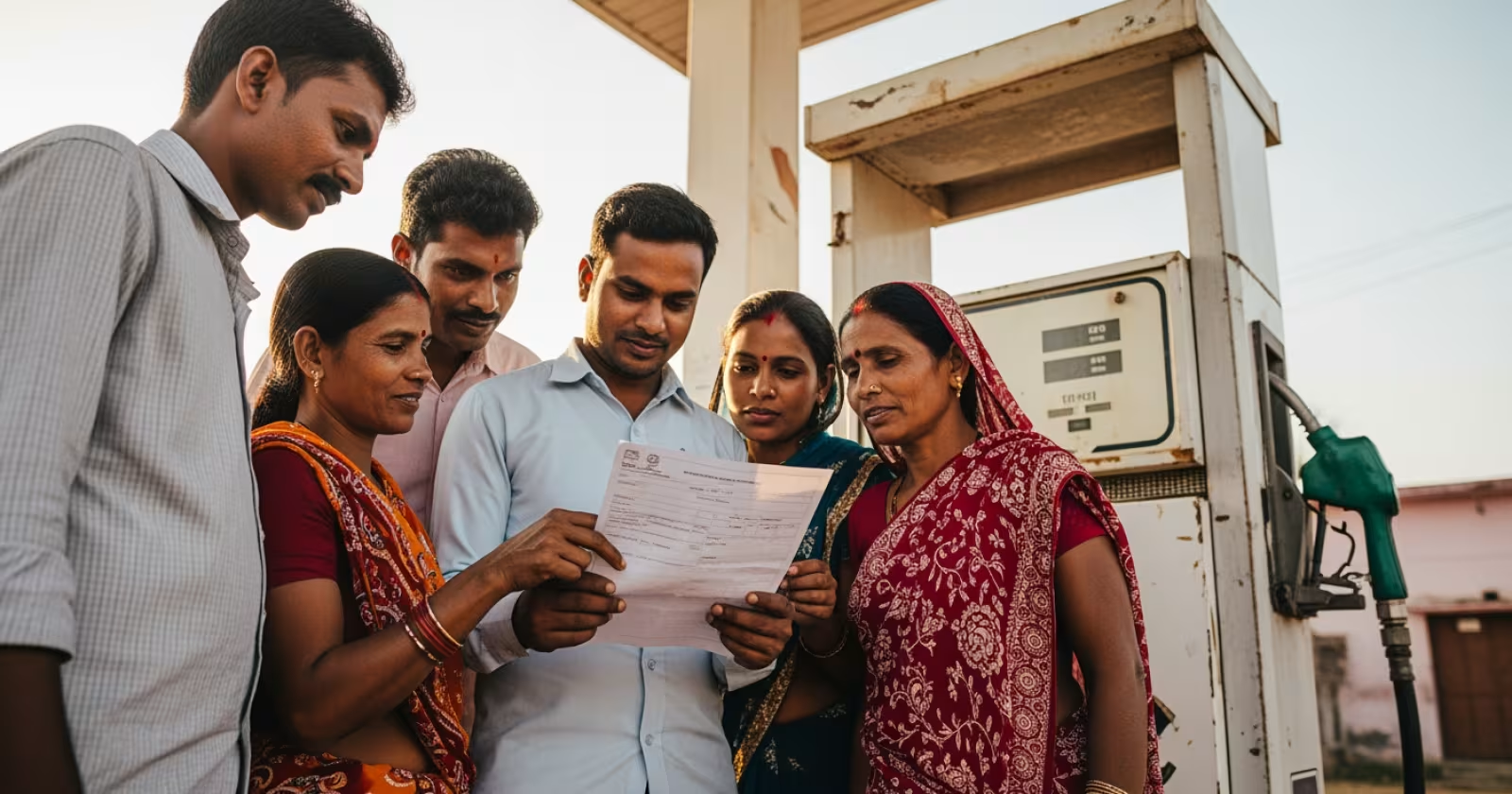
In Barmer district, Rajasthan, a dairy cooperative society runs a fuel station off National Highway 15. The nearest private petrol pump is 38 kilometres away. For the roughly 4,200 member-households of this cooperative, the pump isn’t just a convenience — it’s the reason their tractors run during sowing season without a full day lost to … Read more

Nobody Told Cooperative Society Members This About the 97th Constitutional Amendment

Nobody Told Cooperative Society Members This About the 97th Constitutional Amendment

The 97th Constitutional Amendment was passed by Parliament in December 2011 with almost no public debate. Most of the 8.5 lakh cooperative societies operating across India — and their roughly 290 million members — had no idea that Parliament had just rewritten the constitutional rules governing their daily financial lives, or that a decade later, … Read more

How Karnataka’s Coffee Cooperative in Coorg Exports to Starbucks Without Losing Farmer Control

How Karnataka's Coffee Cooperative in Coorg Exports to Starbucks Without Losing Farmer Control

In the mist-wrapped hills of Kodagu district, a 62-year-old grower named Suresh Ponnappa tends to four acres of Arabica coffee that his grandfather first planted in the 1940s. His entire annual harvest — roughly 1,200 kilograms of cherry — now travels from his small estate to a Starbucks Reserve counter in Mumbai. Yet Suresh has never spoken to a single Starbucks buyer. His cooperative did that for him, negotiating a price nearly ₹40 per kilogram higher than what the local trader offered last season. I travelled to Coorg in early 2026 to understand how this arrangement actually works, and what I found challenged almost everything I assumed about Indian cooperatives.

This is not just a feel-good story about farmers and fair trade. It is a structural lesson in how a cooperative coffee model in Karnataka has cracked the export supply chain to one of the world’s largest coffee brands — without surrendering governance to corporate intermediaries or government bureaucrats. At a time when the Ministry of Cooperation is pushing to modernise India’s 8.5 lakh cooperative societies, Kodagu’s coffee growers offer a rare working blueprint.


Read more

How Andhra’s Cooperative Aquaculture Sector Made Krishna District the Shrimp Capital of India

How Andhra's Cooperative Aquaculture Sector Made Krishna District the Shrimp Capital of India

In Nagayalanka mandal, at the southern tip of Krishna district where the river meets the Bay of Bengal, a 62-year-old farmer named Ramaiah tends to 12 acres of shrimp ponds that earn him more than his rice paddies ever did. His cooperative society — one of over 400 fishermen cooperatives scattered across Andhra Pradesh — negotiated a collective input price for Vannamei shrimp seed that saved each member approximately ₹15,000 per acre per cycle in 2026. I first heard about Nagayalanka’s transformation from a colleague covering rural Andhra, and the numbers stunned me enough to dig deeper.

What I found was not a single success story but an entire economic ecosystem — one where cooperative aquaculture has quietly turned a coastal district into the engine room of India‘s ₹52,000 crore shrimp export industry. Krishna district alone accounts for an estimated 30-35% of Andhra Pradesh’s total shrimp output, and the state itself produces roughly 70% of India’s farmed shrimp. Those are not small numbers. They represent a cooperative-driven revolution that most of India has barely noticed.

Read more

The Cooperative That Employs 80,000 People With No CEO — Mondragón vs IFFCO Explained

The Cooperative That Employs 80,000 People With No CEO — Mondragón vs IFFCO Explained

In the rain-soaked hills of Basque Country, Spain, a factory worker casting engine parts earns no less than one-sixth of what the highest-paid manager takes home — and that manager was elected by the very workers on the shop floor. Meanwhile, in Kalol, Gujarat, a marginal farmer holding two bighas of land collects his subsidised bag of Nano Urea from the local society, blissfully unaware that his purchase traces back to one of the world’s largest fertiliser cooperatives headquartered over a thousand kilometres away in New Delhi. Two cooperatives. Two continents. Two radically different answers to the same question: can ordinary people govern an enterprise worth billions?

I have spent years covering India‘s cooperative sector for IICTF, and no comparison sharpens the ideological fault lines of the movement quite like placing Mondragón Corporation beside IFFCO (Indian Farmers Fertiliser Cooperative Limited). One has no CEO and lets workers vote on salaries. The other has a Managing Director, a government-linked board, and serves over 35,000 member cooperatives across India. Both are wildly successful. Both claim the cooperative identity. Yet their DNA could not be more different.

Read more

UP’s Sugar Belt Has 100+ Cooperative Mills — Most Are Sick, A Few Are Thriving — Here’s the Difference

UP's Sugar Belt Has 100+ Cooperative Mills — Most Are Sick, A Few Are Thriving — Here's the Difference

In Shamli district, barely two hours from Delhi, a rusted padlock hangs on the gates of a cooperative sugar mill that once crushed 2,500 tonnes of cane daily. Weeds push through the concrete yard. The boiler house, silent since the 2019-20 season, looks like an industrial ruin. Seven kilometres east, another cooperative mill — similar vintage, similar capacity — hums through the crushing season, pays farmers within fourteen days, and posted an operating surplus of approximately ₹11 crore last year. I have spent months trying to understand what separates the dead from the living in Uttar Pradesh’s cooperative sugar sector, and the answer is far more uncomfortable than “poor management.”

Uttar Pradesh produces more sugar than any other Indian state — over 12 million tonnes in the 2026-26 season by most estimates. Yet its cooperative sugar mills, once envisioned as farmer-owned engines of rural prosperity, are overwhelmingly sick. Of the 100-plus cooperative mills established across the sugar belt spanning Muzaffarnagar, Shamli, Meerut, Saharanpur, Bijnor, and parts of Rohilkhand, only a fraction operate at viable capacity today. The rest are closed, partially functional, or surviving on government lifelines.

Read more