



KMF — Karnataka’s Milk Cooperative Federation That Quietly Became Amul’s Biggest Rival

KMF — Karnataka's Milk Cooperative Federation That Quietly Became Amul's Biggest Rival

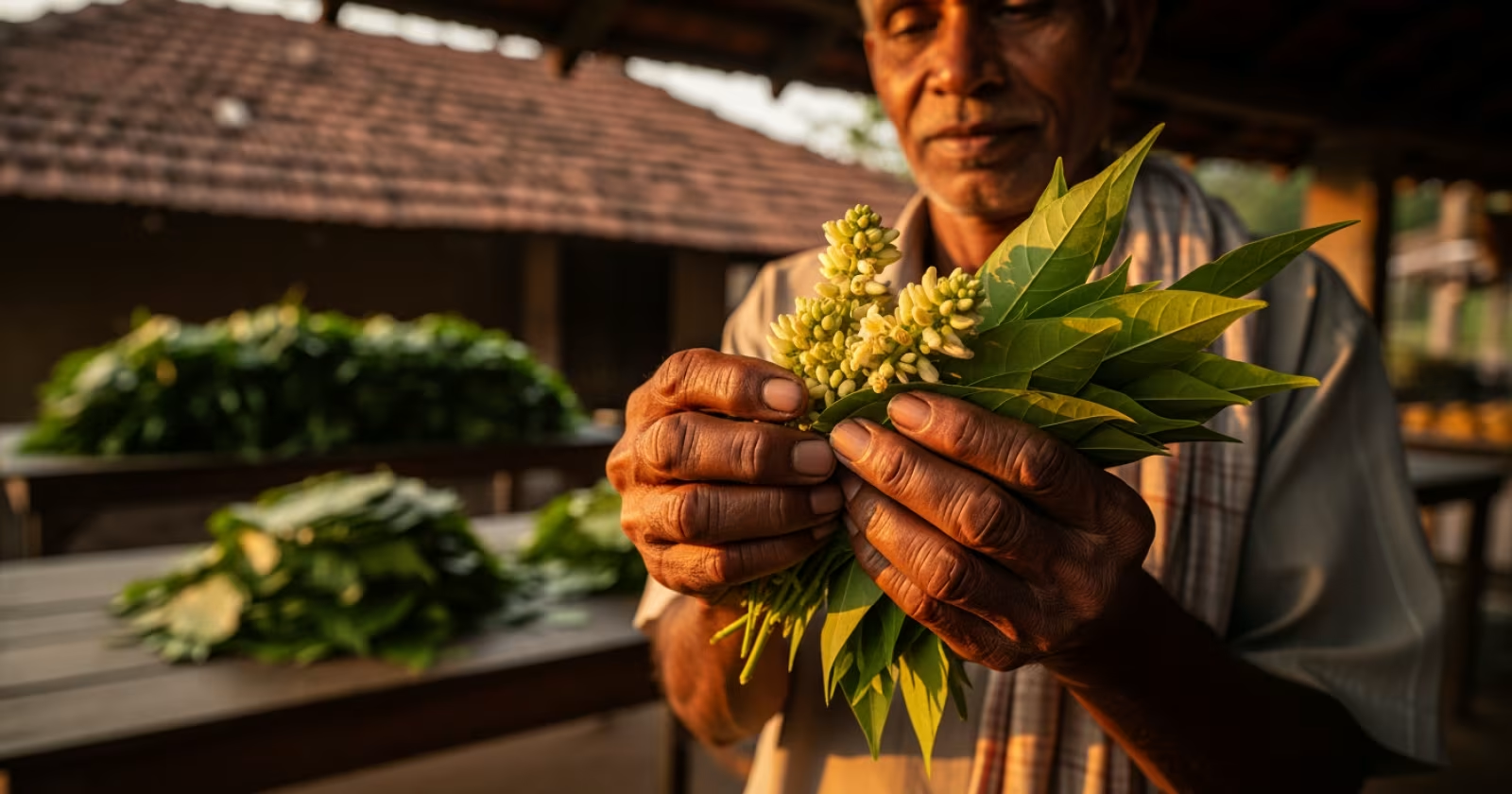
In Mandya district, roughly 120 kilometres southwest of Bengaluru, a 54-year-old farmer named Rangaswamy pours approximately 18 litres of milk every morning into a stainless steel can at his village collection centre. He has done this for over two decades. The board above the centre reads “Mandya District Co-operative Milk Producers’ Societies Union” — one of 14 district unions feeding into a machine most Indians outside Karnataka barely know about. That machine is the Karnataka Milk Federation (KMF), and its flagship brand, Nandini, outsells every dairy brand inside the state — including Amul. Rangaswamy earns roughly ₹32 per litre at the procurement point, a figure that has climbed steadily over the past five years. For him, KMF is not a corporate entity. It is the reason his two daughters went to college.

I have tracked India’s cooperative dairy sector for over a decade, and KMF’s story remains one of the most underreported success narratives in the country. While Amul commands national headlines and advertising budgets, KMF has quietly assembled a turnover exceeding ₹22,000 crore, making it India’s second-largest dairy cooperative. What makes this even more remarkable is that KMF operates almost entirely within one state.

Read more

Bikaner’s Cooperative Spinning Mills: The Thread Connecting Desert Farmers to Global Textile Markets

Bikaner's Cooperative Spinning Mills: The Thread Connecting Desert Farmers to Global Textile Markets

In the dusty outskirts of Bikaner district, a shepherd named Bhoma Ram shears wool from his flock of 120 Magra sheep every winter — and for decades, middlemen paid him barely ₹15-20 per kilogram for it. That changed when a cooperative spinning mill offered him ₹45 per kilogram, nearly triple the rate, and suddenly the … Read more

The Silent Network Powering India’s Milk, Sugar and Cotton Economy

The Silent Network Powering India's Milk, Sugar and Cotton Economy

In Sabar village, Sabarkantha district of Gujarat, a woman named Jashiben walks two kilometres every morning with eight litres of buffalo milk to reach her nearest Primary Agricultural Credit Society (PACS) collection point. She earns roughly ₹480 per day from this routine — money that paid for her daughter’s nursing diploma last year. What Jashiben … Read more

The Quiet Business Revolution Happening in India’s Villages Right Now

The Quiet Business Revolution Happening in India's Villages Right Now

India has roughly 640,000 villages, and for decades the dominant assumption was that serious commerce lived only in its cities — in the glass towers of Bangalore, on the trading floors of Mumbai, and inside the wholesale markets of Delhi. That assumption is cracking apart with remarkable force, and the people dismantling it are women … Read more

What Silicon Valley Can Learn From a Cooperative Society in Tamil Nadu

What Silicon Valley Can Learn From a Cooperative Society in Tamil Nadu

When I first encountered Co-optex — the Tamil Nadu Handloom Weavers’ Cooperative Society, founded in 1935 — I expected a story of dignified decline. What I found instead was an organization that today connects more than 65,000 weavers across Tamil Nadu, operates its own national retail network, and has never filed a venture capital term … Read more

How Farmers Are Getting Tractor Subsidy in 2026 (Full Details)

How Farmers Are Getting Tractor Subsidy in 2026 (Full Details)

Most farmers know tractors are expensive — but very few know that the government is actively subsidising the purchase price, sometimes covering up to 50% of the cost. The problem is not that these schemes do not exist — it is that most farmers never understand how to access them. In 2026, tractor subsidy is … Read more

How India’s Cooperative Insurance Movement Quietly Shaped the Way LIC Was Built

How India's Cooperative Insurance Movement Quietly Shaped the Way LIC Was Built

In 1944, a cotton farmer in Satara district, Maharashtra, paid three annas into a village mutual fund that promised his family a payout if he died before harvest. He never filed a claim, but the ledger recording his contribution still exists — yellowed, hand-ruled, stored in a district cooperative office that most people walk past … Read more

How Audit Grade Determines the Financial Health of Your Cooperative Society

How Audit Grade Determines the Financial Health of Your Cooperative Society

Last March, a dairy cooperative in Sangli district, Maharashtra, with over 1,200 member-farmers, was denied a ₹45 lakh working capital loan by the district central cooperative bank. The reason wasn’t low revenue or shrinking membership — it was a single letter on a government document: audit grade “C.” That one classification, buried in an annual … Read more

Nobody Told Cooperative Society Members This About the 97th Constitutional Amendment

Nobody Told Cooperative Society Members This About the 97th Constitutional Amendment

In the summer of 2012, a dairy farmer in Anand district, Gujarat, was told by a local cooperative officer that his society’s board could no longer have more than 21 directors. The farmer — a member of his village milk cooperative for over fifteen years — had never heard of the 97th Constitutional Amendment. Nobody explained what it meant for his voting rights, his access to audited accounts, or the five-year election cycle that was now supposedly guaranteed by the Constitution itself. A decade later, most cooperative society members across India still do not know what this amendment promised them, and fewer still know that the Supreme Court struck down its most critical provisions.

I have spent years covering India’s cooperative movement, and this remains one of the most consequential — yet least discussed — legal developments affecting over 29 crore cooperative members nationwide. Let me walk you through what actually happened, why it matters in 2026, and what every cooperative member deserves to understand.

Read more

The Cooperative Cold Storage Network in UP That Potato Farmers Cannot Live Without

The Cooperative Cold Storage Network in UP That Potato Farmers Cannot Live Without

In February 2026, when the wholesale price of potatoes at the Agra mandi crashed to ₹4.20 per kilogram, a farmer named Ramveer in Hathras district did something his father never could — he simply refused to sell. Instead, he drove his tractor-trolley loaded with 80 quintals of freshly harvested potatoes to the nearest cooperative cold … Read more