
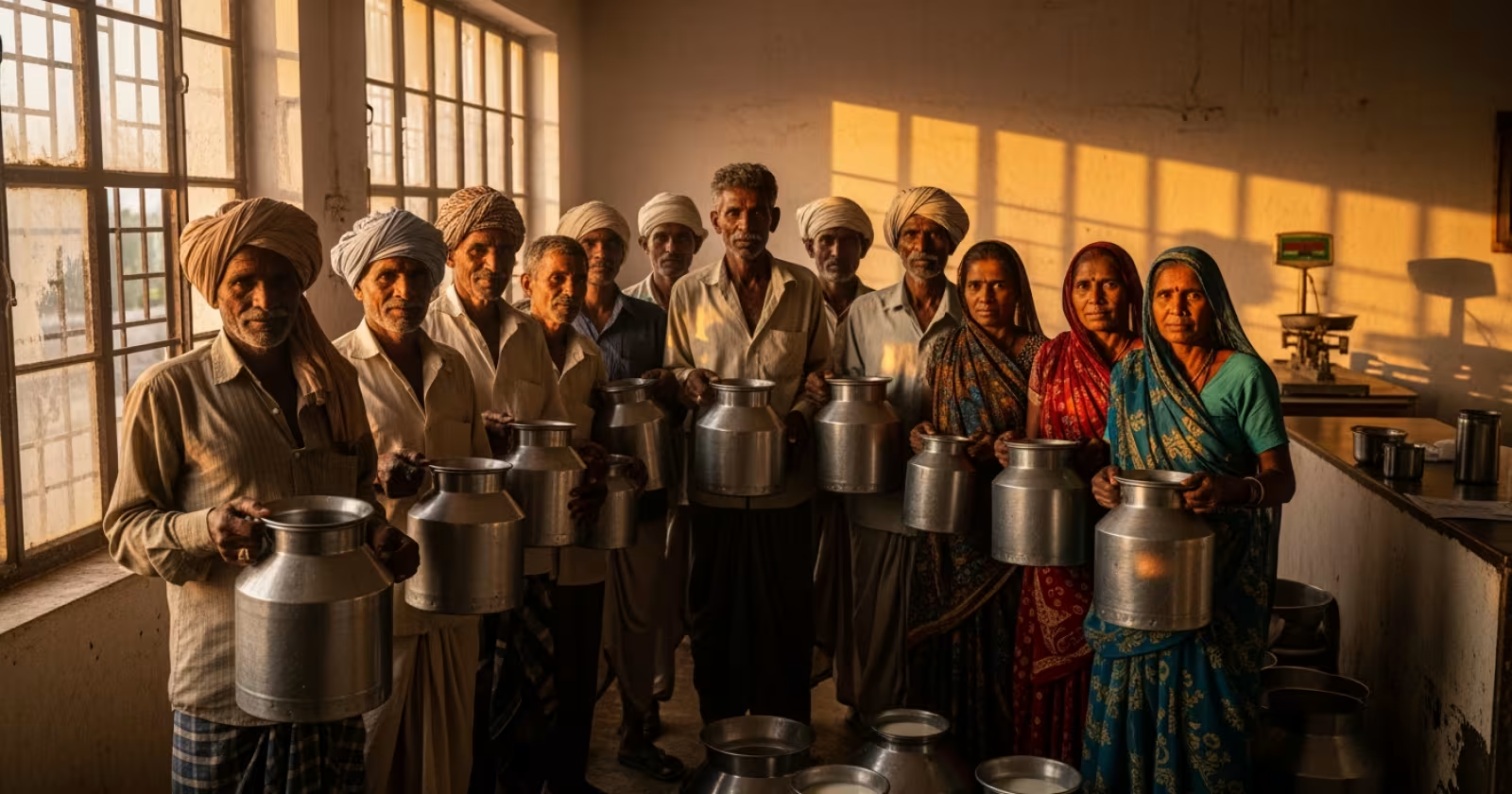
A tiny milk cooperative born out of a farmer revolt against exploitative middlemen in 1946 now commands annual revenues exceeding ₹72,000 crore. I find this story endlessly fascinating because it proves that millions of small dairy farmers, when organized under a cooperative structure, can outperform multinational corporations and reshape an entire nation’s food economy.
The Anand Milk Revolution That Started It All
The story begins in Kaira district (now Anand) of Gujarat, where dairy farmers were at the mercy of Polson Dairy, a private contractor who dictated prices and exploited producers. Inspired by Sardar Vallabhbhai Patel’s advice to form their own cooperative, farmers organized under the leadership of Tribhuvandas Patel in 1946. The Kaira District Cooperative Milk Producers’ Union was formally registered on December 14, 1946, with just two village cooperative societies and a handful of litres of milk.
The real transformation accelerated when Dr. Verghese Kurien, a young engineer who had come to Anand on a government bond, decided to stay and dedicate his career to the cooperative. Kurien brought technical expertise, including the breakthrough of processing buffalo milk into powder — something previously considered impossible by Western dairy technology. By 1955, the Kaira Union had built its own processing plant, and the brand name AMUL (Anand Milk Union Limited) was born.
What made the Anand model distinct was its three-tier structure: village-level cooperative societies collected milk from farmers, district-level unions processed it, and a state-level federation handled marketing and distribution. This structure ensured that farmers remained the owners at every stage. The profits flowed back to the producers rather than being siphoned off by intermediaries or corporate shareholders.
Operation Flood and National Expansion
The success of the Anand pattern caught the attention of the Indian government. In 1970, the National Dairy Development Board (NDDB), chaired by Dr. Kurien, launched Operation Flood — the world’s largest dairy development program. Funded partly by monetizing donated milk powder from the European Economic Community, the program replicated the Anand cooperative model across the country over three phases spanning from 1970 to 1996.
Operation Flood connected over 700 towns and cities through a national milk grid, dramatically reducing seasonal and regional price variations. India’s milk production surged from 20 million tonnes in 1970 to over 230 million tonnes by 2023, making India the world’s largest milk producer. I believe this remains one of the most successful rural development programs ever implemented anywhere on the planet.
The Gujarat Cooperative Milk Marketing Federation (GCMMF), which markets products under the AMUL brand, grew from a regional player into a national behemoth. By 2026, GCMMF operates with 36 lakh (3.6 million) milk producer members organized through 18,600 village cooperative societies across 33 district unions in Gujarat. The milk procurement network collects an average of over 300 lakh litres per day.
Revenue Growth and Product Diversification
AMUL’s revenue trajectory over the past two decades is staggering. From approximately ₹2,000 crore in annual turnover in the early 2000s, GCMMF crossed ₹72,000 crore by the 2023-24 fiscal year and has continued to grow. The federation targets ₹1,00,000 crore in revenue within the next few years, a goal that seemed unthinkable just a decade ago.
| Year | Approximate GCMMF Turnover (₹ Crore) | Key Milestone |
|---|---|---|
| 1994 | 1,144 | Crossed ₹1,000 crore for the first time |
| 2006 | 5,000 | Major ice cream and cheese expansion |
| 2011 | 14,000 | India’s largest food brand by revenue |
| 2017 | 29,220 | Launched organic and premium product lines |
| 2021 | 39,200 | Growth during pandemic through home delivery |
| 2024 | 72,000+ | Second-largest FMCG brand in India overall |
The product portfolio has expanded far beyond butter and milk powder. AMUL now sells over 50 product categories including fresh milk, curd, buttermilk, cheese, paneer, ghee, ice cream, chocolates, health drinks, cream, and even protein-enriched beverages. Each product line is priced to serve mass-market consumers while maintaining quality comparable to premium brands. I notice that their strategy of affordable pricing with consistent quality has been a non-negotiable principle since the cooperative’s founding.
Marketing Genius and the Utterly Butterly Girl
No discussion of AMUL’s rise is complete without mentioning its iconic advertising. The AMUL butter girl, created by Sylvester daCunha of ASP Advertising in 1967, is one of the longest-running ad campaigns in the world. The topical billboard ads, featuring the blue-haired girl commenting on current events with witty wordplay, have kept the brand perpetually relevant in public consciousness for nearly six decades.
What I find remarkable is how efficiently AMUL spends on advertising. The cooperative historically allocates less than 1% of its revenue to marketing — a fraction of what multinational competitors like Nestlé, Danone, or Britannia spend. The outdoor billboard campaign costs a fraction of television advertising, yet achieves outsized brand recall. The AMUL advertising model has been studied in business schools globally as a case study in cost-effective brand building.
Beyond advertising, AMUL invested early in building a cold chain infrastructure across India. With over 10,000 distributors, thousands of refrigerated vans, and a network of AMUL parlours exceeding 10,000 outlets, the distribution system ensures that perishable dairy products reach consumers fresh. This logistical backbone is as much a competitive moat as the brand itself.
Farmer-Centric Model That Defies Corporate Logic
The most powerful aspect of AMUL’s empire is its ownership structure. Unlike a corporation where shareholders extract dividends, GCMMF channels approximately 80 to 85 paise of every rupee earned from consumers back to the milk-producing farmers. This payout ratio is among the highest in the global dairy industry and ensures that rural farming families directly benefit from the brand’s commercial success.
The cooperative model also provides farmers with veterinary services, cattle feed at subsidized rates, artificial insemination facilities, and training on modern dairy practices. According to the National Bank for Agriculture and Rural Development (NABARD), cooperative dairy farming linked to the AMUL model has been one of the most effective tools for rural poverty alleviation in western India. Women constitute a significant portion of milk producers, and the cooperative structure has played a measurable role in women’s economic participation in Gujarat’s villages.
The democratic governance structure means that each village society elects its own chairman, and district union boards are composed of elected farmer representatives. Major policy decisions — from pricing to new product launches — ultimately trace back to farmer-elected leadership. This bottom-up governance has prevented the kind of corporate capture that has undermined cooperatives in other parts of the world.
Challenges and the Road to ₹1 Lakh Crore
Despite its extraordinary success, AMUL faces real challenges in 2026. Private dairy players like Lactalis (which acquired Tirumala and Anik), ITC’s Aashirvaad Svasti, and aggressive regional brands are competing fiercely for milk procurement and consumer market share. Fluctuating fodder prices, climate-related disruptions to cattle productivity, and the rising cost of cold chain operations put pressure on margins.
International expansion remains a growth frontier. AMUL products are already exported to over 50 countries, but capturing meaningful market share in the United States, Middle East, and Southeast Asia requires navigating complex food safety regulations, establishing local cold chains, and competing with established global dairy brands. The federation has been setting up processing infrastructure abroad and expanding its export basket to include value-added products like paneer and flavoured milk targeted at the Indian diaspora.
I genuinely believe that AMUL’s cooperative model holds lessons for every sector — agriculture, manufacturing, even technology. If you are a farmer, entrepreneur, policymaker, or student of business, study the Anand pattern closely. Consider how cooperative ownership could apply to your own community or industry. The proof is in the numbers: 3.6 million farmer families, ₹72,000 crore in revenue, and a brand that every Indian recognizes. That is not just a business success — it is a democratic economic movement worth replicating.