
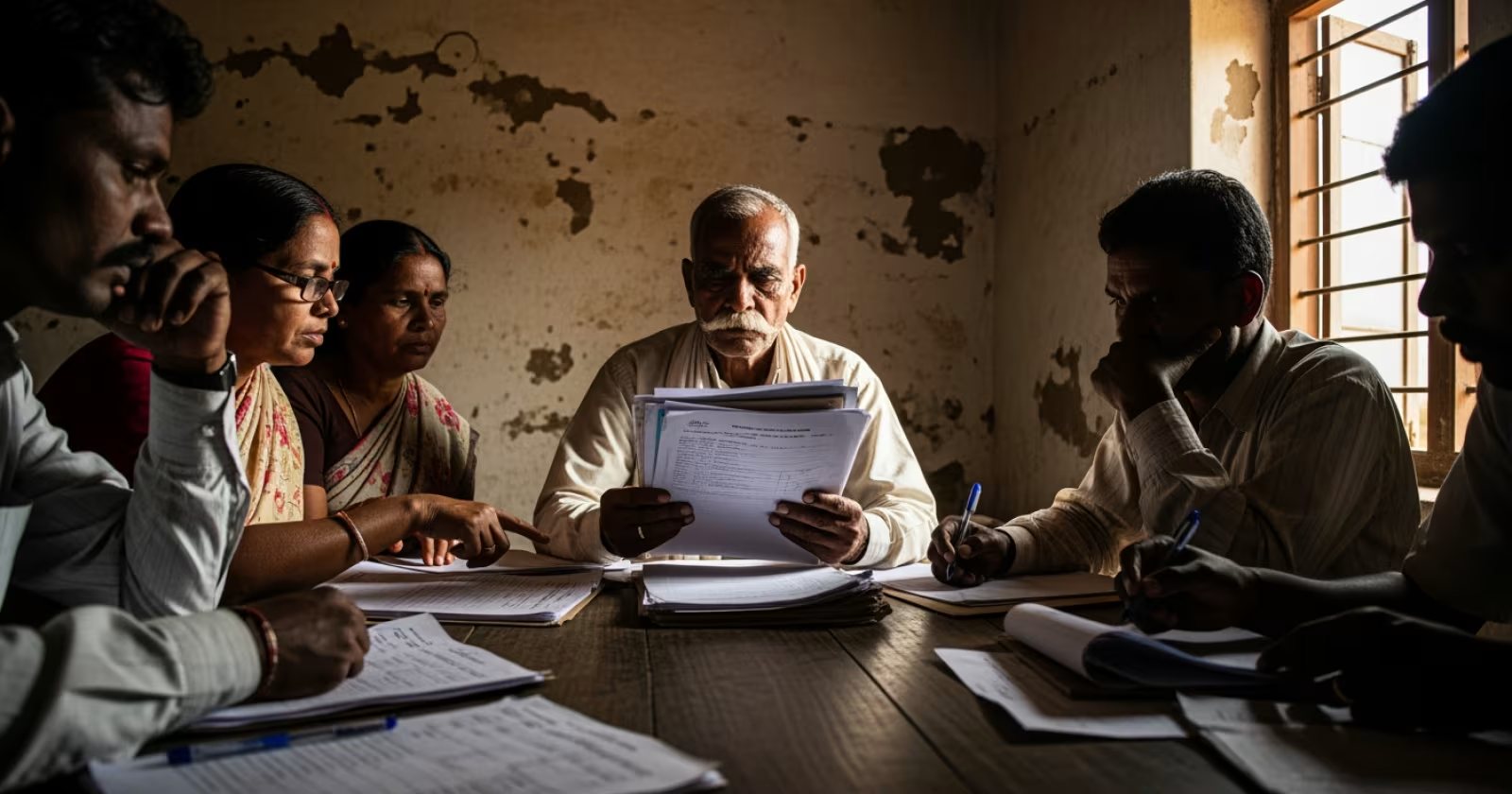
Last monsoon, in Osmanabad district of Maharashtra, a dairy farmer named Ramesh Jadhav watched his Primary Agricultural Credit Society (PACS) chairman approve a ₹14 lakh fertiliser contract with his own brother-in-law’s supply firm. Fourteen members knew it was wrong. Not one knew what to do about it. I’ve heard versions of this story from Rajasthan to Karnataka — and the helplessness is always the same.
Here’s what most cooperative members don’t realise: Indian cooperative law actually gives you powerful, specific tools to unseat a corrupt chairman. The problem isn’t the absence of legal remedy. It’s that nobody explains the process in plain language. That changes today.
Why Corrupt Cooperative Chairmen Survive So Long
The cooperative sector in India covers over 8.5 lakh registered societies with a combined membership exceeding 29 crore people. That’s a staggering democratic infrastructure — on paper. In practice, many societies operate like personal fiefdoms. The chairman controls information, controls meeting schedules, and often controls which members even know their own rights under the society’s bylaws.
The Ministry of Cooperation, established in 2021, has acknowledged governance rot as the sector’s deepest challenge. The 97th Constitutional Amendment was specifically designed to mandate regular elections, transparent audits, and member access to accounts. Yet enforcement remains patchy. State Registrars of Cooperative Societies are understaffed, and political connections shield the worst offenders.
But the law is on your side — if you know how to use it.
Step One: Understand Your State Cooperative Act
Cooperative societies are governed by state-level legislation. Maharashtra has the Maharashtra Cooperative Societies Act, 1960. Karnataka has its own act from 1959. Gujarat, Tamil Nadu, Kerala — each state’s law differs in timelines, quorum requirements, and complaint procedures. If your society operates across states, the Multi-State Cooperative Societies Act, 2002 applies instead.
I cannot stress this enough: before you do anything, get a copy of your society’s registered bylaws and your state’s cooperative act. The bylaws will specify the exact procedure for calling a special general body meeting, the number of signatures required, and the grounds for removal of office bearers. Most state acts allow removal for misappropriation of funds, violation of bylaws, persistent absence, or acting against the society’s interest.
Step Two: The No-Confidence Motion Route
The most direct legal method is a no-confidence motion passed in a special general body meeting. Here’s how the process typically works across most state acts:
| Stage | Action Required | Typical Requirement |
|---|---|---|
| 1. Requisition | Members submit written demand for special meeting | 1/3rd to 1/5th of total members (varies by state) |
| 2. Notice Period | Secretary/Registrar issues meeting notice | 14-30 days advance notice |
| 3. Quorum | Minimum members must attend the meeting | Usually 2/3rd of total membership |
| 4. Vote | No-confidence motion put to vote | Simple majority or 2/3rd majority depending on state |
| 5. Execution | Resolution sent to Registrar for record | Within 15 days of meeting |
The critical trap: if the chairman controls the secretary, your requisition letter may simply be ignored. This is where the Registrar’s office becomes essential. Under most state acts, if the secretary fails to convene the requisitioned meeting within the prescribed period (usually 15-30 days), members can directly approach the Registrar of Cooperative Societies to convene it. The Registrar has statutory authority to override the secretary’s inaction.
Step Three: Complaints to the Registrar and Beyond
If the corruption involves financial misappropriation — siphoning funds, ghost purchases, bogus loans to fictitious members — you have a parallel legal track. File a formal complaint with the District Deputy Registrar of Cooperative Societies. Request an inspection or audit under the relevant section of your state act. In Maharashtra, Section 83 empowers the Registrar to order a special audit. In Karnataka, it’s Section 63.
The Registrar can, based on audit findings, supersede the managing committee entirely and appoint an administrator. This is the nuclear option — and it works when financial evidence is clear. I’ve seen cases in Kolhapur and Sangli districts where forensic audits triggered by member complaints led to criminal charges under the Indian Penal Code for breach of trust and criminal misappropriation.
Beyond the Registrar, you can also file complaints with NABARD (if the society receives NABARD refinance), approach the State Cooperative Tribunal, or file a civil suit in district court. For criminal matters, an FIR at the local police station is your right — though getting police to act against politically connected chairmen requires persistence.
What the PACS Digitalisation Push Changes
The central government‘s PACS Computerization Project, which aims to bring all primary societies onto a common digital platform by 2026-27, could be a game-changer for accountability. When transactions are digitised, members can theoretically access real-time financial data. A chairman who diverts ₹5 lakh to a phantom supplier has a much harder time when every transaction is logged on a centralised system.
Several states including Maharashtra, Gujarat, and Madhya Pradesh have already onboarded thousands of PACS onto the National Cooperative Database. The transparency this creates should, in theory, make the kind of corruption Ramesh Jadhav witnessed in Osmanabad immediately visible to any member with a smartphone.
Practical Advice I’d Give Any Member Starting This Fight
Having tracked cooperative governance disputes across multiple states, here’s what I’ve learned actually works. First, never act alone. You need a group of committed members — ideally one-third of total membership as a starting bloc. Second, document everything. Photograph notice boards, record attendance at meetings, keep copies of every letter submitted. Third, send all communications by registered post or speed post with acknowledgement — verbal complaints vanish.
Fourth, get your local District Cooperative Officer involved early. They are often more accessible and responsive than the Registrar’s main office. Fifth, if your society is affiliated with a district or state cooperative federation, raise the issue there. Federations have reputational stakes and sometimes intervene faster than government machinery.
Finally, know that the National Cooperative Development Corporation (NCDC) and the Ministry of Cooperation have grievance portals. The political visibility of cooperative reform in 2026 means that well-documented complaints to these bodies do receive attention — especially when multiple members sign together.
The Bigger Picture: Democracy Starts at the Bylaws
Back in Osmanabad, Ramesh Jadhav and eleven other members eventually filed a requisition for a special meeting. The secretary ignored it. They approached the District Deputy Registrar, who ordered the meeting convened within 21 days. The chairman lost the no-confidence vote by a margin of 47 to 19. No lawyers were needed. No court case was filed. The bylaws did the work.
India’s cooperative movement is only as strong as the governance at its grassroots. If your chairman is corrupt, the law doesn’t ask you to suffer quietly. It asks you to organise, document, and act. The tools exist. Use them — and if you need help understanding your specific state’s process, reach out to your nearest District Cooperative Office or write to us here at IICTF. We’ll help you find the right section of the right act.