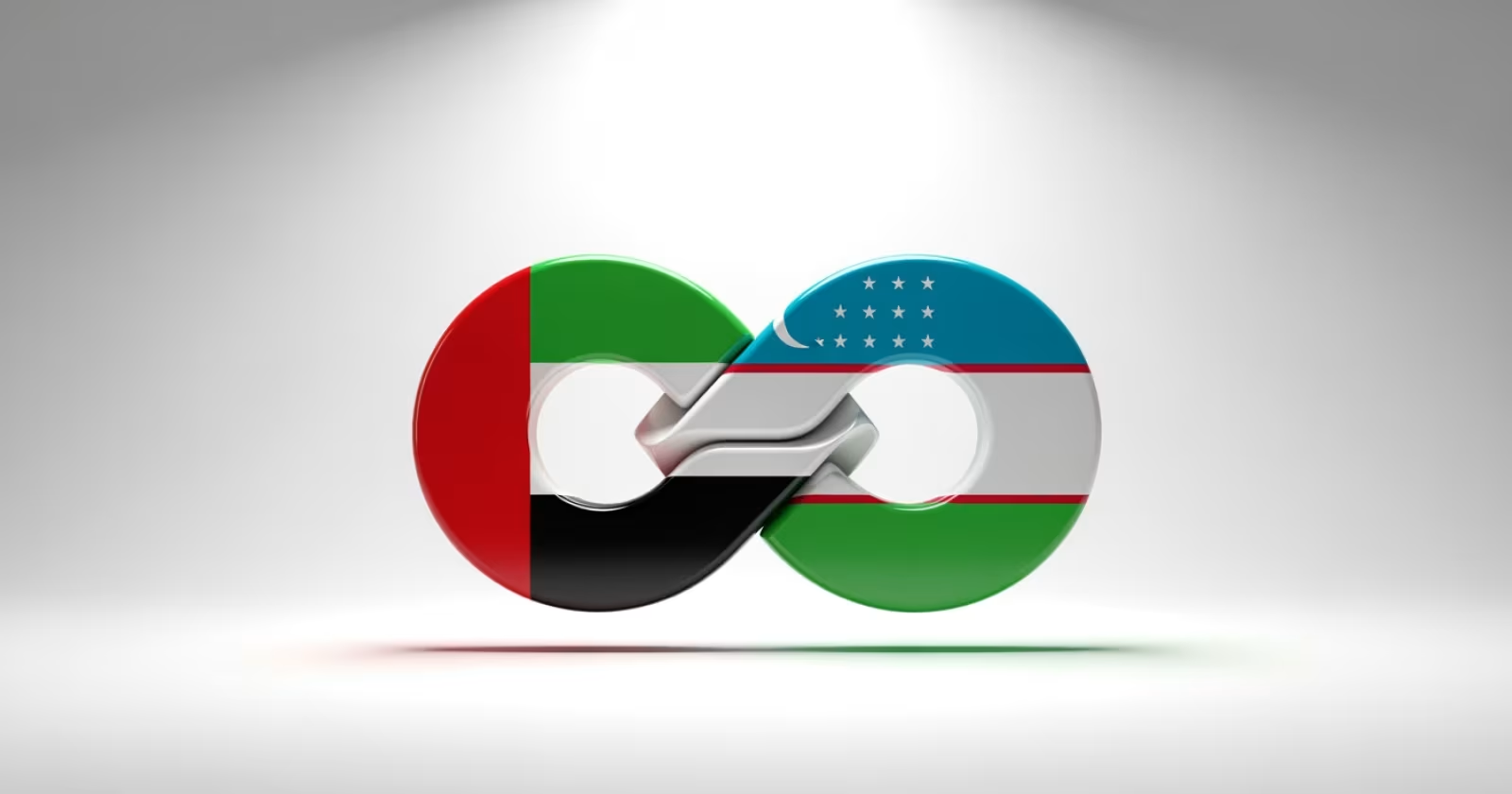
More than 2,300 Uzbek companies already operate inside the UAE, yet the two governments believe the commercial relationship is still well below its ceiling. A high-level meeting in Abu Dhabi has now put at least ten sectors on the table for deeper joint ventures.
Abdulla bin Touq Al Marri, the UAE’s Minister of Economy and Tourism, sat down with a senior Uzbek delegation to map out where bilateral trade and investment can expand next. The discussions moved beyond diplomatic pleasantries into specific sectors: fintech, renewable energy, aviation, transport, logistics, food security, manufacturing, infrastructure, banking, and tourism.
Why the UAE-Uzbekistan Corridor Matters for MENA
Central Asia has quietly become one of the fastest-growing trade corridors for Gulf capital. Uzbekistan, with a population of roughly 36 million and an economy undergoing rapid liberalisation, offers the kind of demographic dividend and reform momentum that UAE investors have historically sought in frontier markets.
For the UAE, the relationship serves a dual purpose. It opens access to Central Asian supply chains and consumer markets while reinforcing Abu Dhabi and Dubai‘s positioning as the primary gateway between Asia and the Middle East. The fact that thousands of Uzbek firms already have a UAE presence suggests the infrastructure for deeper integration is largely in place.
From Tashkent’s perspective, the UAE offers capital, fintech expertise, and a regulatory environment that has become a benchmark for ease of doing business. The partnership is not starting from scratch. It is scaling something that has been building quietly for several years.
UAE and Uzbekistan Identify Ten Priority Sectors for Joint Ventures
The meeting, which included Uzbekistan’s Deputy Prime Minister Jamshid Khodjaev and Minister of Investment, Industry, and Trade Laziz Kudratov, covered a broad but specific agenda. Both sides reviewed opportunities in what the UAE terms the “new economy,” a category that includes fintech, digital infrastructure, and technology-enabled services.
Beyond technology, the talks addressed tangible industrial cooperation. Food security, logistics, and manufacturing featured prominently, reflecting both countries’ desire to reduce supply chain vulnerabilities exposed during recent global disruptions. Renewable energy was another focal point, consistent with the UAE’s broader clean energy export strategy and Uzbekistan’s ambitious solar and wind targets.
Bin Touq Al Marri stated that the meeting aimed to convert existing market opportunities into practical joint ventures. He emphasised strengthening direct engagement between business communities on both sides, signalling a preference for private-sector-led deals rather than purely government-to-government frameworks.
UAE officials also outlined recent economic reforms designed to maintain competitiveness. These include liquidity support measures for companies, reduced operational costs intended to offset global economic headwinds, and streamlined customs procedures aimed at attracting new economy projects and strengthening private sector participation.
Tourism Growth Signals Deeper People-to-People Ties
One of the clearest indicators of the relationship’s momentum sits in the tourism data. The number of Uzbek visitors to the UAE rose 25% year-on-year, climbing from 57,575 to 71,969. That growth rate outpaces several more established tourism corridors into the Emirates.
I find this figure particularly telling because tourism flows often precede investment flows. When business travellers and tourists from a particular country increase at that pace, it typically reflects growing commercial curiosity, expanding airline connectivity, and rising disposable incomes in the source market. All three factors bode well for the broader economic relationship.
| Indicator | Detail |
|---|---|
| Uzbek companies in the UAE | 2,300+ |
| Uzbek visitors to UAE (prior year) | 57,575 |
| Uzbek visitors to UAE (latest year) | 71,969 |
| Tourism growth rate | 25% |
| Priority sectors discussed | 10 (fintech, renewable energy, aviation, transport, logistics, food security, manufacturing, infrastructure, banking, tourism) |
| Upcoming joint event | Investopia Tashkent |
Investopia Tashkent Sets the Stage for Deal Flow
Both delegations confirmed that the next concrete milestone will be Investopia Tashkent, an event to be held in partnership with the Tashkent International Investment Forum. The initiative will focus on investment opportunities in new economy sectors across the UAE, Uzbekistan, and wider Asian markets.
Investopia has become one of the UAE’s preferred platforms for translating diplomatic engagement into actual capital deployment. Previous editions have generated tangible deal pipelines, and extending the format to Tashkent signals that both governments see Central Asia as a growth frontier worth dedicated institutional attention.
Both sides described the initiative as reflecting a shared commitment to building a flexible and supportive business environment for future collaboration. While the language is diplomatic, the underlying intent is commercial: create a structured forum where UAE capital meets Uzbek opportunity.
What This Does Not Change
A ministerial meeting, however productive, does not constitute a signed agreement or a committed capital allocation. No specific deal values, investment figures, or binding timelines were announced. The ten sectors identified are broad enough to encompass almost any commercial activity, which means the real test will be whether targeted projects emerge in the coming quarters.
Uzbekistan’s regulatory environment, while improving, still presents challenges around currency controls, judicial enforcement, and bureaucratic complexity that can slow foreign investment. UAE-based firms considering entry will need to conduct granular due diligence beyond the headline optimism. The corridor is promising, but it is not frictionless.
The investors and businesses most likely to benefit in the near term are those already operating across both markets. Uzbek firms with UAE bases gain from streamlined customs and reduced operational costs. UAE-based fintech and renewable energy companies gain a structured entry point into a market with genuine demand and limited domestic competition. The timeline for visible results likely extends through the second half of 2026, anchored around the Investopia Tashkent event and whatever deal pipeline it produces.
Central Asia Emerges as the Gulf’s Next Investment Frontier
This meeting fits a pattern I have been tracking across MENA finance for some time. Gulf sovereign capital and private investment are systematically expanding beyond traditional corridors in Europe, North America, and South Asia. Central Asia, with its young populations, resource wealth, and reform-minded governments, is attracting attention that would have been unthinkable a decade ago.
The UAE is positioning itself not just as an investor in these markets but as the intermediary platform through which Central Asian economies connect to global capital. That is a strategic play with long-term revenue implications for Dubai and Abu Dhabi’s financial services ecosystems.
If you are an investor or business leader watching the UAE-Uzbekistan corridor, I would encourage you to monitor the Investopia Tashkent agenda closely. The sectors on the table are real, the trade flows are growing, and the next twelve months will reveal whether this diplomatic momentum converts into bankable deals. Position early, but position with clarity on the risks.