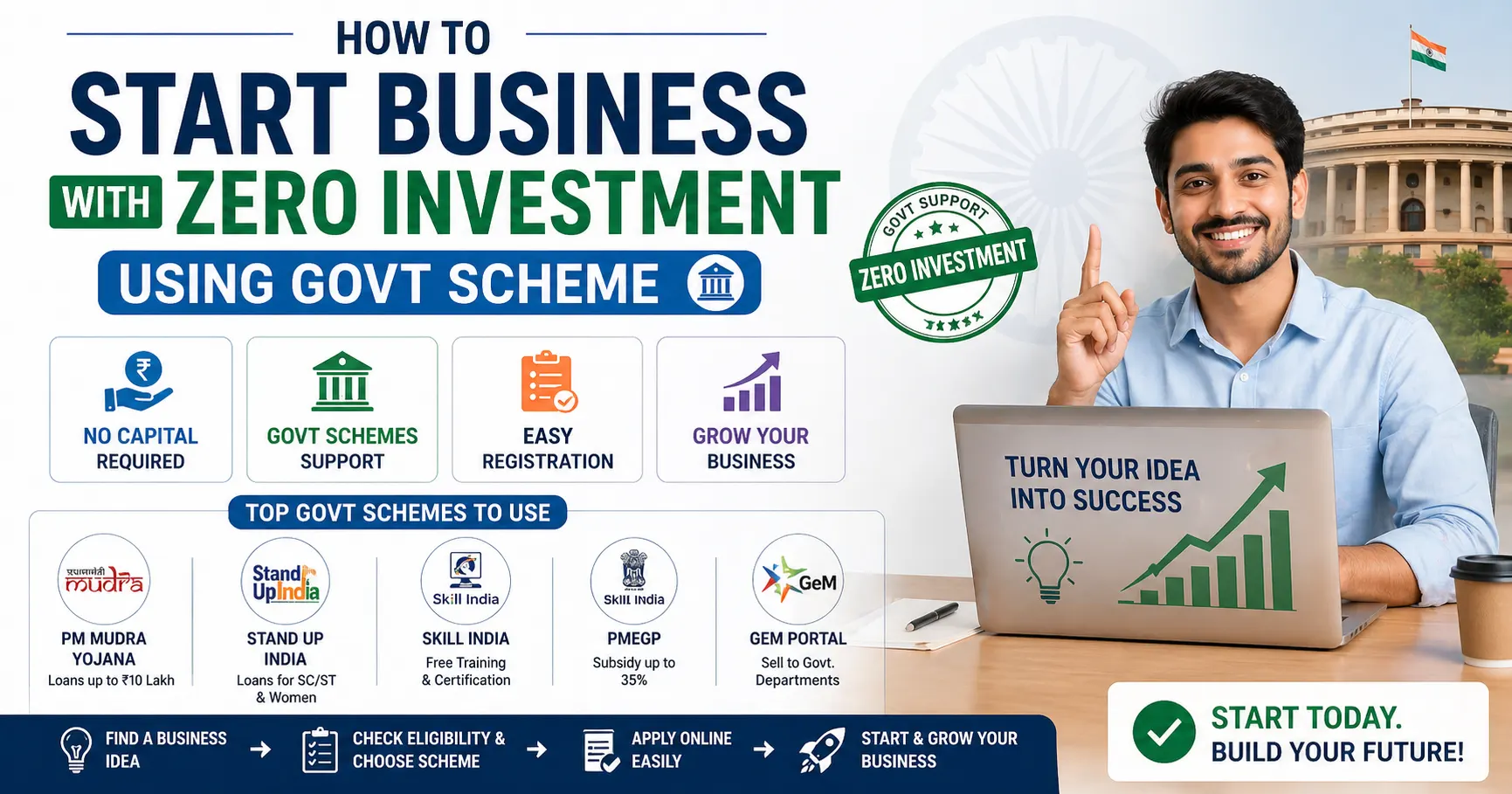
The problem is not that schemes do not exist — it is that most people never understand how to use them. If you have a business idea but no money to start, the Indian government has created multiple pathways that can fund your dream without asking for upfront capital from your pocket.
This is not a single government scheme. It is a combination of different loan and subsidy options available to aspiring entrepreneurs across India. Understanding which one fits your situation is the first step toward actually getting funded.
Quick Answer: Can You Really Start with Zero Investment?
Yes — but with clarity. “Zero investment” here means you do not need your own savings to begin. Government schemes like PMEGP, Mudra Loan, and Stand-Up India provide capital, subsidies, and credit guarantees so that banks lend to you even without collateral. You still need to contribute a small margin in some cases, but the bulk of the funding comes from the scheme.
Who can apply? Individuals above 18 years of age, women entrepreneurs, SC/ST candidates, youth, and self-help group members are all eligible depending on the scheme. The amount you can receive ranges from ₹10,000 under Mudra’s Shishu category to ₹50 lakh or more under PMEGP.
Key Scheme Comparison
| Scheme Name | Loan Amount | Subsidy / Benefit | Interest Rate | Apply Mode |
|---|---|---|---|---|
| PMEGP | Up to ₹50 lakh (manufacturing) / ₹20 lakh (service) | 15% to 35% subsidy on project cost | Approximately 11%–12% per annum | Online via kviconline.gov.in |
| Mudra Loan (PMMY) | ₹10,000 to ₹10 lakh | No collateral required | Depends on bank, typically 10%–12% | Online and offline via banks |
| Stand-Up India | ₹10 lakh to ₹1 crore | Credit guarantee support | Base rate + 3% (varies by bank) | Online via standupmitra.in |
| Startup India | Varies (fund of funds model) | Tax exemption, mentorship, fast-track registration | Not applicable (equity-based support) | Online via startupindia.gov.in |
What These Schemes Actually Offer
PMEGP is one of the most widely used schemes for first-time entrepreneurs. It is run by the Ministry of MSME through KVIC, district industries centres, and banks. The government subsidises 15% to 35% of your project cost depending on your category and location. Rural applicants and SC/ST/women candidates receive higher subsidy percentages.
Mudra Loan under PMMY is designed for micro and small businesses. It has three tiers: Shishu (up to ₹50,000), Kishore (₹50,000 to ₹5 lakh), and Tarun (₹5 lakh to ₹10 lakh). No collateral is required, which makes it accessible for people starting from scratch.
Stand-Up India targets SC/ST entrepreneurs and women specifically. It provides loans between ₹10 lakh and ₹1 crore for setting up greenfield enterprises in manufacturing, services, or the trading sector.
Who Can Apply
- Indian citizens above 18 years of age
- Women entrepreneurs (priority in most schemes)
- SC/ST and OBC candidates (higher subsidy in PMEGP)
- Youth with a business idea and basic educational qualification
- Self-help group members and rural artisans
- Existing micro-business owners looking to expand
For PMEGP specifically, the applicant must have passed at least Class 8 for projects above ₹10 lakh. For Mudra Loan, there is no minimum education requirement in most cases.
Documents You Will Need
- Aadhaar card and PAN card
- Passport-size photographs
- Proof of residence (utility bill, ration card)
- Caste certificate (if applying under SC/ST/OBC category)
- Business plan or project report
- Bank account details (last 6 months statement in many cases)
- Educational qualification certificate (for PMEGP above ₹10 lakh)
- Quotations for machinery or equipment (if applicable)
How to Apply Step by Step
For PMEGP, visit kviconline.gov.in and register as a new applicant. Fill in your personal details, business category, and project cost. Upload the required documents and submit your application. After submission, your application is reviewed by the district-level KVIC or DIC office, and you will be called for an interview before bank processing begins.
For Mudra Loan, visit any nationalised bank, regional rural bank, or microfinance institution. You can also apply online through the Udyamimitra portal at udyamimitra.in. Fill in the Mudra application form, attach your documents, and submit. The bank will assess your business plan and disburse the loan if approved.
For Stand-Up India, register at standupmitra.in. The portal connects you with banks and handholding agencies. You can also walk into any scheduled commercial bank branch and request a Stand-Up India loan directly.
For Startup India recognition, register your business on startupindia.gov.in. Once recognised, you become eligible for tax benefits, faster patent processing, and access to the Fund of Funds programme managed by SIDBI.
Reality Check: What Actually Happens on the Ground
Many applicants face delays at the bank level even after government approval. Banks have their own credit assessment process, and approval is not guaranteed just because you applied through a government portal. In many cases, banks ask for additional documents or a guarantor even when the scheme says no collateral is needed.
Common rejection reasons include an incomplete project report, low credit score, mismatch between stated business activity and loan category, and missing documents. Approval timelines can range from 4 weeks to 6 months depending on the bank and district office workload.
The subsidy under PMEGP is not given upfront. It is kept in a locked account for 3 years and released only after the business is operational and verified. This is important to understand before planning your cash flow.
A Practical Example
For example, consider a young woman in a semi-urban area of Rajasthan who wants to start a tailoring unit. She applies under PMEGP with a project cost of ₹2 lakh. As a woman applicant in a rural area, she qualifies for a 35% subsidy, which means ₹70,000 is covered by the government. She contributes 5% (₹10,000) as her own margin, and the bank finances the remaining ₹1.2 lakh. In many cases like this, the actual out-of-pocket cost to start is minimal.
This is not a guaranteed outcome, but it reflects how the scheme is designed to work when all documents are in order and the bank processes the application smoothly.
What You Should Do Next
Start by identifying which scheme matches your business type and personal category. If your project cost is below ₹10 lakh, Mudra Loan is the fastest route. If you need a larger amount with a subsidy, PMEGP is the right choice. If you are an SC/ST entrepreneur or a woman planning a larger venture, Stand-Up India is built for you.
Prepare a clear, realistic project report before approaching any bank or government office. A well-written project report is the single biggest factor that separates approved applications from rejected ones. If you need help writing one, your nearest District Industries Centre (DIC) offers free guidance in most states.
Do not wait for the perfect moment. These schemes exist in 2026 with active funding, and the window to apply is open right now. Take the first step today by visiting the relevant portal or walking into your nearest bank branch with your documents ready.