
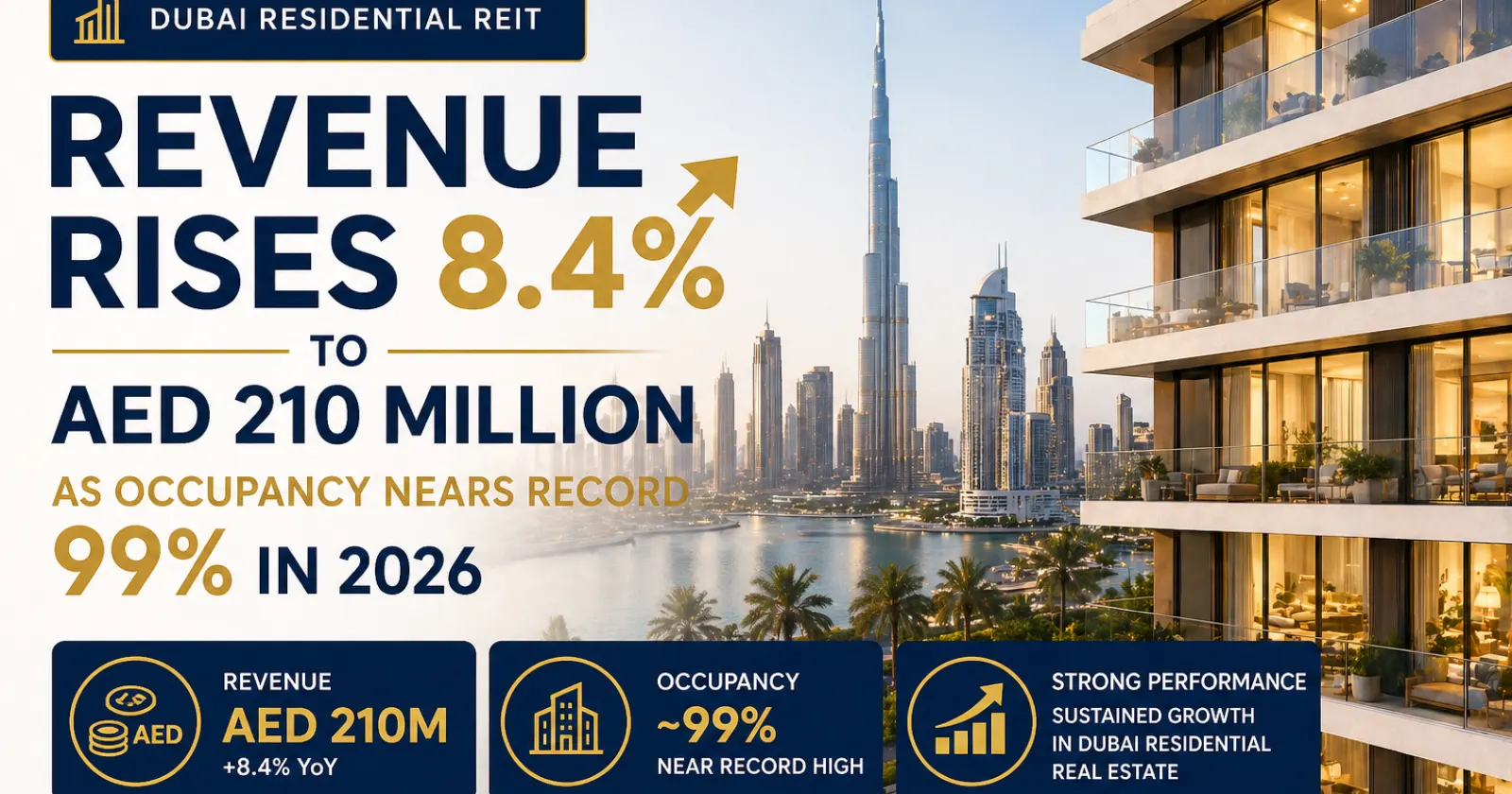
When a residential portfolio in one of the world’s most competitive rental markets operates at 98.9 per cent occupancy, the conversation shifts from demand to capacity. Dubai Residential REIT’s first-quarter results for 2026 confirm that the trust is running closer to full than almost any comparable vehicle in the region.
The REIT reported an 8.4 per cent year-on-year increase in revenue for the three months ending March 31, 2026. Average revenue per leased space rose 7.4 per cent to AED 58.9 per square foot, while tenant retention held at 98 per cent. Gross asset value reached AED 23.8 billion, bolstered by the addition of 56 villas in the Garden View Villas development.
For anyone tracking Dubai’s residential investment landscape, these numbers tell a clear story: rental demand is not softening, and well-managed portfolios are extracting more value per square foot without losing tenants.
What Dubai Residential REIT Means for MENA’s Real Estate Investment Market
Dubai Residential REIT is one of the few publicly listed real estate investment trusts focused exclusively on residential assets in the UAE. Its portfolio spans communities across Dubai, offering exposure to the emirate’s rental market through a single, income-generating vehicle.
The REIT structure matters here. In a region where real estate investment has traditionally meant direct ownership, REITs offer liquidity, diversification, and regulated income distribution. For institutional and retail investors across the MENA region, a trust operating at near-full occupancy with rising rents represents a relatively stable yield play in a market that has historically been volatile.
Dubai’s residential sector has been on a sustained upswing since 2022, driven by population growth, visa reforms, and corporate relocations. The question for investors has shifted from whether demand exists to how long pricing power can hold. This REIT’s Q1 numbers suggest the answer, at least for now, is that pricing power remains intact.
Dubai Residential REIT Q1 2026 Performance in Detail
The headline 8.4 per cent revenue growth is notable, but the underlying metrics are what I find more telling. Occupancy at 98.9 per cent is up from 98.3 per cent in Q1 of the prior year. That half-percentage-point gain may look marginal, but at this level of occupancy, every fraction represents real units filled in a portfolio of significant scale.
Ahmed Al Suwaidi, Managing Director of DHAM REIT Management, attributed the performance to disciplined asset management and proactive leasing strategies. He pointed to the quality, scale, and diversity of the REIT’s communities as factors underpinning stability despite what he described as rapidly changing market dynamics.
The REIT also confirmed that Jebel Ali Village is expected to contribute 220 additional units in the second quarter of 2026, with further developments under review across Dubai. That pipeline matters because it signals the trust is not simply riding existing assets but actively expanding its income base.
| Metric | Q1 2026 | Q1 2026 | Change |
|---|---|---|---|
| Revenue Growth (YoY) | — | +8.4% | — |
| Average Occupancy | 98.3% | 98.9% | +0.6 pp |
| Tenant Retention | — | 98.0% | — |
| Avg Revenue per Leased Space | — | AED 58.9/sq ft | +7.4% YoY |
| Gross Asset Value | — | AED 23.8 BN | — |
| New Villas Added (Garden View) | — | 56 units | — |
How Rental Growth and Retention Drive REIT Returns
The mechanics here are straightforward but worth spelling out. A REIT generates income primarily through rental yields. When occupancy is near-total and rents are rising, the trust’s distributable income grows without requiring proportional capital expenditure. That is the sweet spot for unitholders.
The 7.4 per cent increase in average revenue per leased space tells me that the REIT is successfully repricing leases upward at renewal. Combined with 98 per cent tenant retention, this means tenants are absorbing higher rents rather than vacating. In practical terms, the cost of moving in Dubai’s tight rental market likely exceeds the incremental rent increase for most tenants.
The broader Dubai market data reinforces this. During Q1 2026, the emirate recorded 170,000 lease contracts valued at AED 15.1 billion, including 60,545 new leases. Renewals rose 3.2 per cent year-on-year. On the sales side, residential transactions totalled AED 134.8 billion across 44,378 deals, a 19 per cent increase in value and 4.2 per cent rise in volume.
What This Does Not Change for Dubai’s Residential Market
Near-perfect occupancy at one REIT does not mean Dubai’s entire residential market is uniformly tight. Supply is coming. Developers across the emirate have announced significant pipeline projects, and the second half of 2026 will see thousands of new units delivered across multiple communities.
The REIT’s own expansion into Jebel Ali Village and other developments under review introduces execution risk. New units need to be leased at comparable rates to maintain portfolio-level metrics. There is also no guarantee that the current pace of rental growth will persist if macroeconomic conditions shift or if population inflows moderate.
For investors, the REIT’s performance is a snapshot of current strength, not a forward guarantee. The trust has not disclosed specific distribution figures for Q1, which limits the ability to assess yield directly from these results alone.
The most immediate beneficiaries are existing unitholders, who gain from rising rental income and asset appreciation. Tenants within the portfolio face continued upward pressure on rents, though the high retention rate suggests the increases remain within tolerable bounds. Prospective investors looking at Dubai residential exposure now have a clearer data point: a well-managed, diversified portfolio can sustain near-full occupancy even as the broader market absorbs new supply.
Dubai’s REIT Sector Signals a Maturing Investment Landscape
I see this quarter’s results as part of a larger shift in how capital flows into Gulf real estate. The era of purely speculative, off-plan-driven investment is giving way to a more institutional model where yield, occupancy data, and asset management discipline matter as much as location and branding. Dubai Residential REIT’s numbers are the kind of evidence that attracts long-term capital, particularly from foreign institutional investors who need auditable, recurring income streams.
As Dubai continues to position itself as a global business hub, the depth and transparency of its listed real estate vehicles will become a competitive advantage in attracting sovereign and pension fund allocations from outside the region.
If you are evaluating residential exposure in the UAE, this quarter’s data from Dubai Residential REIT deserves a close read. The occupancy and retention figures set a benchmark, and the upcoming Jebel Ali Village additions in Q2 will be the next test of whether the trust can scale without diluting performance.
The 220 units arriving at Jebel Ali Village this quarter will reveal whether Dubai Residential REIT can grow its portfolio and its per-unit economics at the same time.