
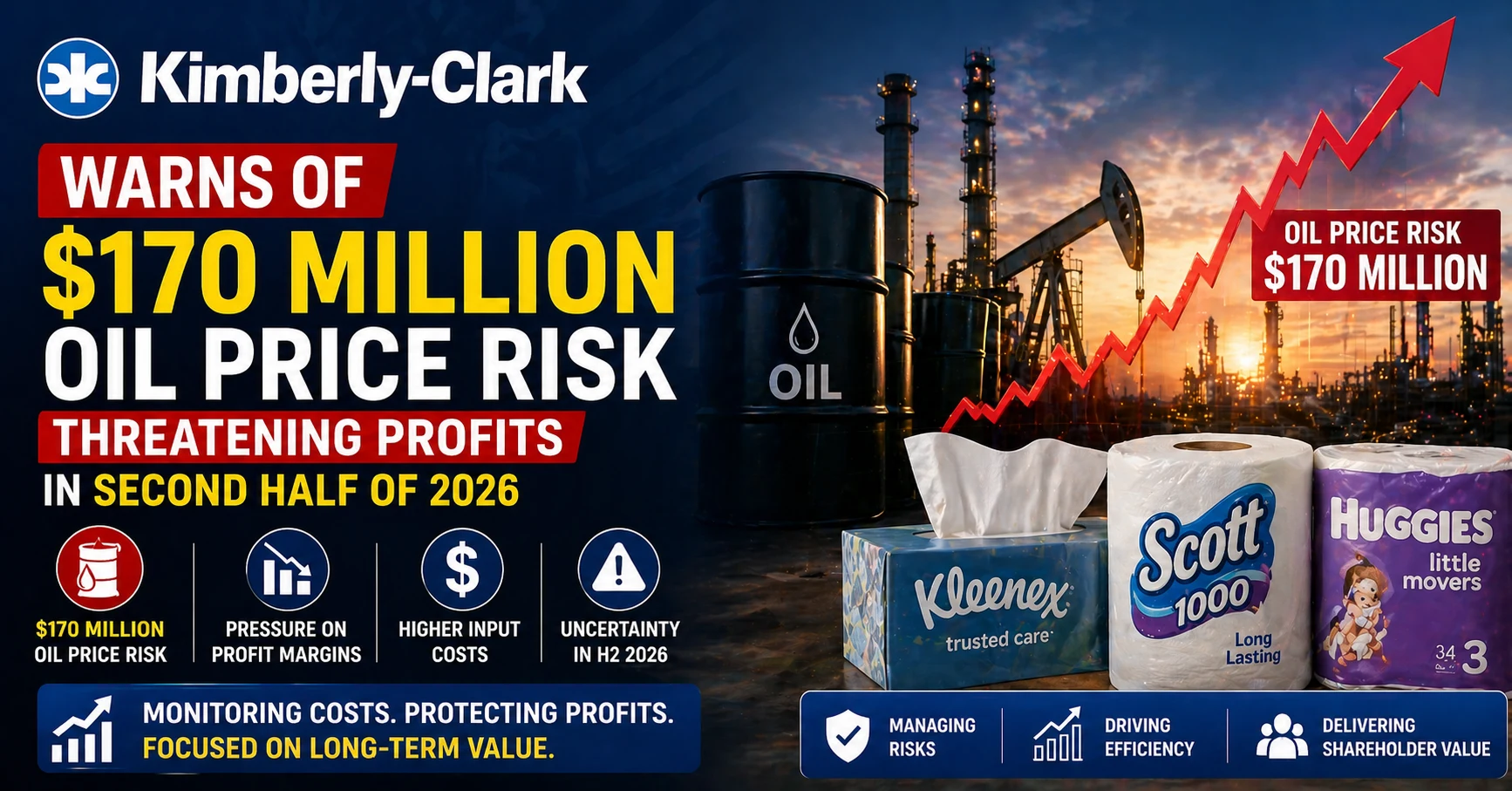
Oil at US$100 a barrel is not a hypothetical for Kimberly-Clark — it is a live cost scenario the company is already stress-testing, with up to US$170 million in additional gross input costs potentially landing in the second half of this year. That kind of exposure, sitting outside the current annual forecast, is the sort of number that gets passed straight to procurement and pricing teams.
The personal care giant reported first-quarter sales of US$4.16 billion, beating analyst estimates of US$4.09 billion compiled by LSEG. Despite the beat, the company’s adjusted profit per share slipped to US$1.60 from US$1.62 a year earlier, reflecting the cost of price cuts and investment in product innovation.
What the Oil Price Warning Actually Means
Kimberly-Clark’s chief financial officer, Nelson Urdaneta, was direct in his prepared remarks. If oil prices hold at the US$100-per-barrel level through the second half of the year, the company could absorb between US$150 million and US$170 million in additional gross input cost inflation. That figure is not baked into the current outlook.
Management confirmed it is evaluating mitigation measures, though none have been formally announced. The warning is not unique to Kimberly-Clark — Procter & Gamble has flagged similar input cost pressures as Middle East conflict continues to influence global oil markets.
For FMCG professionals tracking commodity exposure, this is a signal worth watching. Oil feeds directly into resin costs, packaging materials, and logistics — three cost lines that sit across almost every consumer goods supply chain.
The California Distribution Centre Fire Adds to Near-Term Pressure
Separate from the oil price risk, Kimberly-Clark expects a US$50 million hit in the second quarter from a fire at a distribution centre in California. The incident adds a one-off operational cost on top of the broader input cost environment the company is navigating.
The combination of a supply chain disruption and rising commodity costs in the same reporting period illustrates the kind of compounding pressure that tests even well-resourced consumer goods businesses. How quickly the California facility is restored to capacity will matter for near-term service levels in North America.
Kenvue Acquisition Remains on Track for H2
Kimberly-Clark’s US$40 billion acquisition of Kenvue, the Tylenol maker spun out of Johnson & Johnson, is still expected to close in the second half of this year. The deal would significantly expand the company’s footprint in consumer health, adding a portfolio of well-established over-the-counter brands to sit alongside its existing personal care and hygiene lines.
The scale of that transaction means integration planning is already consuming significant management bandwidth. Closing a US$40 billion deal while managing a live commodity cost spike and a distribution centre recovery is a demanding operational context by any measure.
How Kimberly-Clark’s Cost Exposure Compares to Peers
| Company | Flagged Input Cost Risk | Primary Driver | Current Outlook Status |
|---|---|---|---|
| Kimberly-Clark | US$150m–$170m (H2 risk) | Oil prices / resin / packaging | Annual forecast maintained |
| Procter & Gamble | Rising input costs flagged | Oil and commodity inflation | Monitoring; no revision disclosed |
| Kraft Heinz | Outlook lowered | Weak volume and cost pressure | Full-year guidance reduced |
Where Kimberly-Clark Has an Edge
Brian Mulberry, chief marketing strategist at Zacks Investment Management, noted that Kimberly-Clark appears better positioned than some peers because its internal transformation has built momentum around a clear value architecture. The company’s good, better, best tier structure across its product range has given it flexibility to absorb volume pressure without sacrificing shelf presence.
That tiering strategy is increasingly relevant in the current retail environment. Shoppers trading down within a brand’s own range is a far better outcome for a manufacturer than losing the basket entirely to private label. Kimberly-Clark’s affordable offerings have helped it hold volume even as price cuts compressed margin.
The company expects fiscal 2026 organic sales growth to be in line with, or ahead of, the weighted average growth in its categories and markets — a benchmark that has been running at approximately 2.5 per cent over the latest 12 months. It also maintained its annual adjusted profit forecast, which will reassure investors watching the commodity situation closely.
What This Means for Australian FMCG Buyers and Suppliers
For Australian retailers and brand managers sourcing Kimberly-Clark products — including Huggies, Kleenex, and related personal care lines — the key question is whether any cost mitigation measures translate into pricing conversations at the shelf level. Global input cost inflation at this scale rarely stays contained to the country of origin.
Buyers at Coles, Woolworths, and independent grocery operators should be monitoring supplier cost submissions in the personal care and hygiene categories closely over the coming months. If oil prices remain elevated and mitigation measures prove insufficient, price increase requests are a logical next step for any manufacturer in this position.
Supply chain leads should also note the California distribution centre disruption as a reminder of how quickly single-site incidents can ripple through a global network. Dual-sourcing and safety stock strategies in hygiene and personal care categories are worth reviewing in light of this event.
If Kimberly-Clark’s mitigation measures fall short and oil holds above US$100 a barrel, the pressure to recover margin through pricing will intensify — and the retailers absorbing those conversations will need to decide how much of that cost lands on the shelf and how much stays with the supplier.