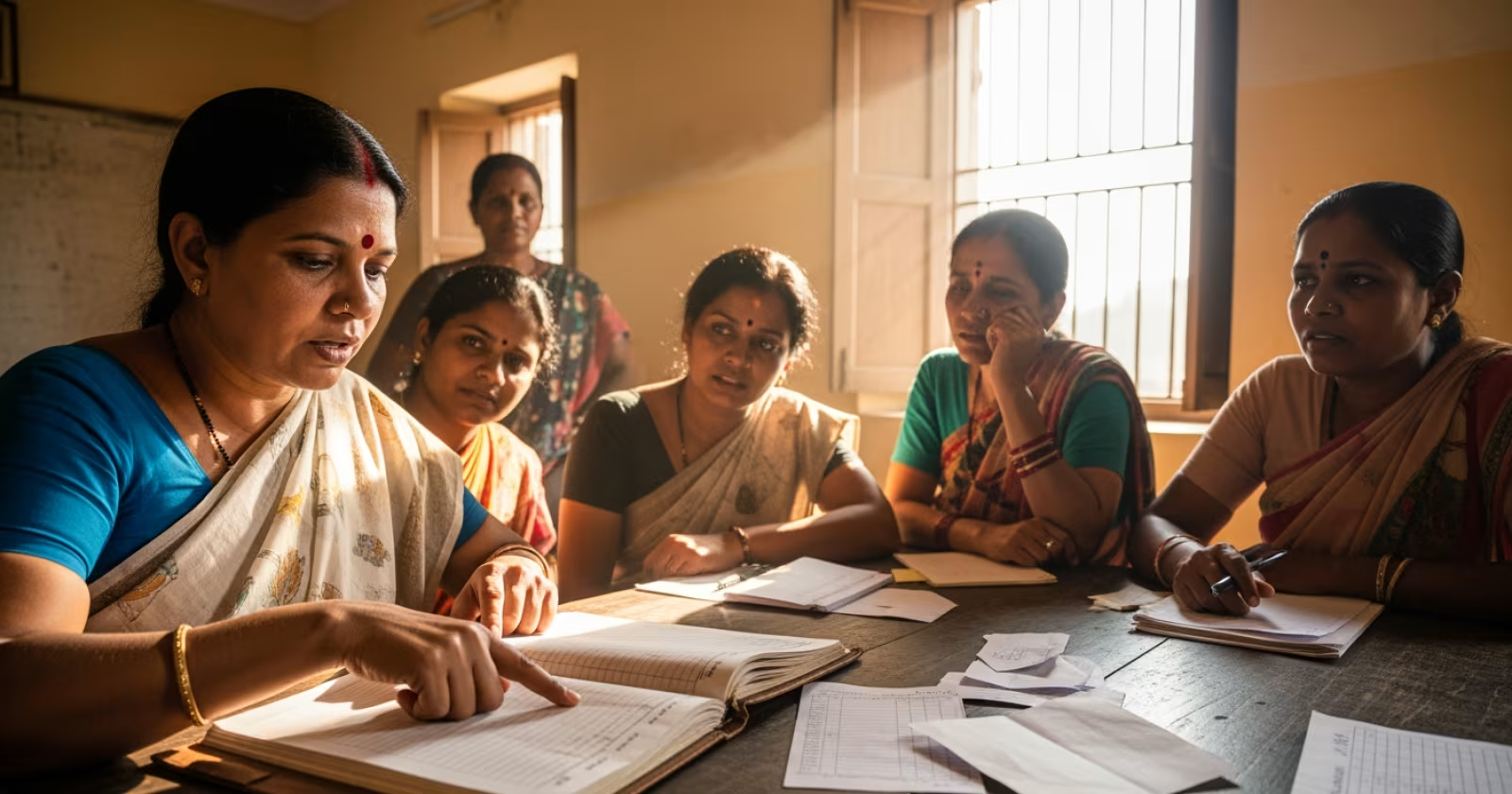
In a small rented room in Alappuzha district, a woman named Sreelatha once counted ₹47 in weekly savings collected from nine neighbours. That was 2001. Today, that same neighbourhood group manages a catering micro-enterprise turning over ₹12 lakh annually. I find her story remarkable not because it is unique — but because it has been replicated approximately 3.06 lakh times across every single ward in Kerala. This is the quiet, staggering mathematics of what cooperative mobilisation can achieve when women hold the ledger.
I have spent years covering India’s cooperative sector for IICTF, and no model has fascinated me more than Kudumbashree — a name that translates to “prosperity of the family” in Malayalam. With over 4.5 million women members as of 2026, it is not merely Kerala’s pride; it is the single largest women-run cooperative network anywhere in Asia. Yet most Indians outside Kerala have only a vague sense of what it actually does or how it works. That gap deserves closing.
Why Kudumbashree Matters Beyond Kerala
When the Ministry of Cooperation under Amit Shah began pushing the revival of Primary Agricultural Credit Societies (PACS) as multi-service centres in 2023, officials privately admitted they were studying Kudumbashree’s ward-level penetration model. The reason is straightforward: no other cooperative structure in India has achieved near-universal coverage of a state’s poorest households while simultaneously running viable micro-enterprises.
At a national level, the National Rural Livelihoods Mission (NRLM) — also known as DAY-NRLM — borrowed directly from Kudumbashree’s three-tier architecture when it was redesigned in 2011. Kerala had already proven the blueprint worked. The rest of India is still catching up.
Born From Crisis: The Origins of a Movement
Kudumbashree was formally launched on 17 May 1998 by the Government of Kerala, during the tenure of Chief Minister E.K. Nayanar. But its intellectual roots go deeper. In the early 1990s, a community-based nutrition programme called the Urban Basic Services Programme ran a pilot in Alappuzha municipality. Women from below-poverty-line families were organised into neighbourhood groups to track child health indicators. What organisers discovered surprised everyone: when poor women met regularly, tracked data together, and pooled small savings, they began solving problems far beyond nutrition — housing, sanitation, income.
The State Poverty Eradication Mission (SPEM) took this insight and scaled it statewide. Kudumbashree was registered as a society under the Travancore-Cochin Literary Scientific and Charitable Societies Act, with the state government as its patron. The founding idea was radical for the late 1990s — poverty is not merely an income problem; it is a capability problem. And the unit of intervention should not be the individual but the neighbourhood.
By 2002, Kudumbashree had organised women in all 14 districts. By 2006, it had become the community arm of local self-government institutions. Its growth was not accidental — it was architecturally tied to Kerala’s famous decentralised planning movement, the People’s Plan Campaign, which devolved significant funds to gram panchayats.
The Three-Tier Engine: How It Actually Functions
I think the genius of Kudumbashree lies in its structure. It operates through a simple but disciplined three-tier system that I have summarised below.
| Tier | Unit Name | Level | Approximate Count (2026) | Key Function |
|---|---|---|---|---|
| 1 | Neighbourhood Group (NHG) | Ward | 3,06,000+ | Weekly savings, thrift lending, micro-plans |
| 2 | Area Development Society (ADS) | Ward cluster / Panchayat ward | 19,800+ | Coordination, monitoring, sub-project management |
| 3 | Community Development Society (CDS) | Municipality / Panchayat | 1,070+ | Interfaces with local government, manages large projects |
Each NHG has 10 to 20 women, typically from BPL households identified through a nine-point vulnerability index — not just income but factors like housing quality, access to sanitation, and whether the household has a chronically ill member. Members contribute weekly thrift savings starting from as little as ₹10 per week. These pooled savings become the seed capital for internal lending at reasonable interest rates, bypassing exploitative moneylenders entirely.
The revenue model is multi-layered. Kudumbashree runs approximately 34,000 micro-enterprises spanning food processing, garment stitching, IT services, organic farming, and even hospitality. Its cafe brand, Kudumbashree Canteens, operates across government offices and hospitals. NABARD and NCDC have both provided refinance and project support, while the state government channels a portion of plan funds through CDS units.
What Threatens the Model
No cooperative model is immune to friction, and I would be dishonest if I painted Kudumbashree as flawless. The most persistent criticism concerns political capture. Because CDS elections often align with local body elections, both the LDF and UDF have treated Kudumbashree leadership positions as extensions of party machinery. In several panchayats, ADS and CDS office-bearers are essentially party workers first and cooperative leaders second. This erodes member trust and skews resource allocation.
A second challenge is enterprise viability. While 34,000 micro-enterprises sound impressive, estimates suggest that only about 60 percent remain consistently active. Many food-processing units face stiff competition from commercial FMCG brands and struggle with quality standardisation, packaging, and market access. The digital commerce push that accelerated after COVID-19 has helped — Kudumbashree products are now listed on platforms like Kerala’s own K-SWIFT portal — but rural digital literacy remains uneven.
Third, Kerala’s demographic transition poses a subtle risk. With younger women pursuing higher education and formal employment, the volunteer energy that sustained NHGs is thinning in some urban wards. Succession planning at the grassroots is becoming a genuine concern.
A District That Got It Right: Wayanad’s Tribal NHGs
In Wayanad district, Kudumbashree operates specialised NHGs among Paniya and Kurichiya tribal communities. What makes this sub-model notable is its integration with the Mahatma Gandhi National Rural Employment Guarantee Scheme. Tribal NHGs in Wayanad have used MGNREGS labour budgets to develop community farms cultivating turmeric, ginger, and pepper — crops with strong market demand. The CDS in Mananthavady block reported cumulative farm-gate sales exceeding ₹2.3 crore in the 2024-25 cycle. Compared to isolated self-help group models I have observed in Jharkhand and Odisha, Wayanad’s version benefits from institutional handholding that only a statewide network like Kudumbashree can provide. The lesson is clear: scale creates infrastructure, and infrastructure creates outcomes.
The Road to 2030: Digital Cooperativism and National Replication
In 2026, Kudumbashree is piloting a digital ledger and micro-credit tracking app across 500 CDS units, developed in partnership with Kerala’s IT Mission. If successful, this will replace handwritten thrift registers — some of which still use ruled notebooks — with real-time financial dashboards accessible to every NHG member on her phone.
At the policy level, the Ministry of Cooperation’s push to create a national cooperative database could finally give Kudumbashree’s model the visibility it deserves beyond Kerala. Several states, including Tamil Nadu and Andhra Pradesh, have already sent study teams. The question is whether the political will exists to let women-led cooperatives operate with genuine autonomy rather than as vehicles for scheme delivery.
Back to Alappuzha
Sreelatha’s catering unit now employs seven women from her original NHG. She told a Kerala State Planning Board field team in 2024 that her only regret was not having a cold storage unit to expand into ready-to-eat products. That single missing link — cold chain infrastructure — is something NCDC’s cooperative infrastructure fund is designed to address, yet applications from Kudumbashree micro-enterprises remain a fraction of what they should be. Her story sits at the exact intersection of what works and what still needs fixing in India’s cooperative ecosystem. If we get this right, the model does not stay in Kerala. It becomes the template for every state in the country.