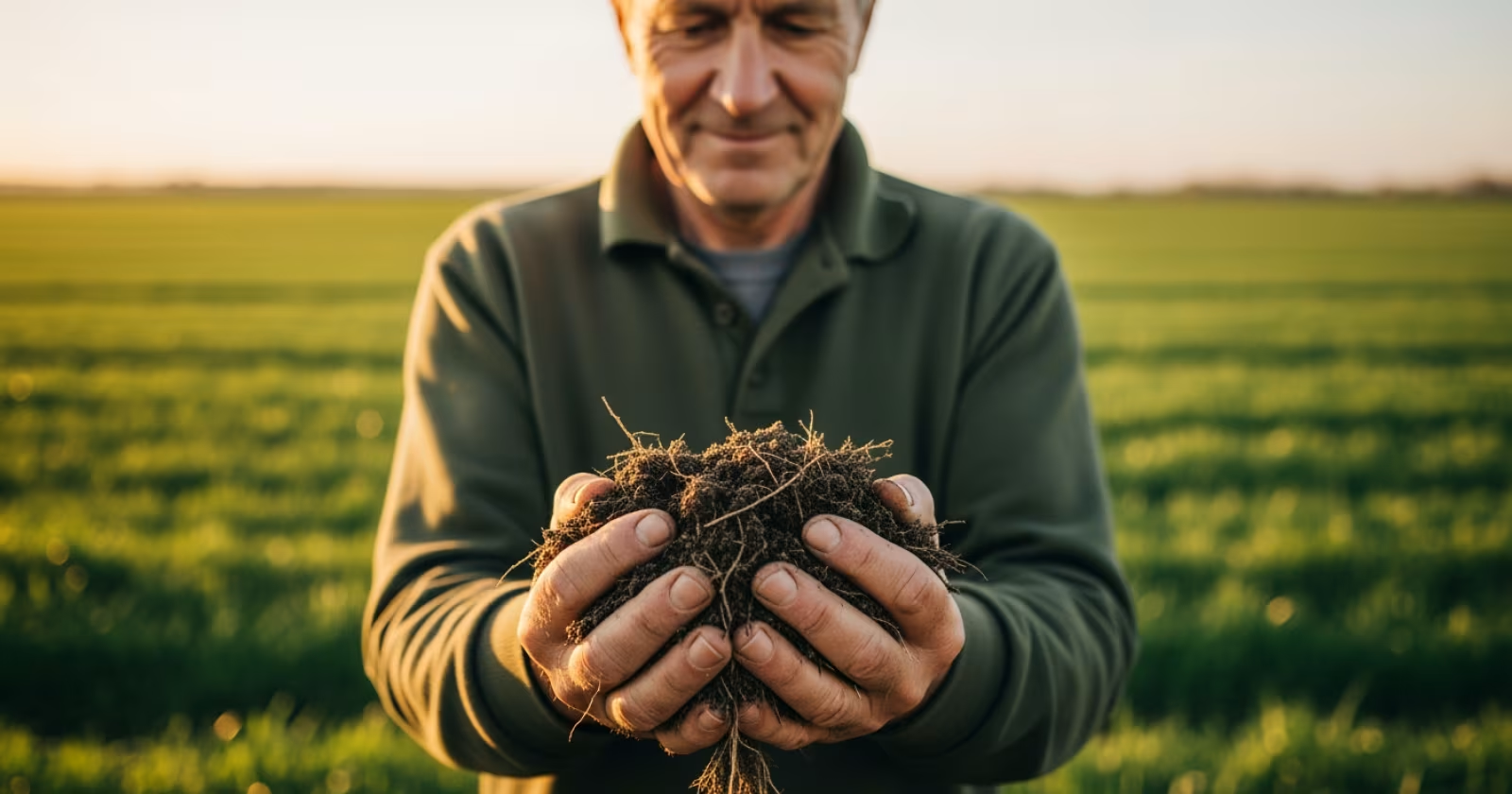
In the summer of 1966, a groundnut farmer in Mehsana district, Gujarat, watched his crop wilt — not from drought, but from the sheer impossibility of buying fertiliser at a price he could afford. That year, India imported nearly 60% of its fertiliser requirement, and private traders in rural Gujarat marked up prices by margins that made farming a losing bet. I have spent years covering the cooperative sector, and no origin story fascinates me quite like what happened next — how that farmer’s desperation became the seed for an institution that now serves over 35,000 cooperative societies and touches the lives of approximately 50 million Indian farmers.
The institution I am talking about is Indian Farmers Fertiliser Cooperative Limited (IFFCO), registered on 3 November 1967. What most people do not know is that IFFCO was not a government project imposed from Delhi. It was a grassroots demand, channelled through cooperative networks in Gujarat, that eventually convinced policymakers to back one of the boldest experiments in India’s agricultural history.
Why This Story Matters for India’s Cooperative Movement
In 2026, as the Ministry of Cooperation pushes to computerise and revitalise over 63,000 Primary Agricultural Credit Societies (PACS) across India, the IFFCO model is frequently cited as the gold standard. It is the world’s largest fertiliser cooperative by membership and among the top producers globally. Understanding how it was born — in a specific district, under specific pressures — is not merely historical curiosity. It is a blueprint. If India wants to replicate cooperative success in sectors like organic farming, seed production, or renewable energy, the IFFCO origin story offers tactical lessons that no management textbook can match.
The Gujarat Roots: 1960s Crisis and a Cooperative Answer
Post-independence India faced a grim agricultural reality. The country’s Green Revolution was just beginning, and Dr. M.S. Swaminathan and his colleagues were introducing high-yielding variety seeds that demanded reliable fertiliser supply. But the supply chain was broken. Private sector fertiliser production was limited, imports were expensive, and distribution to small farmers was inefficient and exploitative.
Gujarat’s cooperative ecosystem — already robust thanks to the success of dairy cooperatives like Amul in Anand — became the proving ground. Leaders from cooperative societies across the state argued that if farmers could collectively produce and distribute milk, why not fertiliser?
The idea gained momentum through cooperative congresses and meetings at the district level. By 1967, the proposal had crystallised: create a multi-state cooperative owned entirely by other cooperatives, which would manufacture fertiliser and sell it to farmer-members at fair prices. On 3 November 1967, IFFCO was formally registered under the Societies Registration Act, with its initial equity drawn from cooperative societies — not from a single industrialist or government grant. The founding members included approximately 57 cooperative societies who pooled resources and political will to bring the institution to life.
How IFFCO Actually Works in 2026
I find that most coverage of IFFCO treats it as a monolith. But the mechanics are worth unpacking. IFFCO is owned by its member cooperatives — over 35,000 societies as of recent counts — which in turn represent millions of individual farmers. This means the farmer is, structurally, both the owner and the consumer. Profits cycle back as dividends to member societies or as investments in rural infrastructure.
IFFCO operates five major production plants across India. The first two — at Kalol and Kandla (now Deendayal Port) in Gujarat — remain symbolically significant. The others are at Phulpur and Aonla in Uttar Pradesh and Paradip in Odisha. Together, these plants produce millions of tonnes of Urea, DAP, and NPK fertilisers annually.
| IFFCO Plant | Location | Commissioned | Primary Product |
|---|---|---|---|
| Kalol Unit | Gujarat | 1975 | Urea, Ammonium Sulphate |
| Kandla Unit | Gujarat | 1975 | DAP, NPK Complex |
| Phulpur Unit | Uttar Pradesh | 1981 | Urea |
| Aonla Unit | Uttar Pradesh | 1988 | Urea |
| Paradip Unit | Odisha | 2005 | DAP, NPK |
Revenue figures have been impressive. IFFCO has consistently reported annual turnovers exceeding ₹30,000 crore in recent years. Distribution happens through a network of cooperative marketing societies, ensuring fertiliser reaches the last mile — often a village with no private dealer. The cooperative also runs farmer training programmes through IFFCO Kisan Sewa Trust, reaching millions via mobile advisories and village-level sessions.
What Threatens the Model
No institution this large is without cracks. I have tracked three persistent challenges that IFFCO — and the cooperative fertiliser sector broadly — faces in 2026.
First, subsidy dependency. Indian fertiliser pricing is heavily regulated, and cooperatives like IFFCO rely on government subsidies to keep retail prices affordable. Any policy shift — and there have been murmurs of further subsidy rationalisation under the Nutrient Based Subsidy (NBS) scheme — could squeeze margins severely.
Second, governance and political interference. While IFFCO has been comparatively well-managed, the broader cooperative fertiliser sector includes entities where board elections are contested along political lines, and professional management takes a backseat. NCDC and NABARD audits have flagged governance gaps in affiliated societies.
Third, environmental scrutiny. Fertiliser production is energy-intensive. As India pushes its net-zero commitments, IFFCO faces pressure to adopt greener manufacturing — a transition that demands capital and technology.
Nano Urea: A Gujarat-Born Innovation Goes Global
Perhaps the most compelling recent chapter is IFFCO’s development of Nano Urea, launched in 2021 and now scaling rapidly. Produced at the Kalol plant in Gujarat — the very site where IFFCO began manufacturing — Nano Urea is a liquid formulation that claims to reduce conventional urea usage by up to 50%. A 500 ml bottle, priced at approximately ₹240, can replace a 45 kg bag of urea.
By 2026, IFFCO has been exporting Nano Urea to multiple countries, and this product has attracted attention from agricultural cooperatives in Africa and Southeast Asia. Whether Nano Urea fully delivers on its agronomic promises is still debated among soil scientists, but as a cooperative-led innovation, it is without parallel globally.
The Road Ahead: Five Years That Will Define IFFCO
The next five years will test IFFCO on multiple fronts. The Ministry of Cooperation’s push to strengthen multi-state cooperatives could bring fresh policy support — or fresh regulatory burden. IFFCO’s expansion into Nano DAP, organic fertilisers, and rural retail (through IFFCO Bazar) suggests diversification beyond its core product.
Digitisation is another frontier. IFFCO has been integrating its distribution data with cooperative banking networks, aiming for real-time tracking of fertiliser movement from plant to farmer. If successful, this could become a template for cooperative supply chains across sectors. The cooperative’s ambition to become a ₹1 lakh crore entity by the decade’s end is bold — but given its trajectory, not implausible.
Back to Mehsana: What the Farmer’s Story Tells Us
I think about that Mehsana farmer often — not as a named individual, but as an archetype that recurs across India’s cooperative history. A person priced out of a market, who found power not in individual protest but in collective ownership. IFFCO did not emerge from a boardroom strategy session. It emerged from the fields of Gujarat, from cooperative meetings held under neem trees and in district offices.
In 2026, as India debates the future of its cooperative movement, IFFCO stands as evidence of what is possible when farmers own the means of production — literally. The model is imperfect, subsidy-dependent, and politically entangled. But it works. And that is a story worth telling, again and again. If you are interested in understanding how cooperatives can reshape Indian agriculture, I encourage you to explore more stories on IICTF and engage with the cooperative sector’s evolving narrative — because the next IFFCO could be forming right now, in a district you have never heard of.