
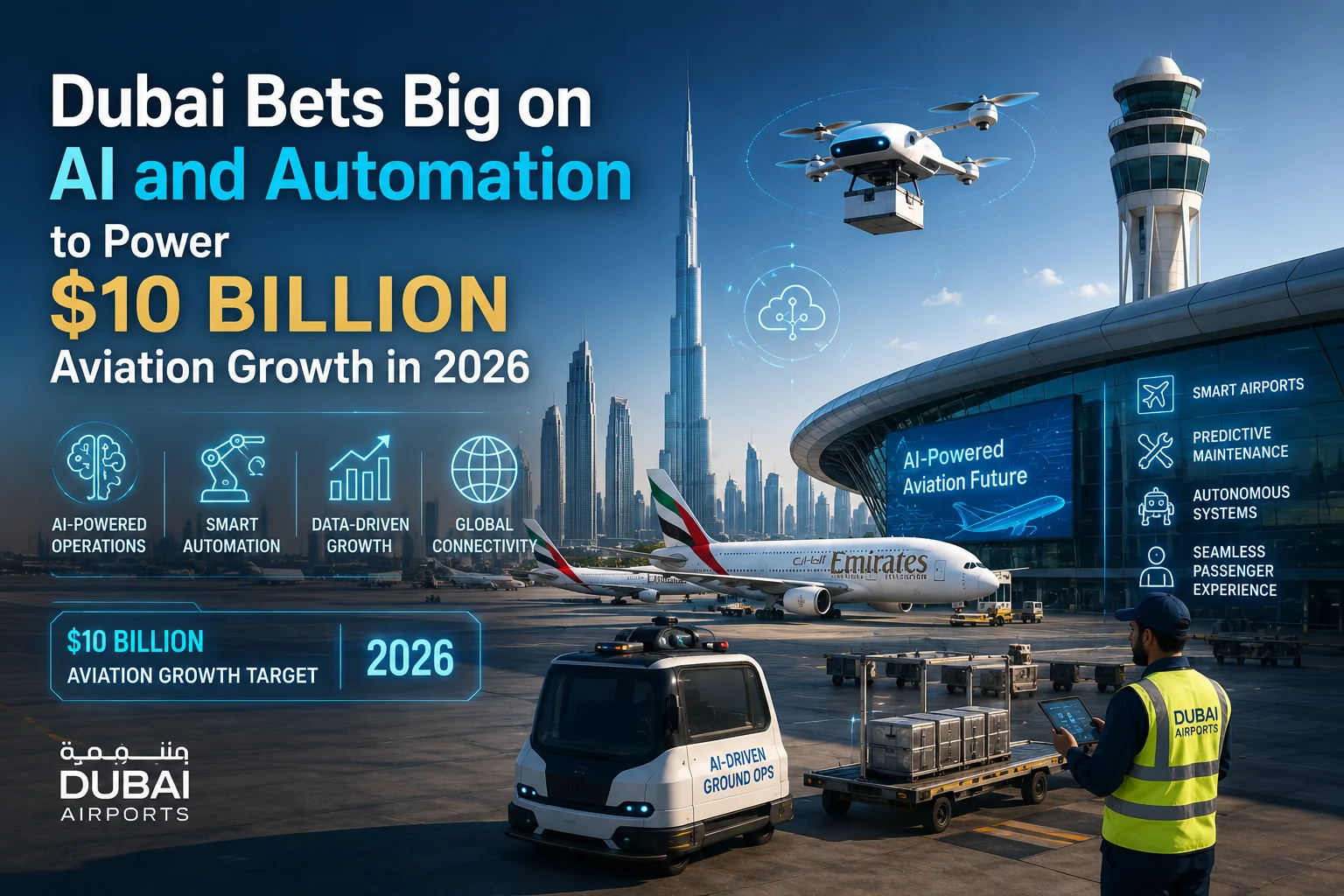
When the world’s busiest international airport starts rebuilding its operations around artificial intelligence, the signal is less about technology and more about capacity economics. Dubai is now channelling strategic investment into smart technologies across its aviation ecosystem, a move that ties digital infrastructure directly to the emirate’s long-term traffic and revenue ambitions.
The push centres on automation, AI-driven operations, and advanced data analytics deployed across airport workflows. The goal is straightforward: handle significantly more passengers without proportionally increasing physical footprint or headcount, while keeping the experience frictionless for travellers passing through one of the world’s most connected hubs.
What Smart Aviation Means for Dubai and the Wider MENA Region
Dubai International Airport has held its position as the busiest airport globally for international passengers for over a decade. That status, however, comes with a structural challenge. Passenger volumes have been climbing steadily, and the physical constraints of terminal space, runway slots, and ground handling create bottlenecks that concrete alone cannot solve.
This is where smart technologies enter the equation. By integrating AI into scheduling, baggage handling, security screening, and passenger flow management, Dubai aims to extract more throughput from existing infrastructure. Automation reduces manual processing times at check-in, immigration, and boarding gates, while data analytics allows operations teams to predict congestion and reallocate resources in real time.
For the MENA region, Dubai’s approach sets a benchmark. Aviation is a critical economic pillar across the Gulf, and the digital transformation of airport operations has implications for Abu Dhabi, Riyadh, and Doha as they compete for transit traffic and airline partnerships. The emirate’s willingness to invest early in these systems gives it a structural advantage that compounds over time.
Dubai’s Aviation Technology Strategy Takes Shape
The strategy places digital transformation at the core of Dubai’s next aviation development phase. Rather than treating technology as a support function, the emirate is positioning it as the primary driver of capacity expansion and operational resilience.
Three pillars define the approach. First, automation across passenger-facing touchpoints reduces processing times and staffing dependencies. Second, artificial intelligence applied to flight scheduling, maintenance prediction, and security operations improves decision-making speed. Third, data analytics platforms aggregate information from across the airport ecosystem to identify inefficiencies before they become service failures.
This is not a single procurement or a one-off upgrade. The investment reflects a phased, long-term commitment to embedding technology into every layer of airport operations. It aligns with Dubai’s broader economic vision, which treats aviation not as a standalone sector but as connective tissue linking tourism, trade, logistics, and financial services.
| Technology Area | Application | Expected Impact |
|---|---|---|
| Artificial Intelligence | Flight scheduling, predictive maintenance, security | Faster decision-making, reduced delays |
| Automation | Check-in, immigration, baggage handling | Lower processing times, higher throughput |
| Data Analytics | Passenger flow, resource allocation, congestion prediction | Real-time operational adjustments |
| Digital Infrastructure | Integrated airport management platforms | System-wide visibility and coordination |
How the Technology Actually Works at Scale
I find it useful to think of a modern smart airport as a logistics network rather than a building. Every passenger, bag, aircraft, and ground vehicle generates data. The value of AI and analytics lies in connecting those data streams so that the airport operates as a single coordinated system rather than a collection of independent processes.
Consider passenger flow management. Traditional airports react to congestion after it forms. An AI-driven system monitors queue lengths, boarding gate status, retail dwell times, and flight schedules simultaneously, then adjusts staffing levels, opens additional lanes, or redirects passengers through less crowded routes before bottlenecks develop.
Predictive maintenance works on a similar principle. Rather than servicing equipment on fixed schedules, sensors and machine learning models identify when a baggage conveyor or air bridge is likely to fail, triggering maintenance before a breakdown disrupts operations. The cost savings are meaningful, but the real value is in avoided delays and the passenger experience that remains intact.
What This Does Not Change
Smart technologies improve efficiency within existing infrastructure, but they do not eliminate the need for physical expansion. Dubai’s long-term aviation plans still require significant capital investment in terminal construction, runway capacity, and ground transport links. Technology extends the useful life of current assets and buys time, but it is not a substitute for steel and concrete when demand crosses certain thresholds.
There are also limits to what automation can achieve in a regulated environment. Immigration, customs, and security processes are governed by national and international rules that constrain how far digital systems can replace human oversight. Regulatory alignment across jurisdictions remains a slow-moving process, and Dubai’s technology ambitions will need to operate within those boundaries.
Who Benefits and When
Airlines operating through Dubai stand to gain from reduced turnaround times and more predictable scheduling. Passengers benefit from shorter queues and fewer manual touchpoints. For the emirate’s economy, the payoff is indirect but substantial: a more efficient airport supports higher visitor volumes, which feeds into hospitality, retail, and real estate revenue. The timeline is progressive rather than immediate, with incremental improvements compounding over the next several years as systems mature and integrate.
Aviation Technology Becomes a Competitive Moat for Gulf Hubs
I see this investment as part of a broader pattern across the Gulf. Aviation hubs in the region are no longer competing solely on route networks and airline partnerships. The next layer of competition is operational intelligence, the ability to move more people more efficiently through the same physical space. Dubai’s early commitment to AI and automation positions it to maintain its lead as regional rivals invest heavily in new airports and expanded capacity. The technology gap, once established, is difficult to close because the data advantages and operational learning compound with each year of deployment.
If you are tracking aviation investment trends in the MENA region, Dubai’s smart technology push is worth watching closely. The returns will not show up in a single quarterly report, but the structural advantage it builds will shape competitive dynamics across Gulf aviation for the rest of this decade.