
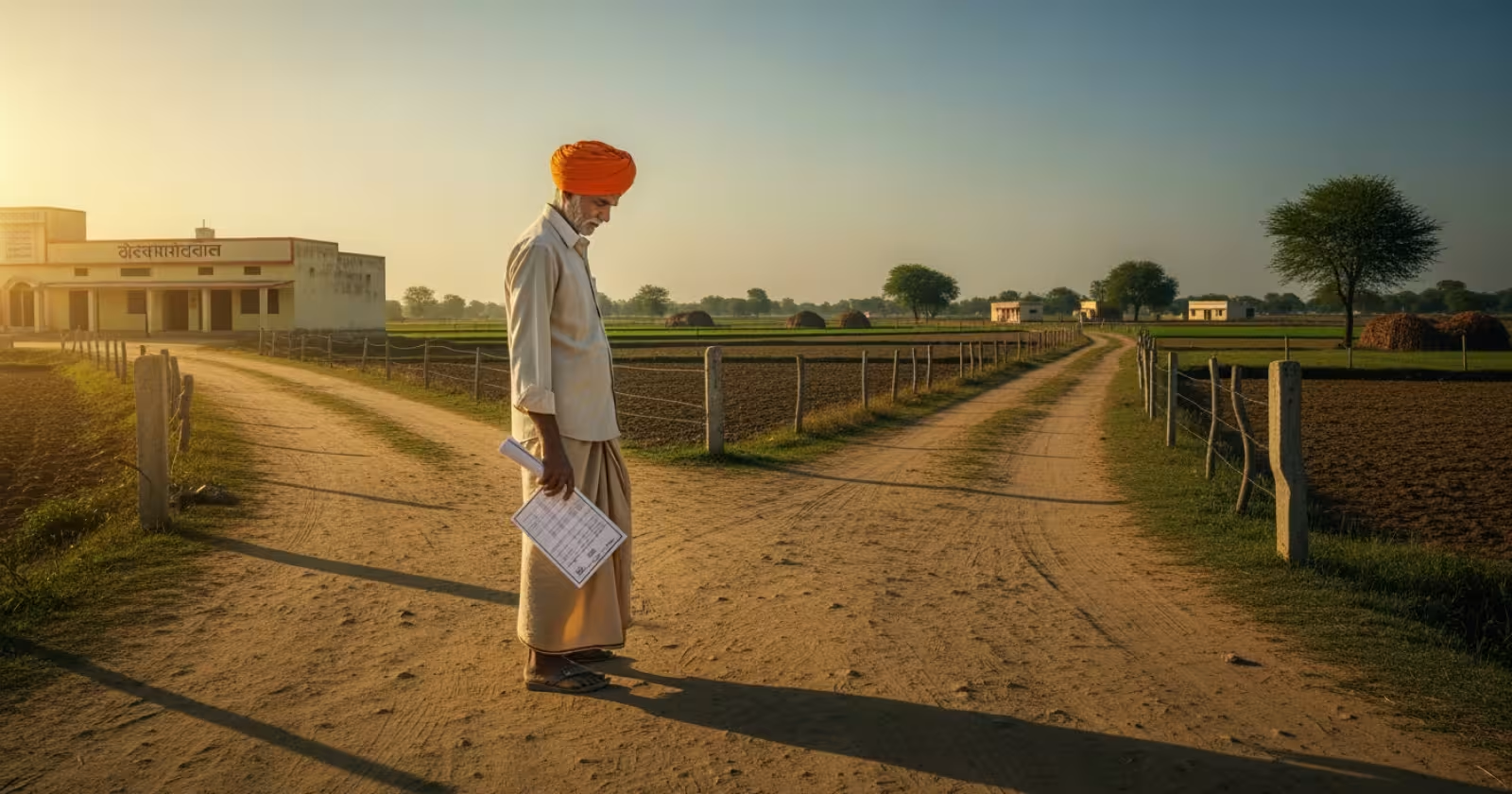
In Sangli district, Maharashtra, a dairy cooperative with 1,200 members spent nearly three years trying to purchase 14 acres of agricultural land for a fodder cultivation unit. They had the funds — approximately ₹85 lakh pooled from member contributions and an NCDC subsidy. They had the willing seller. What they did not have was legal clarity on whether a cooperative society registered under the Maharashtra Cooperative Societies Act could actually hold agricultural land in its own name. The sub-registrar’s office bounced them twice. The cooperative’s secretary told a local reporter the process felt like “fighting a law that nobody fully understands.”
Why This Question Haunts Thousands of Cooperatives
This is not an isolated confusion. Across India, I’ve found that cooperative societies — from primary agricultural credit societies to large dairy unions — routinely stumble over one deceptively simple question: can we own farmland? The answer, frustratingly, is not uniform. Land is a State subject under the Indian Constitution’s Seventh Schedule. Each state drafts its own land reform legislation, tenancy laws, and ceiling acts. What is perfectly legal for a cooperative in Punjab may be outright prohibited in Karnataka.
The Ministry of Cooperation, established in 2021, has pushed for harmonisation of cooperative laws, but land ownership rules remain firmly in state hands. With over 8.5 lakh cooperative societies registered across India as of 2026, and the government’s ambitious plan to strengthen PACS (Primary Agricultural Credit Societies) into multi-service centres, the land ownership question has become more urgent than ever.
The Legal Roots: How Land Reform Shaped Cooperative Land Rights
To understand why states differ so sharply, I need to take you back to the 1950s and 1960s. Post-independence India enacted sweeping land reforms — abolishing zamindari, imposing ceiling limits, and redistributing surplus land to landless tillers. The intent was noble: break feudal concentration of agricultural land.
But cooperatives got caught in an awkward middle ground. Most land reform acts defined “person” narrowly. Some states explicitly included cooperative societies in the definition of entities that could hold agricultural land. Others did not. A few states — worried that cooperatives could become a loophole for landlords to dodge ceiling laws — actively restricted cooperative land ownership.
The Maharashtra Tenancy and Agricultural Lands Act, 1948, for instance, allows certain cooperative societies (particularly farming cooperatives and sugarcane cooperatives) to hold agricultural land, but with conditions tied to the land ceiling limits. The Karnataka Land Reforms Act, 1961, on the other hand, has been far more restrictive — treating cooperative societies similarly to “non-agriculturist” entities in several provisions. In Punjab and Haryana, cooperative farming societies have historically enjoyed relatively easier land acquisition rights under the Punjab Land Reforms Act, 1972, partly because the Green Revolution era demanded collective farming infrastructure.
The result in 2026 is a patchwork. No single central law governs whether a cooperative can buy, lease, or hold agricultural land.
State-by-State Reality: Where Cooperatives Can and Cannot Own Farmland
Let me break this down with the most relevant states. The table below summarises the broad legal position — though I must stress that specific provisions, exemptions, and recent amendments can alter the picture significantly.
| State | Can Cooperatives Own Agricultural Land? | Key Condition / Restriction |
|---|---|---|
| Maharashtra | Yes, with conditions | Subject to ceiling limits; farming and sugar cooperatives have clearer pathways |
| Karnataka | Restricted | Non-agriculturist restrictions apply; prior government permission often required |
| Gujarat | Yes, with conditions | Dairy and farming cooperatives can hold land for allied agricultural purposes |
| Punjab | Yes | Cooperative farming societies permitted; ceiling norms apply collectively |
| Kerala | Highly restricted | Kerala Land Reforms Act imposes strict ceiling; cooperative exemptions are narrow |
| Uttar Pradesh | Yes, with permission | Requires District Magistrate or state-level approval in many cases |
| Rajasthan | Yes, with conditions | Cooperative farming societies recognised; grazing and fodder land provisions exist |
| Tamil Nadu | Restricted | Land ceiling and tenancy laws limit direct ownership; leasing is more common |
The critical detail many cooperative administrators miss is that even in “permissive” states, the cooperative must typically demonstrate that the land purchase serves the cooperative’s registered objectives. A housing cooperative cannot simply buy agricultural land for farming. A dairy cooperative buying land for a fodder plot has a stronger legal footing than the same cooperative buying land for speculative purposes.
The Challenges That Make Land Ownership a Minefield
Beyond the legal text, practical hurdles are enormous. First, revenue department officials at the taluk level often lack clarity on cooperative land provisions. I’ve heard from cooperative secretaries in at least three states that sub-registrars refused to register sale deeds simply because they were unsure whether a cooperative qualified as a “person” under the local land revenue code.
Second, political interference complicates matters. In states like Maharashtra and Karnataka, sugar cooperatives — which are deeply entangled with electoral politics — have historically accumulated large landholdings. This has made state governments cautious about expanding cooperative land rights, fearing misuse.
Third, the land ceiling question itself is tricky for cooperatives. If a cooperative has 500 members, is the ceiling calculated per member or for the cooperative as a single entity? States answer this differently. In some jurisdictions, the cooperative is treated as one unit with a single ceiling limit — which severely restricts how much land it can hold. In others, the aggregate of members’ existing holdings is factored in.
Finally, there is the issue of tribal and scheduled area land. In states like Jharkhand, Chhattisgarh, and parts of Odisha, the Chota Nagpur Tenancy Act and similar protective legislation prohibit transfer of tribal land to non-tribal entities — and cooperatives with mixed membership may fall foul of these protections.
What Gujarat’s Dairy Cooperatives Got Right
Gujarat offers perhaps the most instructive case study. The state’s dairy cooperative network — anchored by the Gujarat Cooperative Milk Marketing Federation (Amul) and its district unions — has long held agricultural land for cattle feed cultivation, fodder farms, and processing infrastructure. The Gujarat government, recognising that dairy cooperatives needed land access to remain competitive, created relatively clear provisions under both the Gujarat Tenancy and Agricultural Lands Act and the state cooperative societies rules.
The result is that district-level dairy unions in Anand, Mehsana, and Sabarkantha own or lease significant agricultural parcels — legally, transparently, and productively. This model has been cited by NABARD in multiple reports as a template for other states to follow. The key ingredient was not just legal permission but administrative simplicity — a cooperative could approach the District Registrar with a defined land-use plan and receive approval within a reasonable timeframe.
What Comes Next: Policy Shifts on the Horizon
The Ministry of Cooperation’s push to convert PACS into multi-service cooperatives — offering everything from credit to input supply to storage — will inevitably force the land question into sharper focus. A PACS that wants to build a warehouse or a custom hiring centre needs land. If agricultural land is the only affordable option in a rural setting, the legal pathway must be clear.
Several state governments are reportedly reviewing their land reform provisions as part of the broader National Cooperation Policy expected to be finalised in 2026. There is also growing discussion around allowing cooperatives to lease agricultural land on long-term agreements (15-30 years) without ownership transfer — a middle path that addresses ceiling concerns while giving cooperatives operational security.
Technology may help too. The digitisation of land records under the Digital India Land Records Modernisation Programme could make it easier for cooperatives to establish clear title and for revenue departments to verify compliance with ceiling norms.
Back to Sangli: What Happened to That Dairy Cooperative
The Sangli dairy cooperative eventually managed to register its land purchase — but only after engaging a lawyer specialised in cooperative law, obtaining a no-objection certificate from the District Deputy Registrar of Cooperatives, and waiting out a bureaucratic process that took 34 months from start to finish. The fodder unit is now operational and serves approximately 800 member households.
Their story captures the state of cooperative land ownership in India perfectly: it is possible, but needlessly difficult. If you are part of a cooperative society exploring agricultural land acquisition, my strong advice is to start with your state’s specific land reform act, consult a cooperative law specialist, and engage your District Registrar early. The legal landscape is shifting — and cooperatives that understand it will be the ones that thrive.