
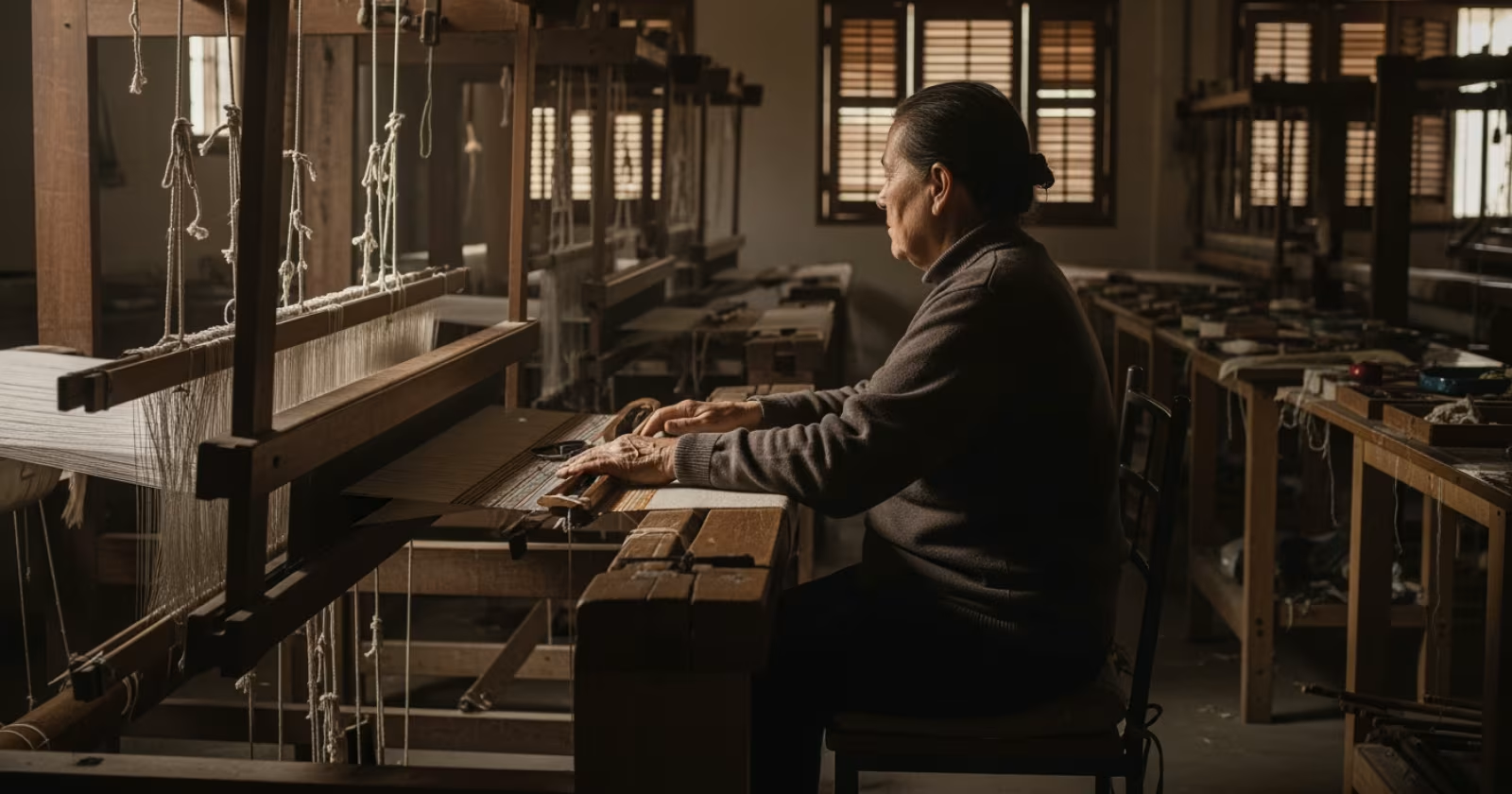
In a narrow lane behind Jaipur’s Sanganer bypass, Ramlal Meena sits before a wooden loom that his grandfather built in 1971. His fingers move mechanically, knotting wool into a pattern he has repeated for thirty years. But the order pinned to his wall — a single 6×9 carpet for a Delhi exporter — is the only work he has received in four months. Two years ago, he earned approximately ₹12,000 a month. Today, he is lucky to clear ₹4,500. His eldest son left for a construction site in Gurugram last winter and has no intention of returning to the loom.
Ramlal’s story is not exceptional. It is the norm across Jaipur’s carpet-weaving clusters, where an entire generation of artisans is quietly walking away from a craft that once defined Rajasthan’s export identity.
Why Jaipur’s Carpet Weavers Matter Beyond Jaipur
India‘s handmade carpet and rug exports were valued at approximately ₹8,400 crore in 2024-25, according to the Carpet Export Promotion Council. Rajasthan, alongside Uttar Pradesh and Kashmir, has historically been one of the three pillars of this industry. Jaipur district alone housed an estimated 15,000 active looms at its peak in the early 2000s. Industry observers now put that number closer to 6,000 — and falling.
The decline matters not just for heritage reasons but for rural employment. Each active loom supports between two and four workers directly, plus ancillary jobs in wool processing, dyeing, and finishing. When a loom goes silent, an entire micro-economy collapses around it.
A Craft Born from Royal Patronage and Export Ambition
Hand-knotted carpet weaving arrived in Jaipur through Mughal artisan migrations in the 16th and 17th centuries. The craft flourished under royal patronage from the Kachhwaha rulers, who commissioned elaborate durbar carpets. But the modern industry took shape in the 1970s and 1980s, when Jaipur became a hub for export-oriented carpet production. Entrepreneurs — many of them not weavers themselves — set up putting-out networks where rural households wove carpets on contract for urban exporters.
By the 1990s, Jaipur’s carpet belt stretched across Sanganer, Achrol, Chomu, and parts of Jaipur Rural district. The city’s exporters shipped hand-knotted rugs to the United States, Germany, and the UK. At its peak, the cluster employed an estimated 60,000 people directly and indirectly. Several cooperative societies were registered during this period, though most functioned as loose aggregation points rather than genuine member-owned enterprises.
The early cooperative attempts largely failed because they replicated the middleman model. Weavers had no real say in pricing, design selection, or profit distribution. The cooperatives existed on paper for subsidy access, not for collective bargaining.
The Economics of Decline — How the System Works Against Weavers in 2026
I spent time understanding the economics, and they are brutal. A skilled weaver working on a hand-knotted wool carpet of 120-knot density can complete roughly one square foot per day. A standard 6×9 carpet takes three to four months of continuous work. The exporter pays the weaver between ₹15,000 and ₹25,000 for a finished piece, depending on complexity. That same carpet sells in a European retail showroom for anywhere between ₹1.5 lakh and ₹4 lakh.
The weaver captures, at best, 10-15% of the final retail value. The rest is absorbed by the contractor, exporter, shipping agent, and retailer. This is not a new problem — it has defined the putting-out system for decades. What has changed is the competitive landscape.
Machine-made carpets from China and Belgium now flood the mid-range market at a fraction of the cost. Meanwhile, hand-tufted rugs — which are faster and cheaper to produce — have eaten into the demand for genuine hand-knotted work. Many exporters have quietly shifted their production to tufted rugs, leaving hand-knotting weavers without orders.
| Factor | Hand-Knotted (Jaipur) | Machine-Made (Imported) |
|---|---|---|
| Production time (6×9 rug) | 3-4 months | 1-2 days |
| Weaver/operator wage per piece | ₹15,000-₹25,000 | ₹2,000-₹3,000 |
| Retail price (Europe) | ₹1.5-4 lakh | ₹20,000-₹60,000 |
| Durability | 50-80 years | 10-15 years |
| Export demand trend (2020-2026) | Declining | Growing |
Add to this the generational shift. Young weavers see no dignity or financial security in the craft. A construction labourer in Jaipur city earns ₹500-600 per day with immediate cash payment. A weaver earns less, with payment delayed until the carpet is completed and accepted.
What a Genuine Cooperative Could Change
The Jaipur Rugs Foundation, though technically a social enterprise and not a registered cooperative, has demonstrated one possible model. It connects approximately 40,000 artisans across Rajasthan and other states directly to global markets, cutting several middlemen from the chain. Weavers reportedly earn 20-30% more than those working through traditional contractors.
But a true cooperative — one registered under the Multi-State Cooperative Societies Act or the Rajasthan Cooperative Societies Act — would go further. It would give weavers ownership, voting rights on pricing, and access to institutional credit through NABARD and NCDC channels that individual artisans cannot tap.
The Ministry of Cooperation, established in 2021, has been pushing to strengthen Primary Agricultural Credit Societies (PACS) as multi-service centres. There is growing discussion about extending this model to artisan clusters. If PACS in Jaipur’s carpet belt could offer weavers working capital loans, raw material procurement at wholesale rates, and collective marketing — the economics shift dramatically.
A weaver cooperative that buys wool directly from Bikaner’s sheep farming cooperatives, for instance, could reduce raw material costs by an estimated 15-20%. Collective branding and a GI Tag application for Jaipur hand-knotted carpets could unlock premium pricing in export markets.
The Challenges No One Wants to Talk About
I would be dishonest if I painted cooperatives as a silver bullet. The Rajasthan cooperative sector has a troubled history of political capture and administrative lethargy. Several handloom cooperatives in the state have been defunct for years, surviving only as names in registrar records.
The carpet exporter lobby in Jaipur is powerful and has little incentive to support a cooperative that would bypass their role. Weavers themselves, after decades of dependency on contractors, often lack the confidence or financial literacy to manage a collective enterprise. Trust deficits run deep — many weavers have been cheated by previous cooperative ventures that collected contributions and delivered nothing.
Climate is another emerging threat. Rajasthan’s increasing temperatures are making it physically harder to weave for long hours in poorly ventilated homes. Water scarcity is affecting the dyeing process. These are not abstract future risks — they are present realities in 2026.
A Model from Across the Border — and Across the State
Morocco’s carpet cooperatives, particularly in the Atlas Mountain regions, offer an instructive comparison. Women-led weaving cooperatives there have successfully branded Amazigh carpets as luxury artisanal products, commanding prices of $2,000-$5,000 per piece in European markets. The key was collective branding, direct-to-consumer online sales, and international fair-trade certification.
Closer to home, the Kota Doria weavers’ cooperative in Kaithoon, Rajasthan, has shown modest success in sustaining a traditional textile through cooperative organisation, though it too faces membership decline. The lessons are clear: cooperatives work when they solve a real market access problem, not when they are imposed top-down for subsidy capture.
What the Next Five Years Will Decide
The NCDC has allocated increased funding for artisan cooperatives under its current plan cycle. The National Handloom Mission and Craftmark certification offer additional scaffolding. If even two or three genuine weaver-owned cooperatives emerge in Jaipur’s carpet belt by 2028 — with proper governance, digital market access, and NABARD credit linkage — they could serve as proof of concept for the entire sector.
Technology is part of the answer. Digital design tools can allow weavers to take custom orders directly from international buyers. Blockchain-based provenance tracking — already being piloted for Kashmiri carpets — could authenticate Jaipur’s hand-knotted products and justify premium pricing.
But the window is narrow. Every year that passes without intervention means more looms dismantled, more skills lost, more young people who will never learn the 120-knot technique.
Back to Ramlal’s Loom
When I think about Ramlal Meena in Sanganer, what strikes me is not just the financial hardship. It is the loneliness of practising a craft that the market no longer seems to value. He told a local reporter last year that he would join a cooperative tomorrow if one existed that actually paid on time and let him have a say in what he weaves.
That is not a complicated demand. It is, in fact, the most basic promise of the cooperative movement — dignity through collective ownership. Whether Jaipur’s carpet weavers get that chance before it is too late will say a great deal about whether India’s cooperative revival is real or merely rhetorical. The looms are waiting. The question is whether anyone is listening.