
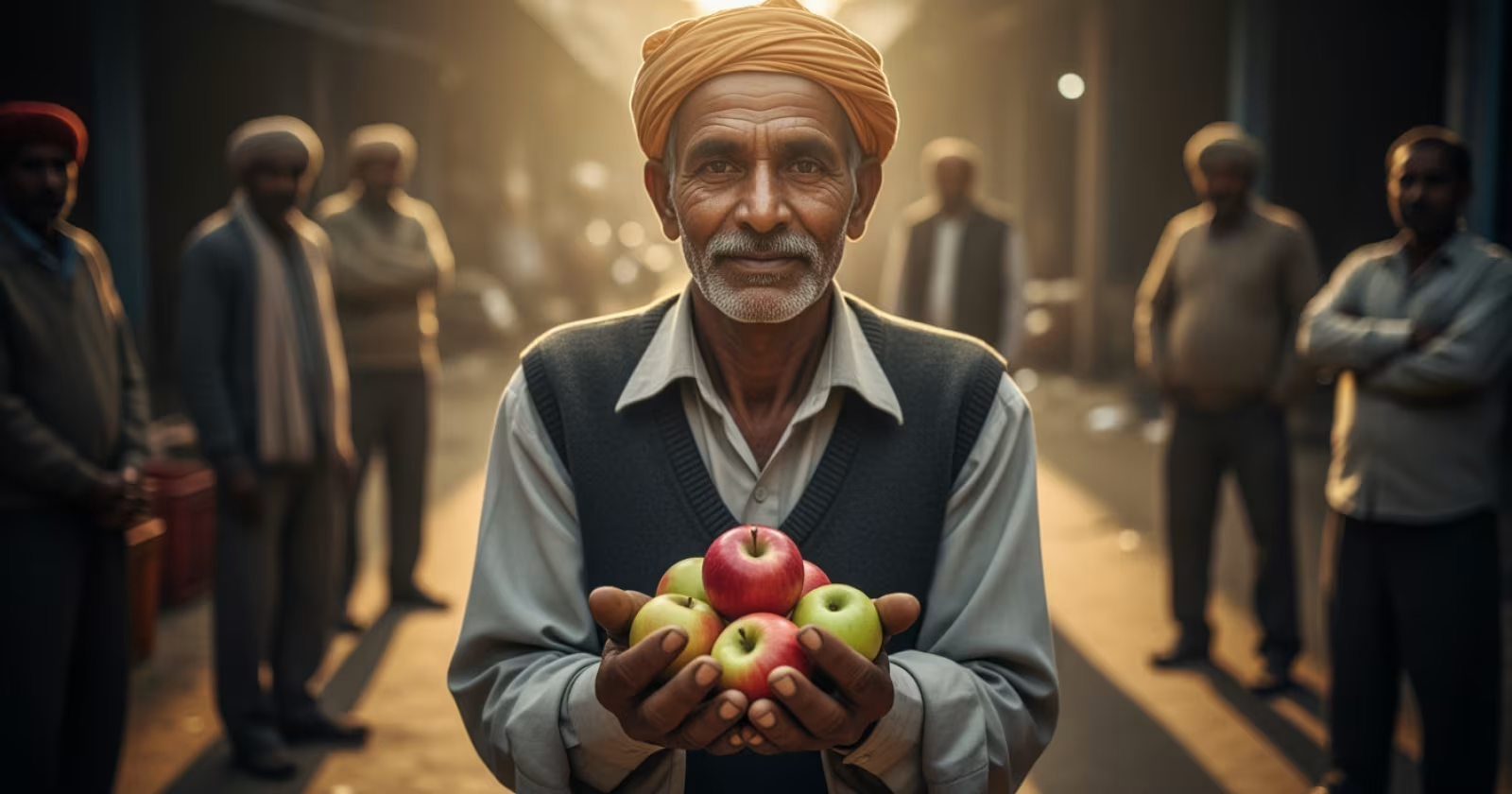
In the autumn of 2023, a small-holding apple farmer in Kotkhai, Shimla district, watched a commission agent in Delhi’s Azadpur Mandi sell his Royal Delicious apples at ₹120 per kilogram — while he had received just ₹38 per kg at the farm gate. The arithmetic was brutal: the middleman chain swallowed roughly 60% of the final consumer price, leaving the person who actually grew the fruit with barely enough to cover inputs. That farmer’s name was among the first 200 to join a restructured fruit growers’ cooperative that would, within two seasons, change the equation entirely.
I have been tracking the cooperative movement in India‘s hill states for years, and what happened next in Himachal’s apple belt is one of the most compelling turnaround stories I have encountered. It is not a story of government subsidy alone — it is a story of growers choosing collective bargaining over individual helplessness.
Why the Apple Economy Matters Beyond Himachal
Himachal Pradesh produces approximately 4-5 lakh metric tonnes of apples annually, contributing to nearly ₹5,000 crore in farm-gate value. The state accounts for roughly 25% of India’s total apple production, second only to Jammu & Kashmir. But for decades, the value chain has been one of India’s most extractive agricultural supply chains. Apples move from orchard to local aggregator, then to the arhtiya (commission agent) network in mandis across North India — each layer adding cost and stripping grower margins.
The cooperative intervention here is not merely a feel-good narrative. It is a direct challenge to entrenched trade monopolies and a test case for whether India’s cooperative infrastructure — championed by the Ministry of Cooperation since its creation in 2021 — can actually deliver at scale in perishable commodity markets.
The Roots of Collective Action in the Apple Belt
Cooperative fruit marketing in Himachal is not new. The Himachal Pradesh Horticultural Produce Marketing and Processing Corporation (HPMC), established in 1974, was among the earliest state interventions to provide growers a direct selling platform. Similarly, HIMFED (Himachal Pradesh State Cooperative Marketing and Consumers’ Federation) has operated as a nodal cooperative body for decades.
But for years, these institutions suffered from the same disease that plagues cooperatives across India: political patronage, bureaucratic management, and a failure to match the speed and flexibility of private traders. By the 2010s, HPMC’s market share in apple procurement had dwindled. Private traders and commission agents filled the vacuum. The arhtiya network in Azadpur, Chandigarh’s Sector 26 mandi, and Lucknow became the de facto price setters.
The turning point came around 2021-2022, when several village-level Primary Agricultural Credit Societies (PACS) in Shimla and Kullu districts were repurposed with a broader mandate. Under guidance from NABARD and the National Cooperative Development Corporation (NCDC), these PACS began functioning as aggregation and marketing nodes specifically for apple growers. The idea was elegantly simple: if 200 small growers pooled their produce, they could bypass two layers of middlemen entirely.
How the Cooperative Model Actually Works
I visited the Theog-Kotkhai belt in late 2026 to understand the mechanics. Here is what the restructured cooperative does differently from the old system:
First, grading and packaging happen at the cooperative level. Members bring their harvest to a common facility — often a repurposed community hall or a newly built pack house funded through NCDC grants. Trained sorters grade apples into A, B, and C categories using basic but effective manual-plus-machine systems. This alone adds ₹8-12 per kg in realisable value, because graded produce commands a premium that loose, ungraded boxes never do.
Second, direct linkages to institutional buyers and modern retail. The cooperative markets collectively to buyers including Reliance Fresh, Mother Dairy, and NAFED’s own retail network. By presenting consolidated volumes — often 40-50 tonnes per lot — they negotiate prices that no individual grower could.
Third, cold storage access. Cooperatives in Rohru and Narkanda have invested in controlled atmosphere (CA) storage units, some supported by NABARD’s warehouse infrastructure fund. Storing apples for even 8-10 weeks post-harvest allows growers to sell in December-January when prices are 30-40% higher than the glut-season rates of September.
| Parameter | Before Cooperative (Individual Selling) | After Cooperative Intervention |
|---|---|---|
| Average farm-gate price (₹/kg) | ₹35-42 | ₹62-78 |
| Middlemen layers | 3-4 | 0-1 |
| Post-harvest loss | 18-22% | 8-10% |
| Payment cycle | 30-60 days | 7-15 days |
| Grading at source | Rare | Standard practice |
| Cold storage access | Less than 10% of growers | Approximately 45% of members |
The numbers speak clearly. Cooperative members in pilot clusters reported an average income increase of 65-80% per season compared to their pre-cooperative earnings. The cooperative retains a modest 4-6% commission — a fraction of the 25-35% that traditional arhtiyas charged.
What Threatens This Progress
I would be dishonest if I painted this as a clean victory. Several structural problems persist. First, not all cooperatives are equally functional. In some blocks of Mandi and Kullu, cooperatives exist on paper but lack active management. Political interference — local leaders attempting to capture cooperative boards — remains a real risk, particularly ahead of state elections.
Second, climate change is an existential threat to the apple economy itself. Apple cultivation zones are shifting upward in altitude. Traditional growing areas like Kotkhai, at 1,800-2,000 metres, are experiencing warmer winters with insufficient chill hours. Estimates suggest that Himachal could lose 15-20% of its viable apple-growing area by 2035 unless high-density, low-chill varieties are adopted aggressively.
Third, competition from imported apples — particularly from Turkey, Iran, and Washington State — continues to depress domestic prices. Indian tariff walls offer some protection, but quality gaps remain. If cooperatives do not invest in premium packaging and branding, they risk losing the urban consumer to imports even within India.
What Kinnaur’s Cherry Cooperative Teaches Us
A useful comparison sits within Himachal itself. In Kinnaur district, a small cherry growers’ cooperative has achieved something remarkable: branded direct-to-consumer sales via e-commerce. Using a cooperative-owned brand, they sell Kinnauri cherries online at ₹800-1,200 per kg, with growers receiving 70% of the sale price after logistics and packaging costs. The volumes are tiny — perhaps 15-20 tonnes per season — but the margin structure is revolutionary for Indian horticulture.
The apple cooperatives in Shimla district are now studying this model. If they can create a recognisable Himachali apple brand — think of it as a “Nandini for apples,” borrowing from Karnataka’s dairy cooperative branding success — the value capture could shift permanently toward growers. NCDC has reportedly sanctioned funds for a cooperative branding pilot in 2026.
The Road to 2030
Several policy tailwinds favour this movement. The Ministry of Cooperation’s push to convert PACS into multi-service centres means apple cooperatives can offer members not just marketing, but also input supply, crop insurance linkage, and micro-credit — all under one roof. The NCDC has earmarked over ₹1,000 crore nationally for horticultural cooperative development in the current plan period.
Technology adoption will be decisive. Cooperatives that invest in AI-based grading, blockchain-enabled traceability (increasingly demanded by export markets), and solar-powered cold storage will survive and thrive. Those that remain dependent on government grants without building operational self-sufficiency will fade. I estimate that by 2030, the successful cooperative clusters in Himachal could control 20-25% of the state’s apple trade — up from an estimated 8-10% in 2026.
Back to the Orchard
That Kotkhai farmer I mentioned at the start? By the 2026 season, his cooperative membership meant he sold his Royal Delicious at ₹71 per kg — nearly double what he earned two years prior. He still complains, as farmers rightly do, that input costs keep rising and the weather is unpredictable. But for the first time in a decade, he told a local reporter, he did not need to take a loan to fund the next season’s spraying schedule.
His story is not unique, but it is not yet universal either. The cooperative model works — the data from Himachal proves it. The question now is whether India’s institutional machinery can scale it before the middlemen adapt, before climate change narrows the window, and before another generation of hill farmers decides that apples are simply not worth the trouble.
If you are involved in any cooperative — agricultural or otherwise — I encourage you to study Himachal’s apple model closely. Share this story with fellow cooperative members, reach out to your district PACS office, and explore how collective marketing can transform your own sector. The cooperative movement succeeds only when people choose to participate.