
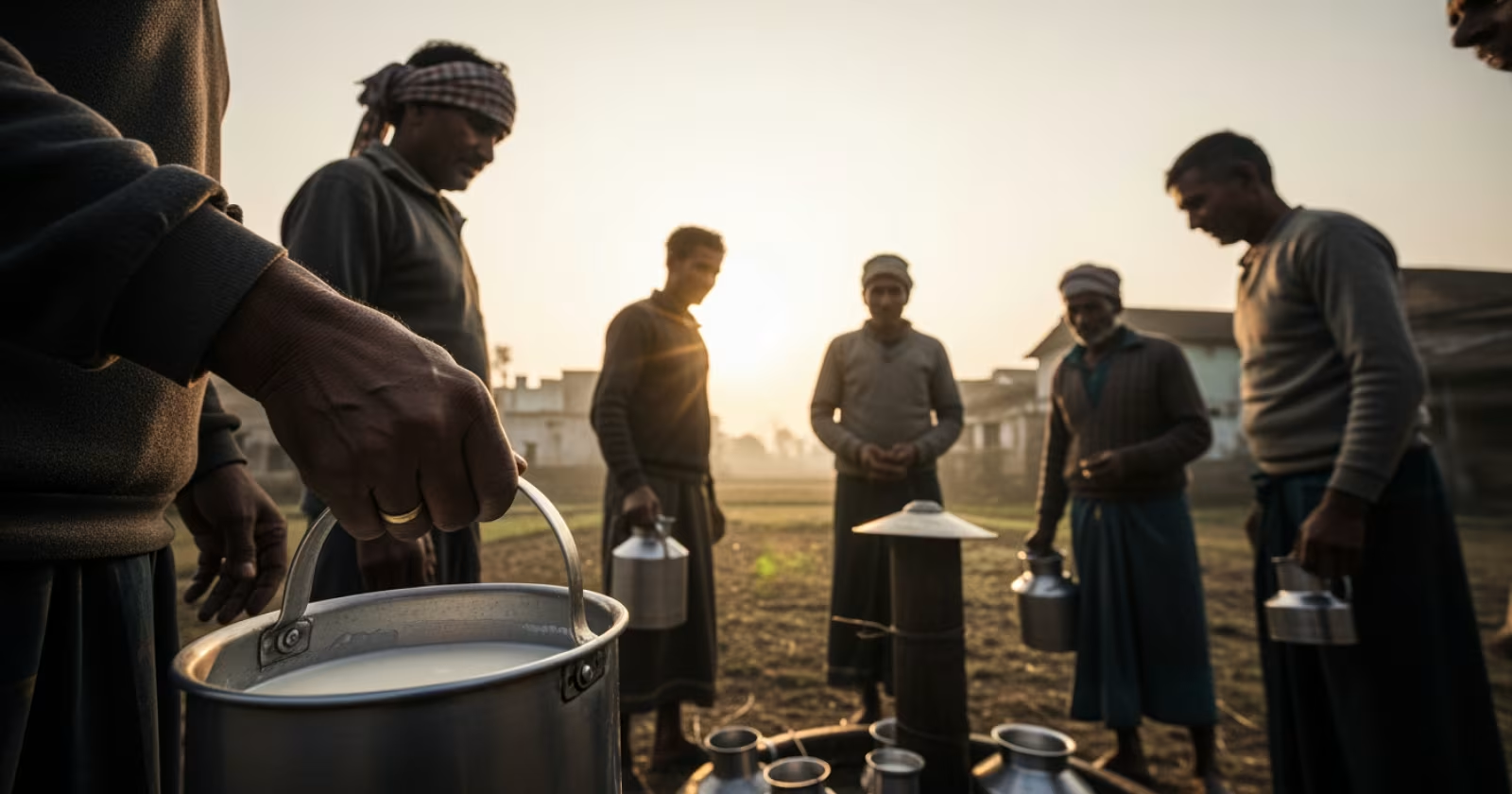
Before most of India wakes up, a chain of 3.6 million dairy farmers has already set the morning in motion. Every glass of milk, every cup of chai, every cube of butter on a breakfast plate carries the quiet fingerprints of one of the most consequential economic experiments any democracy has ever attempted — and almost nobody outside of Gujarat knows exactly how it started.
The story begins not in a ministry or a boardroom but in the small town of Anand in Gujarat in 1946. A group of farmers, fed up with exploitation by private milk contractors who dictated prices and then ignored quality claims, handed their milk to a newly formed cooperative called the Kaira District Cooperative Milk Producers’ Union — the organization the world would eventually come to know as AMUL. What began as a protest became the foundation of an empire built entirely on principle rather than private profit.
The Man Who Refused to Let Farmers Stay Poor
Dr. Verghese Kurien arrived in Anand in 1949 as a young engineer trained in Michigan who wanted nothing more than to leave and build a career elsewhere. He stayed for over five decades and changed the nutritional architecture of a nation. Kurien recognized early that the farmer — not the trader, not the processor — had to sit at the apex of the value chain. He built AMUL into a structure where every village society owned the dairy plant above it and every district union owned the marketing federation above that.
By the time Operation Flood launched in 1970, Kurien had turned a district-level cooperative into a national blueprint for dairy development. Funded in part by the European Economic Community’s gift of surplus butter and skimmed milk powder, Operation Flood used the proceeds from selling those donated commodities to construct a nationwide network of cold chains, processing plants, and village-level collection centers. It ran in three phases and concluded in 1996, by which point India had crossed from being a milk-deficit country to the world’s largest milk producer — a reversal that still stuns agricultural economists who study it.
A Structure That Works Differently From Anything Else
What makes the cooperative model fundamentally different from any private dairy company is the question of ownership. When a farmer sells milk to AMUL, he is not a vendor — he is a shareholder. The surplus earned after processing and sales flows back to the farmer in the form of annual bonuses and village development funds. In 2022-23, the Gujarat Cooperative Milk Marketing Federation, which markets AMUL products nationally and internationally, recorded a turnover exceeding ₹55,000 crore, making it India’s largest food products organization by revenue.
The network operates across more than 18,700 village-level dairy cooperative societies and processes roughly 30 million litres of milk every single day. That scale did not happen by accident. The National Dairy Development Board, established in 1965 and headquartered in Anand itself, was specifically tasked with replicating the AMUL model across every Indian state — training managers, funding infrastructure, and transferring processing technology to federations in states as different as Rajasthan, Odisha, and Tamil Nadu.
| Cooperative Federation | State | Brand Name | Daily Procurement (approx.) |
|---|---|---|---|
| GCMMF (AMUL) | Gujarat | Amul | 30 million litres |
| Karnataka Milk Federation | Karnataka | Nandini | 8.5 million litres |
| Mahanand Dairy | Maharashtra | Mahanand | 3 million litres |
| Milma | Kerala | Milma | 1.5 million litres |
| Saras | Rajasthan | Saras | 2.8 million litres |
India’s total milk production crossed 236 million metric tonnes in 2023-24, according to data from the Department of Animal Husbandry and Dairying. The cooperative sector accounts for the dominant share of that organized volume. No other country has built anything remotely comparable at this scale — not Brazil, not the United States, not any member of the European Union.
Where the Model Strains and Where It Still Fails
The romantic version of this story ends cleanly with every farmer prospering. Reality, as always, carries more friction. Many small farmers in states with weaker cooperative infrastructure still sell to private dairies at suppressed prices, with no share in downstream profits. The cooperative model works best where it has deep historical roots — Gujarat, Karnataka, and parts of Rajasthan — and it struggles significantly where political interference has hollowed out management structures over the decades.
Milk adulteration remains a stubborn problem that cooperatives have largely controlled within their own supply chains but cannot police beyond them. A 2021 survey by the Food Safety and Standards Authority of India found that a meaningful percentage of loose milk sold outside cooperative channels contained adulterants ranging from water to detergent. The cooperatives, by contrast, run ISO-certified testing laboratories and trace every batch from village collection point to processing floor — a quality assurance system that private informal sellers simply cannot replicate.
The Butter Girl Who Became a National Conscience
Few advertising campaigns in Indian history have matched the cultural endurance of the Amul girl — the round-faced, polka-dotted character who first appeared on billboards in 1967 and has been commenting on Indian politics, cricket, and social life ever since. Created by daCunha Communications, she has outlasted prime ministers and survived controversy precisely because she belongs to a farmer-owned institution rather than a shareholder-driven corporation. I find it remarkable that a cooperative born from agrarian protest became one of India’s most sophisticated communicators.
AMUL’s brand reach now extends to ice cream, chocolates, paneer, whey protein, and infant nutrition products — all processed in facilities owned by the same network of farmers who began with a simple refusal to accept exploitation in 1946. In 2026, as India manages the demands of a population approaching 1.5 billion, food security at this scale requires exactly the kind of distributed, community-owned infrastructure that Kurien spent his entire working life building and defending.
Every cup of chai brewed before sunrise, every block of butter placed on a breakfast table, traces back to this network of farmer-owners who decided decades ago that they would not be reduced to vendors in their own supply chain. I believe this cooperative structure is one of the most significant and least-discussed food security achievements of the modern era. The story is right there, printed on every packet of Amul milk — it just takes someone willing to read beyond the brand name and understand what actually built it.