
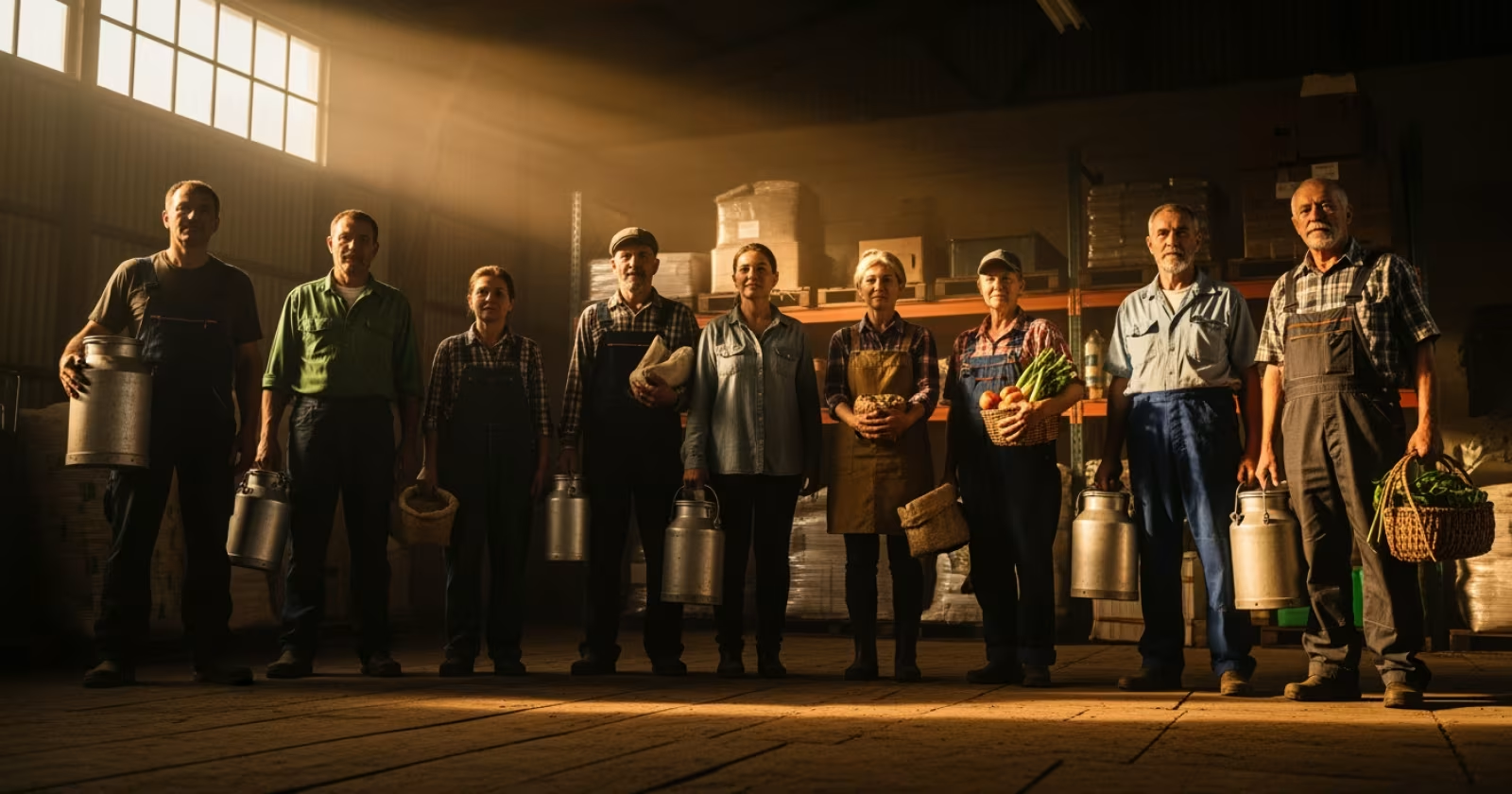
When AMUL’s annual turnover crossed ₹72,000 crore in the fiscal year ending 2026, most business desks treated it as a corporate milestone worth a paragraph. What they consistently missed is that AMUL is not a corporation — it is 3.6 million dairy farmers across Gujarat who collectively own every rupee of that figure, and that distinction changes the entire meaning of the number.
Cooperative trade — the model where producers pool resources, share risk, and distribute surplus among themselves — has been quietly driving income in villages that private equity, commercial banks, and startup accelerators have largely bypassed. It does not generate splashy funding announcements. It does not produce unicorns. What it produces is something rarer in the Indian context: sustained, locally retained wealth at scale.
The Dairy Village That Rewrote the Rules of Rural Income
The story of India’s cooperative movement is impossible to tell without Anand, a mid-sized town in Gujarat’s Kheda district. In 1946, a group of milk farmers exhausted by exploitative middlemen approached Sardar Vallabhbhai Patel, who directed them to Tribhuvandas Patel. The outcome was the Kaira District Co-operative Milk Producers’ Union — the seed from which AMUL eventually grew. Verghese Kurien, who arrived in Anand in 1949 as a young dairy engineer on a government posting, never left, and he spent the next five decades turning that single district cooperative into a national template that economists at institutions from Harvard to IIM-Ahmedabad still study closely.
What Kurien built was not charity or rural welfare policy. It was a supply chain owned entirely by the people supplying it, with no private intermediary extracting margin between the cow and the consumer. By the time India declared its White Revolution complete in the 1980s, rural dairy incomes had measurably risen across Gujarat, Maharashtra, and Rajasthan — not because of government transfers, but because the cooperative structure kept profits where the labour happened. The model proved that rural India did not need rescuing; it needed fair architecture.
How Cooperative Networks Move Money Where Banks Won’t Go
India counts approximately 8.5 lakh registered cooperatives today, covering sugar mills in Maharashtra, fishing collectives in Kerala, and handloom societies across Andhra Pradesh. The Indian Farmers Fertiliser Cooperative — IFFCO — is among the largest fertiliser producers on the planet, with over 35,000 member cooperatives and commercial presence in more than 170 countries. It began in 1967 with a single mandate: ensure that small farmers could access fertiliser at fair prices without being crushed by private distributors who controlled regional supply chains.
The financial logic of cooperatives differs from corporate logic in one critical way — surplus returns to members. A private agri-business extracts margin and sends profit to shareholders in Mumbai or Singapore. A cooperative redistributes that surplus to the same farmers who created it, raising local incomes, funding village infrastructure, and building credit histories for people who otherwise fall entirely outside the formal banking net. The National Cooperative Development Corporation, established under an Act of Parliament in 1962, has channelled over ₹1.5 lakh crore into cooperative ventures across India since its founding, much of it reaching districts with no meaningful private investment presence.
The Numbers Behind a Quiet Revolution
The scale of cooperative trade in India’s rural economy is genuinely striking when laid out plainly. Primary Agricultural Credit Societies, or PACS, function as the grassroots banking layer of rural India — offering credit, storage, and input supply to farmers who would otherwise borrow at punishing informal rates. According to NABARD, short-term cooperative credit reached over ₹2.5 lakh crore in recent reporting periods, a figure that quietly underpins India’s entire agricultural cycle without making a single news headline.
| Cooperative Sector | Key Organisation | Scale / Reach (2026) |
|---|---|---|
| Dairy | AMUL (GCMMF) | ₹72,000+ crore turnover; 3.6 million farmer-members |
| Fertilisers | IFFCO | Operations in 170+ countries; 35,000+ member cooperatives |
| Agricultural Marketing | NAFED | Procures from 22+ states; ₹10,000+ crore annual procurement |
| Sugar | Maharashtra Cooperative Mills | Accounts for approximately 35% of India’s total sugar output |
| Rural Credit | PACS (Primary Agricultural Credit Societies) | 1.2 lakh+ societies serving 130 million rural households |
These figures do not represent a fringe economic movement. They represent one of the largest organised forms of rural economic participation anywhere in Asia. What makes the cooperative model particularly resilient is its structural resistance to wealth extraction — a cooperative’s bylaws make it genuinely difficult for profit to leave the community that generated it, which is not true of any other commercially viable rural institution operating at comparable scale in India.
A New Ministry and an Old Idea Colliding in 2026
In 2021, the Indian government created a standalone Ministry of Cooperation — the first of its kind in post-independence India — with Amit Shah appointed as its inaugural minister. The decision signalled something significant: policymakers finally acknowledged that cooperative trade deserved dedicated administrative focus rather than being treated as a sub-department of agriculture with a small budget and little political attention. The ministry’s mandate included computerising over 63,000 PACS, integrating them with the digital payments infrastructure, and drafting model bylaws to help new cooperatives form in states that had historically lagged.
By early 2026, the ministry had linked roughly 45,000 PACS to the PM Kisan portal, enabling direct benefit transfers and real-time procurement data for the first time in many of these villages. Critics note that cooperatives in Bihar and Uttar Pradesh remain far weaker than those in Gujarat or Maharashtra, reflecting decades of different political attitudes toward collective farming. But the direction is unmistakable — the cooperative model, which many economists in the early 2000s dismissed as a relic, is now receiving infrastructure investment, digital integration, and political capital at the same time.
I find myself returning to something a senior NABARD official once described: a cooperative is not an economic instrument first — it is a trust instrument. The moment farmers trust that their collective will not be hijacked by a politically connected chairperson or quietly siphoned by a procurement agent, the economics follow almost automatically. That trust is what AMUL built over seven decades, and what thousands of smaller cooperatives across India are still in the process of building today.
If you follow rural India’s economic story — as a policy researcher, development journalist, agribusiness professional, or simply as someone who buys dairy, sugar, or handloom goods — the cooperative trade sector deserves far more of your attention than startup valuations or FDI inflow numbers. The next sustained wave of rural income growth is far more likely to come from the quiet machinery of collective ownership than from any venture-backed platform promising to fix agriculture from a Bengaluru office.