
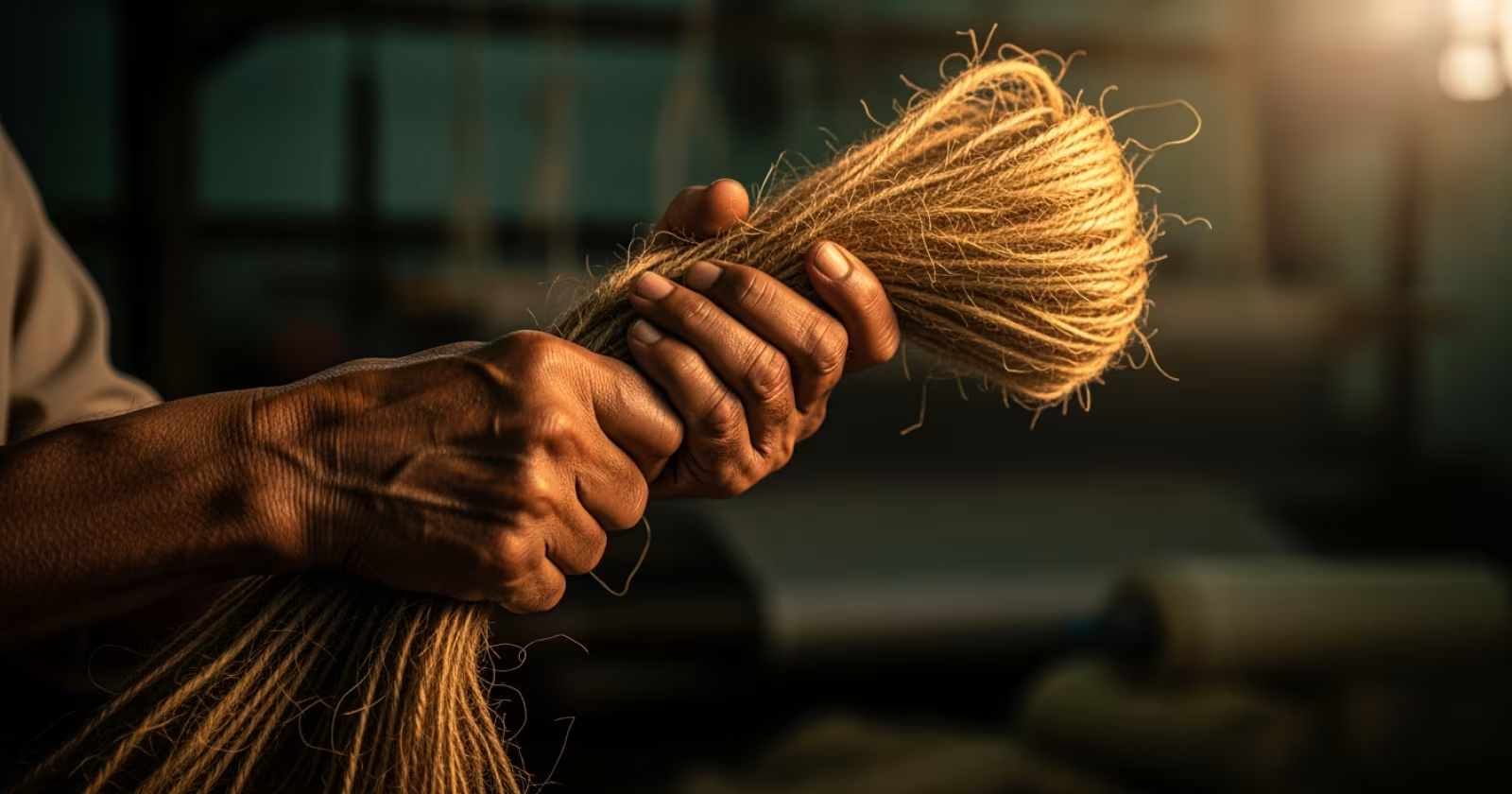
In a humid shed along the Hooghly River, approximately 40 kilometres north of Kolkata, a woman named Rina Mondal feeds raw golden fibre into a carding machine that has been running, with repairs, since 1987. She earns around ₹320 a day. Two years ago, she earned ₹210 — and her mill was weeks from shutting down.
What changed wasn’t charity or a government bailout. It was garbage. Specifically, India’s escalating war on single-use plastic bags, which handed cooperative jute mills in West Bengal an unexpected lifeline — and a market worth thousands of crores that most of them were too broke to chase.
Why a Plastic Ban Became a Jute Story
When the Central government enforced its single-use plastic ban in phases starting mid-2022, few people connected it to the crumbling jute sector of Bengal. But the arithmetic was straightforward. India consumed an estimated 14 million tonnes of plastic packaging annually. Even replacing a fraction of that with jute — for grocery bags, food-grain sacking, cement packaging — represented a demand surge the jute industry hadn’t seen in decades. The Jute Packaging Materials (Compulsory Use in Packing Commodities) Act already mandated jute for packing foodgrains and sugar. The plastic ban widened the runway.
West Bengal produces over 70% of India’s raw jute and houses the majority of its jute mills, many clustered along the Hooghly in districts like Hooghly, North 24 Parganas, and Howrah. Among these, cooperative jute mills — owned collectively by workers or by state cooperative federations — occupy a peculiar position. They’re neither as dead as critics claim nor as healthy as government press releases suggest. I’ve been tracking this sector for years, and the truth sits stubbornly in the middle.
The Origins: How Cooperative Jute Mills Were Born
Jute manufacturing in Bengal is genuinely ancient by industrial standards. The first mechanised jute mill, Acland Mill, started near Serampore in 1855 under Scottish management. For a century, private British and Marwari capital dominated. After Independence, and especially after the wave of mill closures in the 1960s and 1970s, the West Bengal government and cooperative bodies stepped in to rescue failing units.
The model was straightforward: when a private mill shut down, its workers — often with union backing — would petition to reopen it as a cooperative. The National Cooperative Development Corporation (NCDC) and state cooperative banks would provide working capital. By the 1980s, West Bengal had over a dozen cooperative jute mills, including well-known names like Hooghly Jute Mill Cooperative and Bowreah Jute Mill Workers’ Cooperative. These weren’t utopian experiments. They were desperate rescues — workers choosing collective ownership over unemployment.
The trouble was that many inherited ancient machinery, massive debt, and bloated workforces. For decades, they survived on government orders for jute sacking — essentially a captive market. When even that started shrinking due to synthetic alternatives, several cooperatives became functionally dormant.
How Cooperative Jute Mills Operate in 2026
The surviving cooperative jute mills work on a model where workers are both employees and shareholders. A typical mill might have 800 to 2,000 worker-members, each holding nominal shares worth ₹100 to ₹500. An elected board manages operations, often with a government-appointed administrator hovering in the background.
Revenue comes primarily from three streams: mandatory government procurement of jute sacking for foodgrains (under the Jute Packaging Act), direct sales to cement and fertiliser companies that use jute packaging, and — increasingly — the production of jute carry bags, jute geotextiles, and jute-blended fabric aimed at replacing plastic.
| Revenue Stream | Share of Income (Approx.) | Growth Trend |
|---|---|---|
| Government sacking orders (FCI, state agencies) | 50-55% | Stable |
| Cement/fertiliser jute packaging | 20-25% | Moderate growth |
| Jute carry bags and diversified products | 10-15% | Rapid growth |
| Jute geotextiles (road/river bank use) | 5-8% | Emerging |
| Export orders | 3-5% | Flat |
The plastic ban’s real gift is in that third row. Jute carry bag production across Bengal’s cooperative mills has reportedly grown by over 40% since 2023, according to industry estimates cited by the Indian Jute Mills Association (IJMA). Some cooperatives in Hooghly district have installed dedicated bag-making units, spending ₹30-50 lakh on semi-automatic stitching lines. NABARD has facilitated credit for at least four cooperative mills to modernise specifically for this segment.
What’s Still Broken
I’d love to tell you this is a clean revival story. It isn’t. Cooperative jute mills in West Bengal face at least three structural problems that no plastic ban can fix on its own.
First, machinery obsolescence. Most mills run looms and spinning frames that are 40 to 70 years old. Producing fine-quality jute bags that can compete with polypropylene on appearance and consistency requires upgrades costing ₹5-15 crore per mill. Few cooperatives have that capital, and bank lending remains cautious given their history of defaults.
Second, political interference. Cooperative boards in West Bengal have long been entangled with party politics — first the CPI(M), now the TMC. Board elections are often proxy political battles. Operational decisions get delayed. Skilled managers avoid cooperative postings. The Ministry of Cooperation’s push for professionalising cooperative governance has had limited traction in these industrial units.
Third, raw material price volatility. Raw jute prices swung between ₹5,000 and ₹8,500 per quintal over the past two years. Cooperatives, with thin margins and no hedging mechanisms, absorb these shocks directly as wage delays for workers.
A Cooperative That Got It Right: The Matiaburj Example
Not every story is grim. The Matiaburj Jute Workers’ Cooperative in South 24 Parganas invested approximately ₹45 lakh in 2023 — partly through an NCDC grant, partly through member contributions — to set up a jute bag finishing and printing unit. They now supply branded jute shopping bags to retail chains in Kolkata and Bengaluru, reportedly earning ₹12-15 per bag compared to ₹3-4 per metre of plain hessian cloth.
Their secret wasn’t technology alone. The cooperative hired a young manager from outside the political system, a textile management graduate from Serampore, and gave him a three-year contract with performance targets. It’s a small move, but it mirrors what successful dairy and sugar cooperatives in Gujarat and Maharashtra did decades ago — separate professional management from political ownership. The comparison to Amul’s cooperative management model is imperfect but instructive.
What the Next Five Years Look Like
Several policy tailwinds favour cooperative jute mills. The Central government’s Jute-ICARE scheme promotes certified jute seed distribution and better retting practices, which should improve raw material quality. The National Jute Board has been pushing jute geotextiles for rural road construction under PMGSY — a potentially massive market. And the Ministry of Cooperation, under its broader agenda of strengthening PACS and cooperative enterprises, has signalled interest in a dedicated credit window for cooperative industrial units.
The risk? That plastic enforcement weakens. India’s plastic ban has been uneven — robust in metros, patchy in smaller towns. If enforcement slips, the demand surge for jute bags could flatten. Climate change also looms: jute is a rain-dependent crop grown primarily in Bengal and Bihar, and erratic monsoons directly threaten supply stability.
Technology adoption will be decisive. Mills that invest in jute-cotton blended fabrics, laminated jute bags, and branded retail products will survive. Those stuck producing only plain hessian sacking will not, regardless of government orders.
Back on the Mill Floor
Rina Mondal doesn’t track plastic ban enforcement data or NCDC grant cycles. What she knows is that her mill, which ran three days a week in 2023, now runs five. Her ₹320 daily wage, while still modest, is paid on time — something that wasn’t true for eight months during the worst of the downturn. Her cooperative recently started a jute bag stitching line where her teenage daughter has been hired as a trainee.
A 200-year-old fibre, pulled from the rivers of Bengal, processed in mills older than many Indian states — it’s not the obvious answer to a 21st-century environmental crisis. But cooperatives have always been built on the idea that collective action can turn unlikely odds into working models. The question for Bengal’s jute cooperatives isn’t whether the opportunity exists. It’s whether they can organise well enough to seize it before someone else does.
If you work in the cooperative sector or study cooperative industrial models, I’d encourage you to visit one of these mills firsthand. The story of jute cooperatives is a living case study in resilience, mismanagement, and reinvention — and it deserves far more attention than it currently gets. Follow IICTF for continued coverage of India’s cooperative movement.