
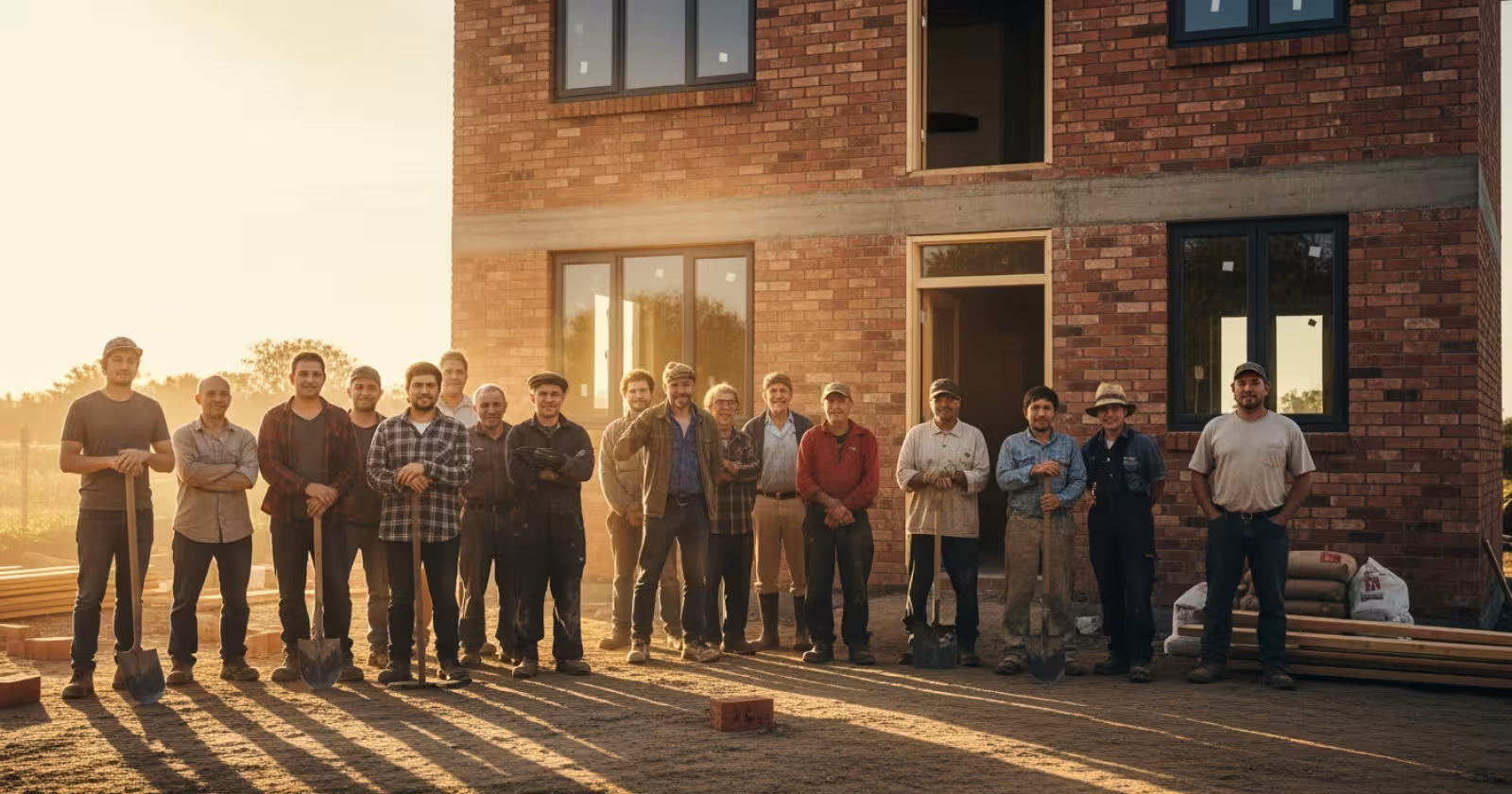
Imagine standing on a stretch of dry, undulating land in western Maharashtra where nothing existed — no school, no clinic, no market, no paved road — and being told that within a few decades, a self-sufficient township of over 50,000 people would rise here, complete with sugar factories, dairies, engineering works, shopping complexes, colleges, and a multi-speciality hospital. That is not a government smart-city pitch. That is what actually happened at Warananagar in Kolhapur district, and I find it one of the most underappreciated stories in India’s cooperative movement.
How Barren Land Became a Cooperative Empire
The story begins in the 1950s, when a freedom fighter and social reformer named Tatyasaheb Kore — formally Ratnaprabha Guruji Kore — looked at the sugarcane-growing villages along the Warana river basin in Panhala taluka and saw unrealised potential. Farmers here grew cane but had no processing infrastructure. Middlemen dictated prices. Poverty was endemic despite fertile soil. Tatyasaheb Kore’s answer was not charity but collective ownership.
In 1955, he mobilised local farmers and established the Warana Sahakari Sakhar Karkhana (Warana Cooperative Sugar Factory). The factory began crushing operations in 1959 with an initial capacity of around 1,250 tonnes of cane per day. What made this different from other sugar cooperatives sprouting across Maharashtra at the time was Kore’s vision — he did not want a single-commodity cooperative. He wanted an entire ecosystem.
Over the next three decades, the Warana Cooperative Complex grew into a constellation of over 20 cooperative institutions, each addressing a different need of the community. The township of Warananagar was literally built from scratch on what had been agricultural wasteland, becoming a model that attracted delegations from across India and abroad.
The Cooperative Complex: What It Actually Includes
I think the best way to appreciate the scale of the Warana experiment is to see what a single cooperative ecosystem managed to build for a largely rural population. Here is a snapshot of the key institutions operating under or associated with the complex as of 2026:
| Institution | Sector | Key Detail |
|---|---|---|
| Warana Sahakari Sakhar Karkhana | Sugar Manufacturing | Crushing capacity expanded to approximately 10,000 TCD |
| Warana Dairy | Dairy Processing | Processes lakhs of litres of milk annually from member farmers |
| Warana Bazaar | Consumer Retail | One of India’s largest rural consumer cooperatives with 40+ outlets |
| Warana Poultry Cooperative | Poultry | Integrated poultry farming and processing |
| Warana Engineering Works | Manufacturing | Fabrication and maintenance for sugar industry |
| Warana Winery | Wine Production | Grape-based wine leveraging local viticulture |
| Warana Shikshan Prasarak Mandal | Education | Schools, colleges, and technical institutes |
| Warana Hospital | Healthcare | Multi-speciality hospital serving the township and surrounding villages |
The membership model is rooted in sugarcane growers. Farmers who supply cane to the factory hold shares in the cooperative. But the genius of the Warana model is that profits from sugar do not just go back as dividends — they are reinvested into building services that the members and their families need. A farmer’s child studies in a Warana school, gets treated in a Warana hospital, and buys daily necessities from Warana Bazaar at fair prices.
The combined annual turnover of the Warana Cooperative Complex has been estimated at over Rs 2,500 crore in recent years, making it one of the most economically significant cooperative clusters in western India. The sugar factory alone generates hundreds of crores in revenue each season.
What Makes Warana Different From Other Sugar Cooperatives
Maharashtra has over 200 cooperative sugar factories. Many have been mired in political capture, debt, and inefficiency. What kept Warana relatively disciplined — at least for its first several decades — was the diversification strategy. When sugar prices crashed, the dairy kept cash flowing. When agricultural margins thinned, the consumer retail network stabilised household budgets. This built-in hedge is something I wish more cooperative planners studied seriously.
The Warana Wired Village project of the late 1990s deserves special mention. Supported by the central government’s IT task force, Warananagar became one of India’s earliest experiments in rural internet connectivity. Farmers could access sugar recovery data, market prices, and government scheme information through village kiosks. It predated the Common Service Centre (CSC) model by years.
The Cracks in the Model
No honest assessment of the Warana complex can ignore the challenges that have emerged over the decades. Political interference has been a persistent issue. Sugar cooperatives in Maharashtra have historically been stepping stones to political power, and Warana has not been immune. Leadership transitions after Tatyasaheb Kore’s passing in 2006 brought factional disputes that occasionally dented the institution’s reputation for clean governance.
Climate variability is another growing threat. Erratic monsoons in the Kolhapur-Sangli belt — including the devastating floods of 2019 and 2021 — have disrupted cane supply chains. Water-intensive sugarcane cultivation itself faces questions about long-term sustainability in a region increasingly prone to both drought and flooding.
Competition from private sugar mills and retail chains also pressures the cooperative model. Younger farmers sometimes question whether cooperatives offer better returns than selling to private buyers. Retaining member loyalty requires the complex to continuously modernise — an expensive proposition.
Lessons for India’s Cooperative Future
The Ministry of Cooperation, established in 2021, has been pushing the idea of multi-purpose cooperative complexes — essentially what Warana built organically decades ago. The NCDC and NABARD both have funding lines for cooperative modernisation, and the government’s push to strengthen PACS (Primary Agricultural Credit Societies) as multi-service centres echoes the Warana philosophy of one community, many cooperative arms.
In 2026, the Warana complex faces a pivotal moment. If it can embrace ethanol blending mandates — converting sugar byproducts into biofuel — and invest in solar energy across its vast campus, it could become a green cooperative township. Early-stage plans for a cogeneration power plant and expanded ethanol capacity suggest the leadership understands this imperative.
Why This Story Matters to You
I keep returning to the Warana story because it challenges a lazy assumption — that rural India cannot build for itself without top-down government intervention. Tatyasaheb Kore and the farmers of Panhala taluka proved that cooperative ownership, paired with relentless reinvestment, can conjure a township out of nothing. If you are involved in the cooperative sector, study Warana. If you are a policymaker, fund more experiments like it. And if you are a young professional curious about India’s rural economy, visit Warananagar — what you see will reframe everything you thought you knew about what cooperatives can achieve.