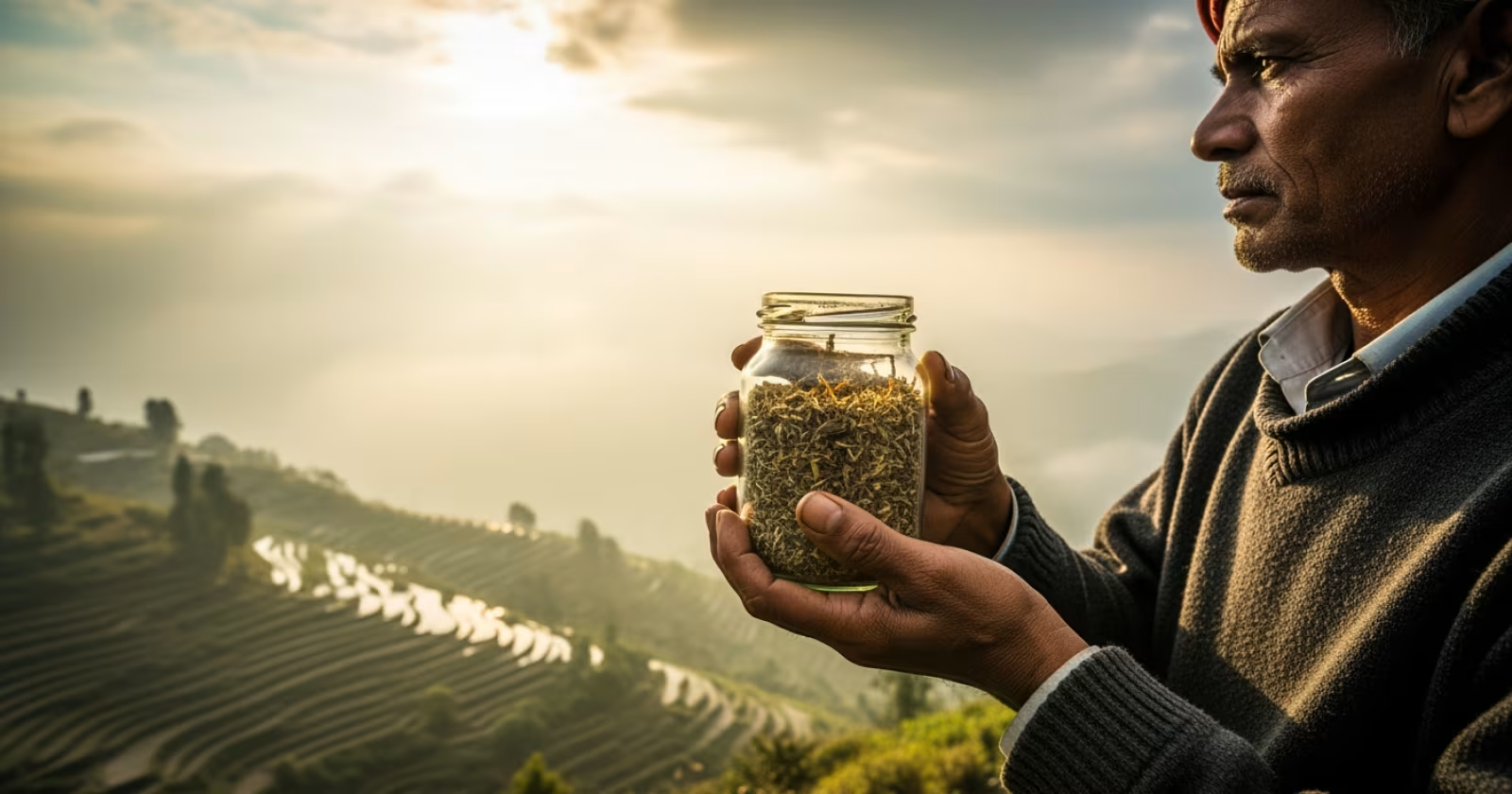
The women of Chamoli district had been picking wild brahmi from the hillsides for generations, selling it to middlemen for ₹12 per kilogram. When those same leaves arrived in wellness stores across Berlin and Amsterdam, they were priced at €45 for a small glass jar. That gap — staggering, almost grotesque in its proportions — is what eventually sparked one of Uttarakhand’s most quietly extraordinary rural stories.
I first came across the Himalayan Herb Growers’ Cooperative through a researcher at the Forest Research Institute in Dehradun, who mentioned it almost as an aside during a conversation about mountain livelihoods. What she described was a group of roughly 340 women from 18 villages across the Chamoli and Uttarkashi districts, who had spent nearly a decade building something most development economists assumed was impossible: a sustainable, export-ready herbal products enterprise rooted entirely in community ownership. By 2026, their products were stocked in health stores across Germany, the Netherlands, and the eastern United States.
A Hillside Full of Value That Nobody Had Claimed
The Garhwal Himalayas have long been recognized as one of the world’s most significant biodiversity zones for medicinal plants. Species like Brahmi (Bacopa monnieri), Ashwagandha, Himalayan Valerian, Jatamansi, and Kutki grow at altitudes between 2,000 and 4,500 metres — conditions that produce markedly higher concentrations of active compounds than lowland cultivation ever achieves. Researchers at the CSIR’s Institute of Himalayan Bioresource Technology in Palampur have documented how altitude stress triggers biochemical responses in these plants, increasing their pharmacological potency in ways that buyers across Europe now actively pay for.
For decades, the dominant model was extraction without equity. Traders from the plains would arrive, purchase harvested material at suppressed prices, and capture value through processing, branding, and export — none of which returned to the hills. The National Medicinal Plants Board, established in 2000 under India’s Ministry of AYUSH, identified this structural imbalance in its own field assessments, but policy recognition and actual economic change are rarely the same thing.
What shifted in Chamoli was not top-down intervention from a ministry or a foreign development agency. A group of women working through self-help groups under the Uttarakhand Rural Livelihood Mission began asking a persistently disruptive question: why couldn’t they handle the processing themselves? The answer, it turned out, was that no structural barrier actually prevented them — only the assumption that they wouldn’t try.
How the Cooperative Was Built, and Who Built It
The cooperative formally registered in 2014, starting with 47 members and a modest drying shed funded partly through a state subsidy and partly through pooled savings from the self-help group network. Within three years, members had developed real processing capacity — cleaning, drying, grading, and packaging — and had earned organic certification through the Participatory Guarantee System recognized by the Uttarakhand Organic Commodity Board. That certification was the pivot point the founders had been working toward from the beginning.
A German herbal products buyer visiting Rishikesh in 2017 on a sourcing trip was directed toward a cooperative near Gopeshwar producing certified organic Brahmi. The purity tests on their material returned bacosides content — the active nootropic compound responsible for the plant’s cognitive benefits — higher than what he was paying for from Southeast Asian suppliers. He placed an initial order of 800 kilograms, generating roughly ₹4.8 lakh for the cooperative in a single transaction.
I spoke with one of the cooperative’s founding members, a farmer whose family had cultivated terraced hillside plots near Gopeshwar for three generations. She told me that when the first international payment arrived, members checked the bank account three times that morning before they believed it. “It was more than my father earned in a whole year,” she said. The sum was not enormous in absolute terms, but the signal it carried was irreversible.
By 2022, the cooperative had grown to 14 distinct product lines — standardized herbal extracts, raw dried herb bundles, and cold-pressed essential oils from Himalayan species. Annual revenue had crossed ₹2.1 crore, with roughly 60 percent of sales flowing to international buyers across four countries.
The Numbers That Tell the Real Story
| Herb | Altitude Range (metres) | Primary Export Market | Farmgate Price Per Kg (2026) |
|---|---|---|---|
| Brahmi (Bacopa monnieri) | 1,200–2,500 | Germany, Netherlands | ₹1,800–₹2,400 |
| Ashwagandha (Withania somnifera) | 1,000–2,000 | United States, United Kingdom | ₹900–₹1,200 |
| Himalayan Valerian (Valeriana jatamansi) | 2,500–4,000 | France, Switzerland | ₹3,200–₹4,500 |
| Kutki (Picrorhiza kurroa) | 3,000–4,500 | Germany, Japan | ₹8,000–₹12,000 |
Kutki commands the highest prices because sustainable cultivation at extreme altitude is genuinely difficult, and because it appears on Schedule VI of the Wildlife Protection Act, which restricts wild harvesting. The cooperative’s decision to cultivate it in managed plots rather than extract it from wild populations attracted interest from the Botanical Survey of India, which initiated a documentation partnership with the group in 2023. Conservation and commerce, in this particular case, reinforced rather than competed with each other.
The Larger Pattern This Cooperative Reveals
The global botanical extracts market was valued at over $8.5 billion in 2024 and continues to expand as wellness spending increases across Europe and North America. India supplies a significant volume of raw botanical material but has historically captured only a fraction of the final consumer value. What happened in Chamoli represents a structural correction to that pattern — achieved not through lobbying or subsidy, but through quality control, traceability certification, and direct relationships with buyers who cared where their herbs came from.
Since 2019, the cooperative has run seasonal training workshops for women from neighboring districts, covering post-harvest handling, quality documentation, and export compliance. More than 120 women from Bageshwar, Pithoragarh, and Rudraprayag have attended at least one session. The cooperative functions as both a commercial enterprise and an informal knowledge institution — an unusual combination that has contributed directly to its longevity.
The financial structure also matters more than it might initially appear. Members own shares, receive annual profit distributions, and participate in pricing decisions at every level. There is no outside investor holding equity with an exit timeline, no intermediary class extracting margin. That ownership structure, maintained through a decade of supply chain disruptions, weather-driven crop losses, and shifting export demand, has proven to be the cooperative’s most durable competitive advantage.
For anyone tracking the economics of mountain livelihoods, the National Medicinal Plants Board maintains detailed resources on cooperative herb cultivation frameworks across India’s hill states — a practical starting point for understanding what an equitable herbal supply chain looks like when it is built from the roots up. What unfolded in Chamoli deserves serious study not as a heartwarming exception, but as a replicable model built by people who simply refused to be price-takers in their own backyards.