
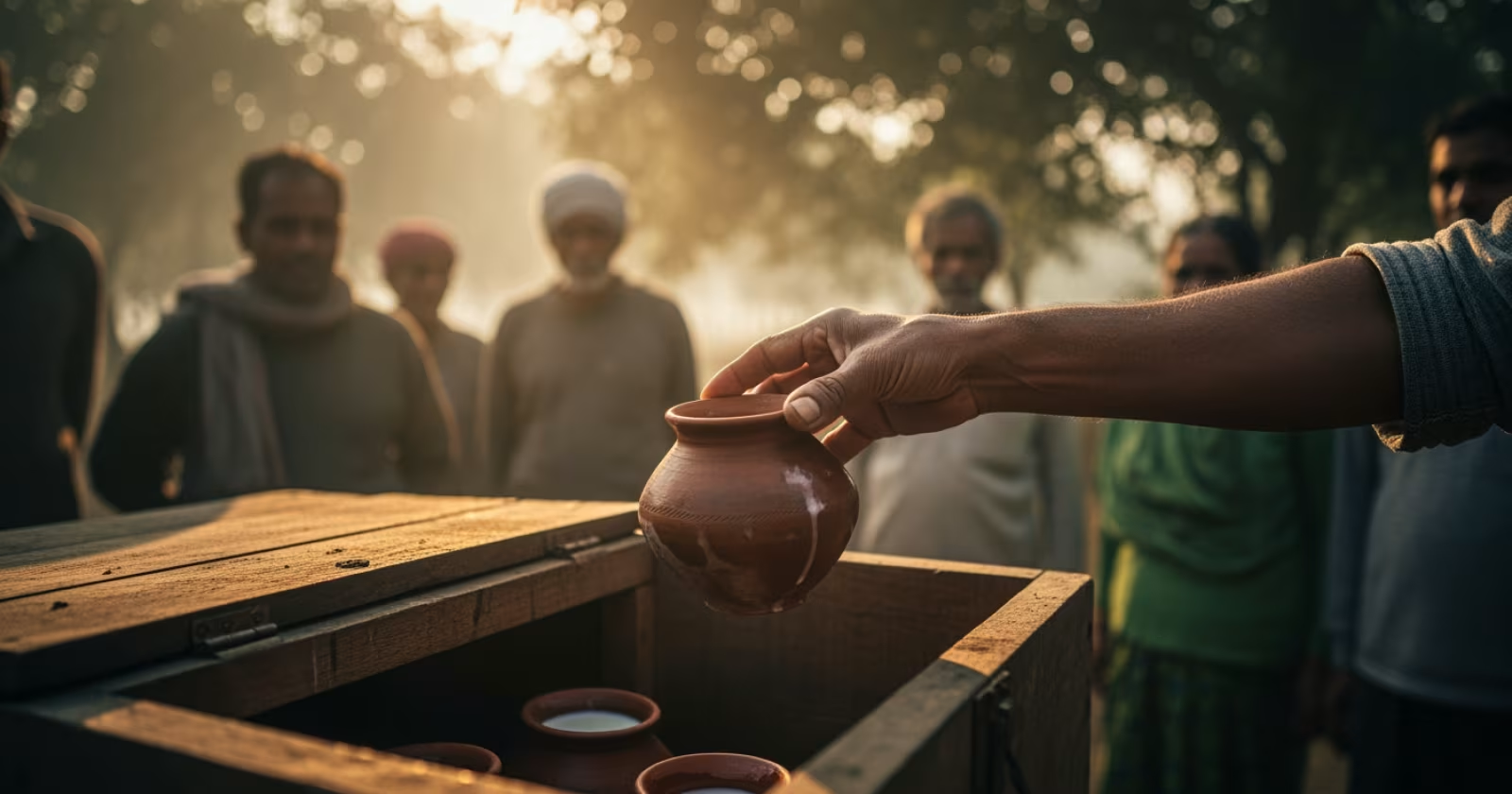
Somewhere in the sal forests south of Jagdalpur, a 62-year-old Muria Gond woman named Sukhmati carries a headload of tamarind and mahua flowers to a collection centre that her grandmother also walked to. The centre belongs to a cooperative that was registered in 1948 — just months after India’s independence — and against every reasonable expectation, it still operates in 2026.
Why a 78-Year-Old Tribal Cooperative in Bastar Still Matters
I first heard about the Bastar District Cooperative Marketing Society not from a government report but from a retired forest officer in Raipur who mentioned it almost casually. He said it had “outlived every scheme Delhi ever sent to Bastar.” That line stuck with me. In a country where cooperatives are often born with a minister’s announcement and die before the next election cycle, a tribal cooperative in Bastar surviving 78 years felt like something worth understanding.
The story matters because Bastar district — now divided into seven districts in southern Chhattisgarh — is home to one of India’s densest concentrations of Scheduled Tribe populations. Approximately 66% of the population here is tribal, and for most of them, minor forest produce remains the primary source of cash income. Cooperatives are not an ideological choice in Bastar. They are an economic lifeline.
Born Before the Constitution
The cooperative was established in 1948, under the old Central Provinces and Berar Cooperative Societies Act. At the time, Bastar was still a princely state that had only recently merged with the Indian Union. The founders were not tribal members themselves — they were a handful of district-level administrators and social workers who saw that tribal families selling sal seeds, tamarind, and lac to private traders were getting roughly one-fifth of the market price.
The original model was simple. The cooperative would aggregate forest produce from weekly haats, store it properly, and sell in bulk to processors in Nagpur and Raipur. Members paid a nominal share of one rupee. In return, they received a fair procurement price and an annual dividend. By the mid-1950s, the society had over 3,000 members spread across what is today Bastar, Dantewada, and Sukma districts.
What kept it alive through the decades was not government patronage — though that came and went — but the fact that it solved a problem no one else was solving. Private traders still dominate forest produce trade in much of central India. The cooperative gave tribal gatherers a second option. That second option, however thin, changed the price dynamic in local markets.
How It Operates in 2026
Today, the cooperative functions through a network of primary collection centres across approximately 40 villages. It is federated under the Chhattisgarh State Minor Forest Produce (Trading and Development) Cooperative Federation, which itself works alongside the LAMPS (Large-Scale Adivasi Multi-Purpose Cooperative Societies) structure that NABARD helped establish in tribal areas during the 1970s and 1980s.
The revenue model has evolved but not dramatically. The cooperative procures mahua, tamarind, sal seed, chironji, harra, and honey at minimum support prices declared by the state government. It then sells to bulk buyers, state agencies, or directly through the federation. Members receive the MSP at the point of collection — no waiting 60 days for a bank transfer.
| Forest Produce | Approx. MSP (₹/kg, 2026) | Typical Private Trader Rate (₹/kg) |
|---|---|---|
| Sal Seed | ₹30 | ₹12–18 |
| Mahua Flower (dried) | ₹32 | ₹17–22 |
| Tamarind (deseeded) | ₹44 | ₹25–30 |
| Chironji | ₹165 | ₹100–120 |
| Wild Honey | ₹265 | ₹150–200 |
The gap between MSP and private trader rates tells you everything. A tribal family gathering 200 kg of sal seed in a season earns ₹6,000 through the cooperative versus ₹2,400–3,600 from a trader. That difference buys school uniforms and cooking oil for three months. Membership today stands at approximately 8,500 families, though active participation fluctuates with the season and, frankly, with the security situation in the region.
What Threatens a 78-Year Survivor
Survival is not the same as thriving. I spoke to a district cooperative official in Jagdalpur who described three persistent threats. The first is Naxal conflict. Several collection centres in interior Sukma and Bijapur areas have been non-functional for years because neither cooperative staff nor government vehicles can safely operate there. The cooperative’s geographical reach has actually shrunk since the early 2000s.
The second is working capital. The cooperative needs cash upfront to pay members at MSP, but reimbursement from the state federation or the NCDC loan cycle often arrives months late. In 2024-25, reports suggest the federation faced a ₹47 crore working capital shortfall across Chhattisgarh’s tribal cooperatives. When money dries up, the collection centre closes its shutters, and the private trader waiting outside opens his.
The third threat is generational. Young tribal men and women are migrating to Hyderabad, Surat, and Visakhapatnam for wage work. The knowledge of which forest produces to gather, when, and how to dry and grade them — that knowledge is held by women like Sukhmati. It does not automatically transfer to the next generation.
What the Van Dhan Model Changed — and Didn’t
The central government’s Van Dhan Vikas Kendra programme, launched under TRIFED, was supposed to add value at the grassroots — turning raw tamarind into paste, raw honey into filtered jars. Bastar got several Van Dhan Kendras, and some cooperatives were linked to them. The early results were promising: tribal women’s self-help groups attached to the cooperative started producing mahua laddoos and chironji packets sold under the Tribes India brand.
But the scale remained tiny. A 2023 evaluation by NABARD found that most Van Dhan Kendras in Chhattisgarh operated at less than 30% capacity due to equipment maintenance gaps and irregular raw material supply. The old cooperative’s collection network was far more reliable than the new value-addition infrastructure bolted on top of it. This is the irony: the 78-year-old institution works better than the five-year-old scheme designed to modernise it.
What the Next Five Years Look Like
The Ministry of Cooperation, established in 2021, has signalled interest in strengthening PACS and primary cooperatives across tribal belts. The computerisation of PACS — a flagship initiative aiming to digitise over 63,000 primary cooperatives — could eventually reach Bastar’s network. If it does, real-time procurement data could solve the working capital timing problem by making reimbursements faster.
Chhattisgarh’s state government has also been expanding the MSP list for minor forest produce — from 7 items two decades ago to over 65 items now. Every new item on that list gives the cooperative another reason to exist and another product to trade. The question is whether the institutional scaffolding — the staff, the storage, the transport — can keep pace with the policy ambition.
Technology is slowly arriving too. A pilot using GPS-tagged collection data and UPI payments was tested in Kondagaon district in 2026. If tribal members can receive MSP payments directly to their Jan Dhan accounts within 48 hours of collection, the cooperative’s value proposition becomes almost unbeatable against private traders.
Back to the Forest Path
Sukhmati does not think in terms of policy cycles or institutional survival rates. She knows the cooperative centre in her village has been there since her grandmother’s time. She knows the rate she gets there is better than what the trader at the haat offers. She also knows that her daughter, who now works at a garment unit in Surat, may never carry a headload of tamarind through these forests.
That tension — between a cooperative that works and a world that is pulling its members elsewhere — is the real story of Bastar’s 78-year-old institution. It has outlived princely states, Five Year Plans, structural adjustment, Naxalism, and at least a dozen rebranded government schemes. Whether it outlives the migration economy of the 2020s is the question no policy document has answered yet. If you care about India’s tribal cooperative future, this is the institution to watch — and to support.