
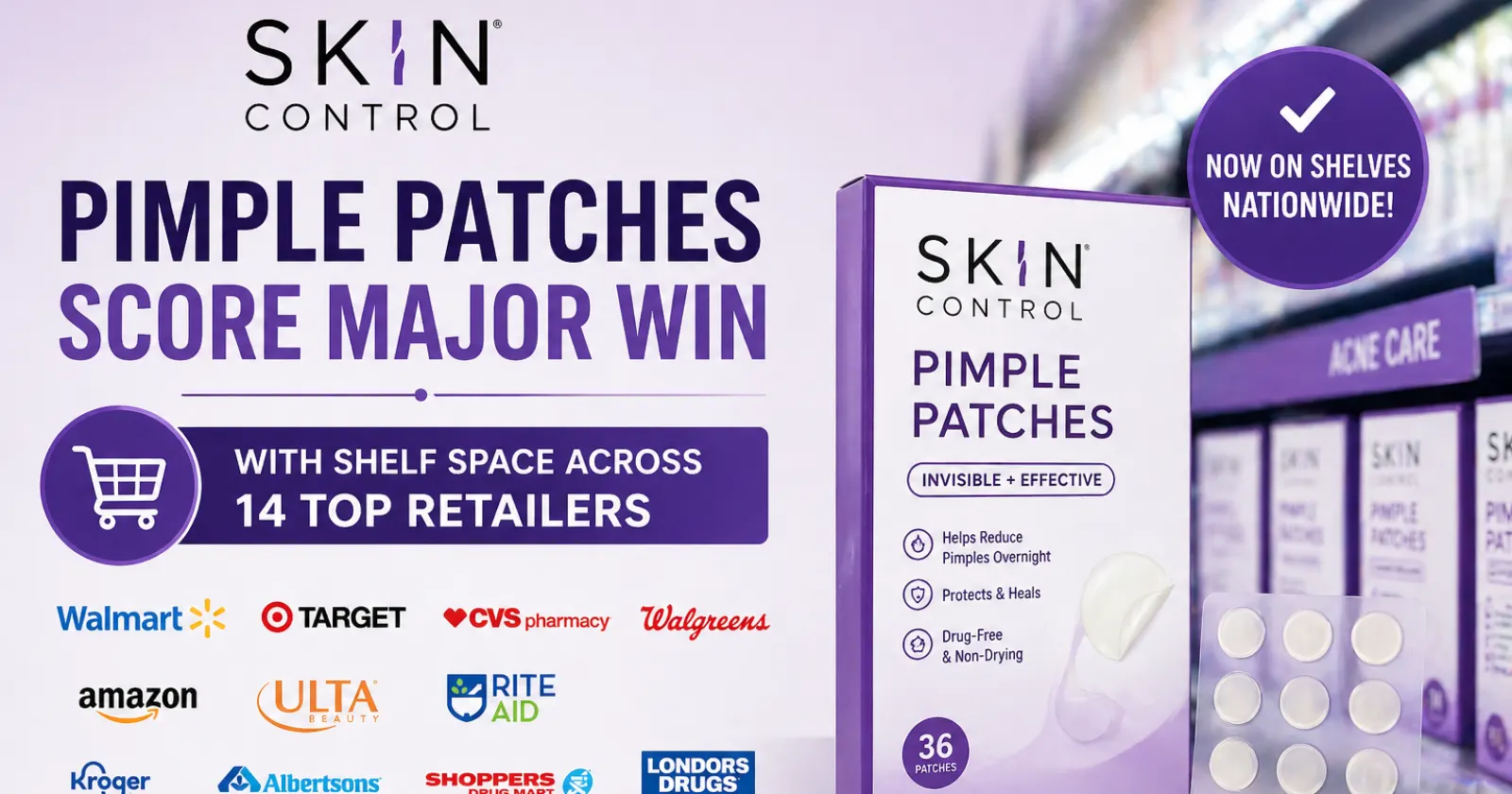
Landing a listing in one major supermarket is hard enough. Landing in fourteen national retailers simultaneously — spanning grocery, pharmacy, convenience, and fashion — is the kind of distribution footprint that most personal care brands spend a decade trying to build.
Skin Control has done exactly that with its pimple patch range, and the story of how an Australian brand turned a single hydrocolloid SKU into what it claims is the country’s number-one selling pimple patch is worth understanding for anyone working in mass beauty, personal care buying, or brand strategy.
What Pimple Patches Are and Why the Category Took Off in Australia
Pimple patches are small hydrocolloid dressings applied directly to a blemish. The technology itself is not new — hydrocolloid has been used in wound care for decades. What changed is the consumer framing: patches moved from a clinical fix to an everyday skincare step, accelerated by social media normalising visible skincare routines.
In Australia, the category found a ready audience among younger shoppers who were already comfortable buying skincare at the supermarket rather than the dermatologist’s counter. The mass channel — Woolworths, Coles, Chemist Warehouse — became the primary battleground, not the specialty beauty retailer.
That shift created a genuine opening for a brand built specifically for the grocery and pharmacy shelf, rather than one migrating down from prestige.
Skin Control’s Retail Footprint Across Australian Mass Channels
The brand is now stocked nationally across a retail network that covers most of the touchpoints an Australian shopper encounters in a week. The current confirmed distribution spans Woolworths, Coles, Chemist Warehouse, Priceline, Big W, Terry White, Amcal, Ampol, 7-Eleven, IGA, Anthropic Australia, WH Smith, Chempro, and Urban Outfitters.
That list is notable not just for its length but for its range. Convenience channels like Ampol and 7-Eleven signal that the brand is positioning patches as an impulse purchase, not just a planned skincare buy. The WH Smith and Urban Outfitters listings extend reach into travel retail and youth fashion — two channels that reinforce the brand’s identity without competing directly on price.
The product range has also expanded beyond the original pimple patch. Skin Control now offers AM daytime patches, PM night patches, XL patches for larger blemishes, pore patches for the nose, and novelty formats including shaped party packs and seasonal designs.
| Retail Channel | Retailer | Channel Type |
|---|---|---|
| Grocery | Woolworths, Coles, IGA | Planned purchase |
| Pharmacy | Chemist Warehouse, Priceline, Terry White, Amcal, Chempro | Health and beauty destination |
| Mass discount | Big W | Value-led shopper |
| Convenience | Ampol, 7-Eleven | Impulse and top-up |
| Online | Anthropic Australia | Search-driven repurchase |
| Specialty / travel | WH Smith, Urban Outfitters | Brand discovery |
How the Product Range Is Structured for the Shelf
Skin Control’s range is built around a clear usage occasion logic. The AM and PM patch split — thin and near-invisible for daytime, stronger formulation for overnight — gives the brand a reason to occupy two facings rather than one. That kind of range architecture is exactly what a category buyer wants to see: internal differentiation that drives basket size without cannibalising the core SKU.
The novelty formats, including heart-shaped, star-shaped, and seasonal Christmas packs, serve a different commercial purpose. They generate social sharing, drive gifting occasions, and keep the brand visible in the seasonal promotional calendar. For a personal care brand without a large above-the-line advertising budget, that earned visibility matters.
The hydrocolloid formulations across the range incorporate active ingredients including salicylic acid, niacinamide, tea tree oil, and cica — ingredients that are well understood by the target consumer and credible enough to justify a skincare positioning rather than a purely cosmetic one.
What This Distribution Win Does Not Guarantee
Shelf space is not the same as sustained velocity. Fourteen retail listings create exposure, but they also create complexity — ranging reviews, promotional commitments, and ranging fees that can compress margin quickly if sell-through rates soften.
The pimple patch category is also attracting more competition. MCo Beauty, which already has strong mass-channel penetration in Australia, has launched its own retinol pimple patch range through Woolworths. International brands with deeper marketing budgets are watching the same consumer data. Skin Control’s number-one claim is a current position, not a permanent one.
Who Gains Most From This Model
The immediate beneficiaries are the pharmacy and grocery buyers who backed the brand early and now have a proven velocity SKU anchoring the pimple patch fixture. For other Australian personal care startups, the Skin Control model demonstrates that a focused, occasion-led product with strong packaging can secure mass-channel listings without a prestige origin story or a large trade marketing budget.
Mass Beauty’s Next Competitive Frontier
The Skin Control story sits inside a broader shift in Australian mass beauty: the grocery and pharmacy shelf is no longer a secondary channel for skincare brands — it is the primary one. Younger consumers are making considered skincare purchases at Woolworths and Chemist Warehouse with the same intent they once reserved for Mecca or Sephora. Brands that understand how to win at that shelf, through range logic, occasion framing, and retailer-specific ranging, are the ones building durable category positions in 2026.
As competition in mass beauty tightens and category buyers become more selective about which brands earn a second facing, the brands that built their distribution architecture deliberately — rather than opportunistically — will be the ones still on shelf in three years.