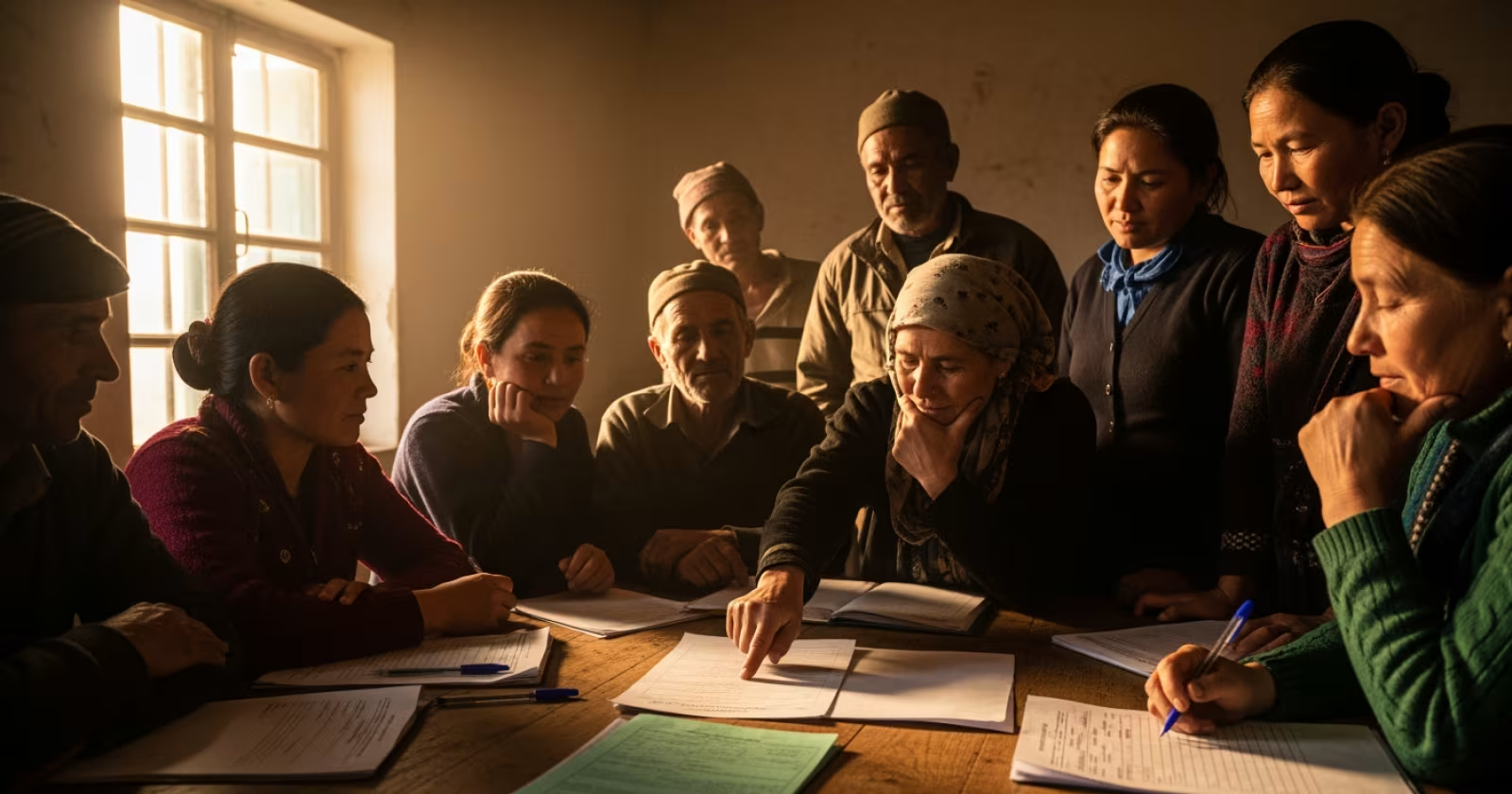
Two of India’s most ancient natural fibers — silk and coir — are quietly fueling a new wave of rural prosperity, and most people outside these communities have no idea how profitable these cooperative ventures have become. I’ve been tracking the growth of fiber-based cooperatives across southern and eastern India, and the numbers tell a compelling story about self-reliance, collective bargaining power, and entrepreneurial spirit flourishing at the grassroots level.
Why Silk and Coir Cooperatives Matter for Rural India
India is the second-largest producer of silk globally and the largest producer of coir fiber, yet millions of artisans and small-scale producers historically struggled with middlemen, low prices, and limited market access. Cooperative societies have changed this equation by pooling resources, sharing infrastructure, and collectively negotiating better terms with buyers. The National Cooperative Development Corporation (NCDC) has been instrumental in financing and supporting these societies since its establishment under the NCDC Act of 1962.
For rural entrepreneurs, joining or forming a cooperative eliminates the isolation that comes with small-scale production. A single silk reeler or coir spinner may produce limited quantities, but a cooperative of 200 members can fulfill bulk orders, invest in processing machinery, and even export products directly. This collective strength transforms what would otherwise be subsistence work into a viable, scalable business model.
The cooperative structure also provides built-in governance, financial transparency, and eligibility for government subsidies that individual entrepreneurs cannot easily access. Under the Multi-State Co-operative Societies Act 2002, cooperatives operating across state boundaries enjoy additional regulatory support and can tap into wider markets without bureaucratic barriers.
Silk Cooperative Societies: From Sericulture to Global Markets
Silk production in India spans four major varieties — Mulberry, Tasar, Eri, and Muga — each concentrated in specific geographic regions. Karnataka alone accounts for nearly 70% of India’s mulberry silk production, while Assam dominates Muga silk, which is exclusive to the northeastern state. The Central Silk Board, operating under the Ministry of Textiles, coordinates research, training, and development programs that directly benefit cooperative members.
Silk cooperatives typically handle the entire value chain from cocoon rearing to yarn reeling and sometimes even weaving. In Karnataka, cooperative societies like the Karnataka Silk Industries Corporation have helped thousands of farmers transition from raw cocoon sellers to value-added product manufacturers. This vertical integration means more profit stays within the cooperative rather than being siphoned off by intermediaries.
Training programs funded by the Central Silk Board provide cooperative members with modern sericulture techniques, disease management for silkworms, and improved reeling technology. In 2026, the focus has shifted increasingly toward bivoltine silk production, which yields higher-quality yarn that commands premium prices in international markets. Rural entrepreneurs entering silk cooperatives today benefit from decades of institutional knowledge and infrastructure investment.
The export potential is significant. India’s silk exports include raw silk, silk fabrics, silk garments, and silk carpets, with major buyers in the United States, European Union, and UAE. Cooperatives that achieve quality certifications and traceability standards can access these lucrative markets through government-facilitated trade fairs and buyer-seller meets organized by the Ministry of Textiles.
Coir Cooperative Societies: Turning Coconut Waste into Wealth
Coir — the fiber extracted from coconut husks — represents one of the most remarkable examples of waste-to-wealth transformation in Indian agriculture. Kerala produces over 60% of India’s coir output, but Tamil Nadu, Karnataka, Andhra Pradesh, and Odisha are rapidly expanding production. The Coir Board of India, established under the Coir Industry Act 1953, oversees the development of coir cooperatives and provides technical assistance, marketing support, and export facilitation.
Coir cooperatives process coconut husks into fiber, yarn, mats, mattresses, geotextiles, and coir pith (used as a growing medium in horticulture). The product range has expanded dramatically beyond traditional coir mats. Coir geotextiles, in particular, have gained international recognition for soil erosion control and bioengineering applications, creating entirely new revenue streams for cooperative members.
The Coir Vikas Yojana, a flagship scheme of the Ministry of MSME, provides financial support for coir cooperative societies through machinery subsidies, skill development programs, and marketing assistance. Under this scheme, cooperatives can receive up to 40% subsidy on equipment purchases, making mechanization affordable even for small societies. NABARD also extends refinancing facilities to banks lending to coir cooperatives, ensuring credit availability in rural areas.
Government Schemes and Financial Support Available in 2026
Multiple government programs converge to support silk and coir cooperatives, creating a favorable environment for rural entrepreneurs. I’ve compiled the most relevant schemes and their key features in the table below for quick reference.
| Scheme / Program | Implementing Agency | Key Benefits | Eligible Entities |
|---|---|---|---|
| Coir Vikas Yojana | Coir Board / Ministry of MSME | Machinery subsidy up to 40%, skill training, marketing support | Coir cooperatives, SHGs, individual artisans |
| Silk Samagra | Central Silk Board / Ministry of Textiles | R&D support, seed organization, reeling technology upgrades | Silk cooperatives, sericulture farmers |
| NCDC Cooperative Development Fund | NCDC | Low-interest loans, equity support, infrastructure financing | Registered cooperative societies |
| NABARD Refinance Schemes | NABARD | Credit access through refinancing to lending institutions | All eligible cooperatives and producer organizations |
| SFURTI Clusters | Ministry of MSME | Cluster-based development, common facility centers, brand building | Traditional industry cooperatives including silk and coir |
The Scheme of Fund for Regeneration of Traditional Industries (SFURTI) deserves special mention because it supports the creation of common facility centers where cooperative members can access shared processing equipment, testing labs, and design studios. For silk and coir cooperatives, these centers dramatically reduce individual capital requirements while improving product quality and consistency.
NABARD plays a particularly crucial role by providing refinance support to cooperative banks and regional rural banks that lend to silk and coir societies. This ensures that credit flows reach the last mile, enabling cooperatives in remote areas to invest in modernization without facing financing bottlenecks.
Practical Steps to Start or Join a Silk or Coir Cooperative
For aspiring rural entrepreneurs, the first step is identifying the natural resource base in your region. If you’re in a coconut-growing area, coir processing offers immediate raw material availability. If sericulture has a presence in your district, silk cooperatives are a natural fit. State-level cooperative registrars maintain databases of existing societies, and joining an established one is often more practical than starting fresh.
Forming a new cooperative requires a minimum of 10 members in most states, a viable business plan, and registration under the respective State Cooperative Societies Act. The registration process involves drafting bylaws, electing a management committee, and opening a cooperative bank account. District Industries Centers and Khadi and Village Industries Commission offices can provide guidance and connect you with mentors who have successfully established cooperatives.
Training is non-negotiable. Both the Central Silk Board and Coir Board conduct regular training programs at their regional centers across India. These programs cover everything from raw material processing to quality control, packaging, and digital marketing. Many cooperatives now sell directly through e-commerce platforms and government procurement portals like the Government e-Marketplace (GeM), opening up revenue channels that were unimaginable a decade ago.
Building a Sustainable Future Through Cooperative Entrepreneurship
What excites me most about silk and coir cooperatives is their dual impact: they generate livelihoods while preserving traditional skills that might otherwise disappear. Young entrepreneurs bringing digital literacy and modern business thinking into these cooperatives are creating hybrid models that honor tradition while embracing technology. Solar-powered coir processing units and automated silk reeling machines are becoming standard in progressive cooperatives.
Environmental sustainability adds another dimension of value. Coir is biodegradable and increasingly preferred over synthetic alternatives in international markets. Silk production, when managed through integrated farming systems, supports biodiversity and can be combined with moriculture (mulberry cultivation) that improves soil health. Buyers in Europe and North America are willing to pay premium prices for sustainably sourced natural fibers with verifiable supply chains.
If you’re a rural entrepreneur looking for a proven path to financial independence, I strongly encourage you to visit your nearest District Industries Center or contact the Central Silk Board or Coir Board regional office. Explore existing cooperatives in your area, attend their meetings, and understand their operations firsthand. The infrastructure, subsidies, and market linkages are already in place — what these cooperatives need most is energetic new members ready to build something lasting for their communities and themselves.