
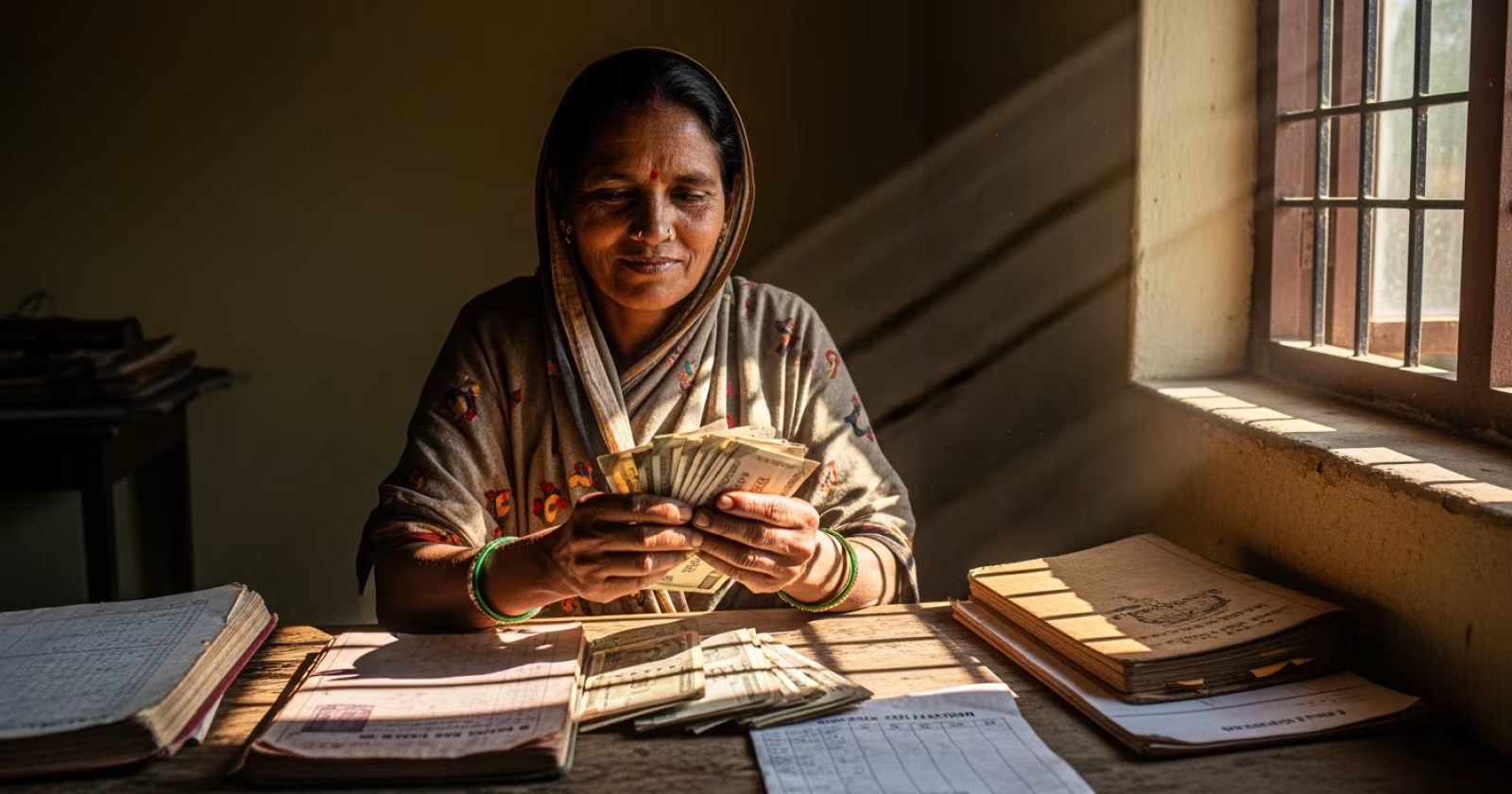
In a dusty village called Bansur in Alwar district, a woman named Kamla Devi walks to the milk collection centre every morning at 5:30 AM, balancing two steel canisters on her head. She pours approximately 14 litres of buffalo milk into the cooperative’s bulk cooler, collects her digital receipt, and walks home — having already earned more that day than her husband will from his rain-dependent mustard crop all week. Across Rajasthan, this scene is repeating itself in thousands of villages, and the numbers tell a story that few policy reports have bothered to narrate properly.
I have been tracking India’s cooperative movement for years, and what is unfolding in Rajasthan’s dairy sector deserves serious attention. Women members of dairy cooperatives in the state are now contributing, on average, ₹8,000 to ₹12,000 per month to household income — figures that frequently surpass what male family members bring in from traditional agriculture. This is not a government press release talking point. This is a quiet economic revolution happening one milk canister at a time.
Why This Matters Beyond Rajasthan
India is the world’s largest milk producer, with output crossing an estimated 240 million tonnes in 2026-26. Rajasthan ranks among the top five milk-producing states, and the Rajasthan Cooperative Dairy Federation (RCDF), which markets milk under the Saras brand, is the backbone of this output. What makes Rajasthan distinct is the gender composition of its dairy cooperative membership. Women constitute over 40 per cent of the members in village-level dairy cooperative societies across the state — a figure that has climbed steadily since 2018.
The Ministry of Cooperation’s push to revitalise Primary Agricultural Credit Societies (PACS) and integrate them with dairy and fishery cooperatives has given further institutional scaffolding to women’s participation. But the real catalyst is simpler: dairy offers daily cash flow, and in drought-prone Rajasthan, daily cash flow is survival.
The Roots of Women’s Dairy Cooperatives in Rajasthan
Rajasthan’s organised dairy cooperative movement traces its origins to the Operation Flood programme launched in 1970, inspired by Verghese Kurien’s Amul model in Gujarat. RCDF was established in 1977, initially as a male-dominated network. Women were the ones doing the actual milking, feeding, and cattle care, yet men held the cooperative memberships and collected the payments.
The shift began in the 1990s when NABARD-funded self-help group (SHG) programmes started linking women’s savings groups to dairy activities. The real acceleration came after 2010, when RCDF, under pressure from both state policy and donor-funded programmes, began registering women-only dairy cooperative societies (DCS). By 2020, Rajasthan had over 2,800 women-only DCS, and by 2026 estimates suggest this number has crossed 3,500.
What problem were they solving? In arid western Rajasthan — districts like Barmer, Jaisalmer, and Jodhpur — crop failure is not an exception, it is the norm. Livestock, particularly buffaloes and indigenous cattle breeds like Rathi and Tharparkar, became the only reliable economic asset. Women, who managed the animals, needed direct access to the income those animals generated. The women-only cooperative became that access point.
How the Model Actually Works in 2026
I visited several village-level DCS in Jaipur and Alwar divisions, and the operating model is remarkably straightforward. A women-only DCS typically has 50 to 200 members. Each member pays a nominal share of ₹100 to ₹500. The cooperative collects milk twice daily, tests it for fat content using electronic analysers, and pays members every ten days directly into their bank accounts.
RCDF procures this milk through district-level unions — there are 21 district milk unions feeding into the federation. The milk is processed at Saras plants and sold as liquid milk, curd, buttermilk, ghee, and flavoured milk across Rajasthan and neighbouring states. Saras reported a turnover exceeding ₹7,500 crore in 2024-25, and early indicators for 2026-26 suggest growth of 10-12 per cent.
| Parameter | Figure |
|---|---|
| Total DCS in Rajasthan | Approximately 24,000 |
| Women-only DCS | Over 3,500 |
| Women members in all DCS | Approximately 8 lakh |
| Average milk procurement price (buffalo) | ₹50–58 per litre |
| Average monthly income per woman member | ₹8,000–12,000 |
| Saras annual turnover (2024-25) | Over ₹7,500 crore |
| District milk unions | 21 |
For women like Kamla Devi, the cooperative does more than buy milk. It provides cattle feed on credit, veterinary services through AI (artificial insemination) technicians, and insurance for animals — all services that a private middleman would never offer. The cooperative also becomes a social institution: a place where women gather, discuss problems, and increasingly contest panchayat elections.
What Threatens This Progress
The picture is not uniformly rosy. Several challenges threaten to stall the momentum I have observed on the ground. First, fodder costs have risen sharply — by some estimates 30 per cent over the last three years — squeezing margins for small-holder women who own just two or three animals. Climate change is making water scarcity worse in western Rajasthan, directly affecting cattle health and milk yield.
Second, private dairy companies — including large players backed by venture capital — are entering rural Rajasthan with aggressive procurement pricing, trying to pull farmers away from cooperatives. Unlike cooperatives, these companies offer no social infrastructure, but their short-term price premiums are tempting.
Third, governance remains a concern. Not all women-only DCS are genuinely women-led. In some cases, male family members control decision-making behind the scenes, and elected women office-bearers serve as proxies. The NCDC and state cooperative department have flagged this issue, but enforcement is patchy.
A District-Level Story Worth Watching
In Bhilwara district, a cluster of 14 women-only DCS formed a mini-federation in 2023 to collectively negotiate better cattle feed prices and share a mobile veterinary unit. The results have been striking. Average milk yield per animal in these villages has risen by approximately 18 per cent in two years, and member incomes have crossed ₹14,000 per month for the top quartile. This kind of grassroots federation-building — cooperatives of cooperatives — is something the Amul model perfected decades ago. The fact that women in Bhilwara are replicating it organically, without waiting for government directives, tells me the cooperative instinct runs deeper than policy frameworks. Compare this to Kenya’s dairy cooperatives, where women’s membership has also surged but without the institutional support of a body like RCDF, leading to fragmented value chains. Rajasthan’s women are, in a sense, better positioned than their global counterparts.
What the Next Five Years Could Look Like
The Ministry of Cooperation has signalled that multi-purpose PACS — integrating dairy, credit, and retail — will be a priority through 2028. If women dairy cooperatives can plug into this expanded PACS infrastructure, their economic footprint could grow significantly. Technology is already making inroads: several RCDF unions have deployed automated milk collection units (AMCUs) that reduce human error in fat-testing and speed up payments via UPI.
The state government’s Rajasthan Dairy Mission, with an allocation reportedly exceeding ₹500 crore, aims to increase procurement capacity and add value-added product lines. If women cooperatives secure a fair share of this investment — and that is a political question as much as an economic one — Rajasthan could become the first state where women’s dairy income definitively and consistently out-earns male agricultural income at the household level.
Back to Bansur
When I last checked on the cooperative in Bansur, Kamla Devi had been elected secretary of her DCS. Her monthly income from milk had stabilised around ₹11,500. Her husband’s mustard crop had failed for the second consecutive year. The family’s survival — their children’s school fees, the EMI on a motorcycle — rested almost entirely on the dairy cooperative. She did not describe this as empowerment. She described it as common sense. That, perhaps, is the most telling thing about Rajasthan’s women dairy cooperatives: they are not waiting for empowerment to be granted. They are building it, one litre at a time.
If you work in the cooperative sector, study it, or simply care about how rural India actually sustains itself, I urge you to pay closer attention to what women-led dairy cooperatives are achieving. Visit your nearest DCS, talk to the women running it, and share their stories — on this platform, in your networks, wherever the cooperative movement needs more honest voices. The data speaks. It is time we listened.