
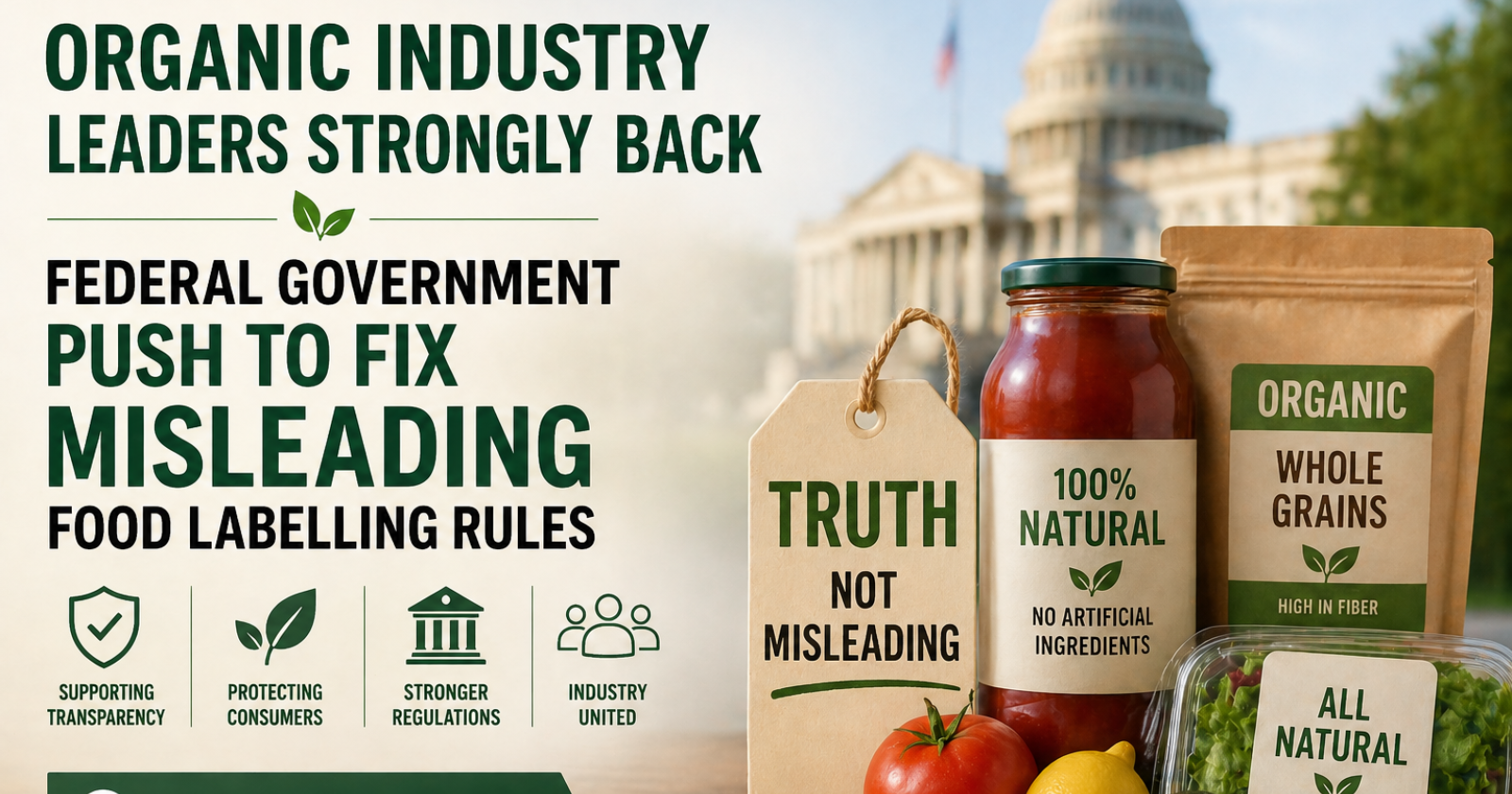
Any brand can print “organic” on a label in Australia right now, and nothing in the law stops them. That single regulatory gap has been quietly eroding the value of certified organic products for years — and the Federal Government has finally signalled it wants to fix it.
Industry body Australian Organic Limited (AOL) has welcomed the government’s openness to reviewing organic labelling regulations, calling it a “landmark shift” in a debate that has dragged on for well over a decade. For brand managers and buyers operating in the certified organic space, this is the most commercially significant policy signal the sector has seen in years.
What Is the Organic Labelling Problem and Why It Matters for FMCG
Unlike certified organic markets in the European Union, the United States, and Japan, Australia has no mandatory national standard governing the use of the word “organic” on food and grocery products. Certification schemes exist — and reputable operators use them — but participation is voluntary.
The result is a market where a product carrying a rigorous third-party certification sits on shelf next to one making an unchecked organic claim. For shoppers, the distinction is invisible. For certified operators, it means competing on price against brands that haven’t absorbed the cost of genuine compliance.
AOL has argued consistently that this dynamic undermines consumer confidence and caps the export potential of Australian organic producers, who face stricter scrutiny when selling into regulated overseas markets than they do at home.
Federal Government Opens the Door to Organic Regulation Reform
The Federal Government has confirmed it is open to working with the organic industry on the labelling issue, a position AOL CEO Jackie Brian described as a meaningful departure from previous inaction. The government has not yet committed to a specific regulatory model or legislative timeline.
AOL is now calling on government, industry, and other stakeholders to identify a “practical and credible model” that supports certified organic businesses over the long term. Brian was direct about what the sector needs: “a model that is practical, proportionate and fit for purpose.”
The organisation has framed the reform as necessary not just for domestic market integrity, but for Australia’s ability to compete internationally. Certified organic exports face scrutiny in markets that require proof of a recognised domestic standard — a bar Australia currently struggles to clear cleanly.
What a Credible Labelling Model Could Look Like
No draft framework has been released, and the government has not indicated which regulatory body would oversee any new scheme. The following table outlines how Australia’s current position compares to key trading partners with established organic labelling regulation.
| Market | Mandatory Standard | Governing Body | Export Recognition |
|---|---|---|---|
| Australia | No — voluntary certification only | None (multiple private certifiers) | Limited — case by case |
| European Union | Yes — EU Organic Regulation | European Commission | Broad — mutual recognition agreements |
| United States | Yes — USDA National Organic Program | USDA Agricultural Marketing Service | Broad — equivalency arrangements |
| Japan | Yes — JAS Organic Standard | Ministry of Agriculture, Forestry and Fisheries | Selective — bilateral agreements |
AOL has not publicly advocated for a single model at this stage, instead emphasising that the process must be collaborative and evidence-based. What the industry wants to avoid is a light-touch scheme that creates the appearance of regulation without the substance.
What This Review Does Not Change Yet
The government’s openness to reform is not a commitment to legislate. No bill has been introduced, no regulatory body has been assigned, and no consultation timeline has been published. Brands currently making unchecked organic claims face no new compliance obligations as a result of this announcement.
For certified operators, the commercial disadvantage on shelf continues until a mandatory standard is in place and enforced. The gap between a policy signal and a functioning regulatory framework in Australian food and grocery has historically been measured in years, not months.
Retailers, too, are not yet required to change ranging or labelling policies for organic products. Any shelf-level impact depends entirely on what model eventually emerges from the consultation process.
Who Stands to Gain from Organic Labelling Reform
Certified organic producers and brands that have invested in third-party accreditation stand to gain the most from a mandatory standard — both through stronger domestic shelf differentiation and cleaner access to export markets. Private label organic ranges at major retailers would also face greater scrutiny, which could reshape category dynamics at Coles and Woolworths. The timeline for any tangible commercial benefit remains tied to how quickly government moves from consultation to legislation.
Organic Regulation and the Broader Push for Food Label Integrity
This review sits within a wider pattern of regulatory attention on food labelling credibility in Australia. From country-of-origin claims to health star ratings and now organic certification, there is growing pressure on government to ensure that what appears on a label reflects what is actually in — or behind — a product.
For the FMCG industry, the organic labelling debate is a proxy for a larger question: how much does a claim need to mean something before it stops being marketing and starts being misleading? The answer to that question has commercial consequences well beyond the organic category.
If you work in ranging, procurement, or brand strategy in the organic or natural grocery space, now is the time to engage with AOL’s consultation process and make sure your category’s commercial realities are on the record before any model is finalised.