
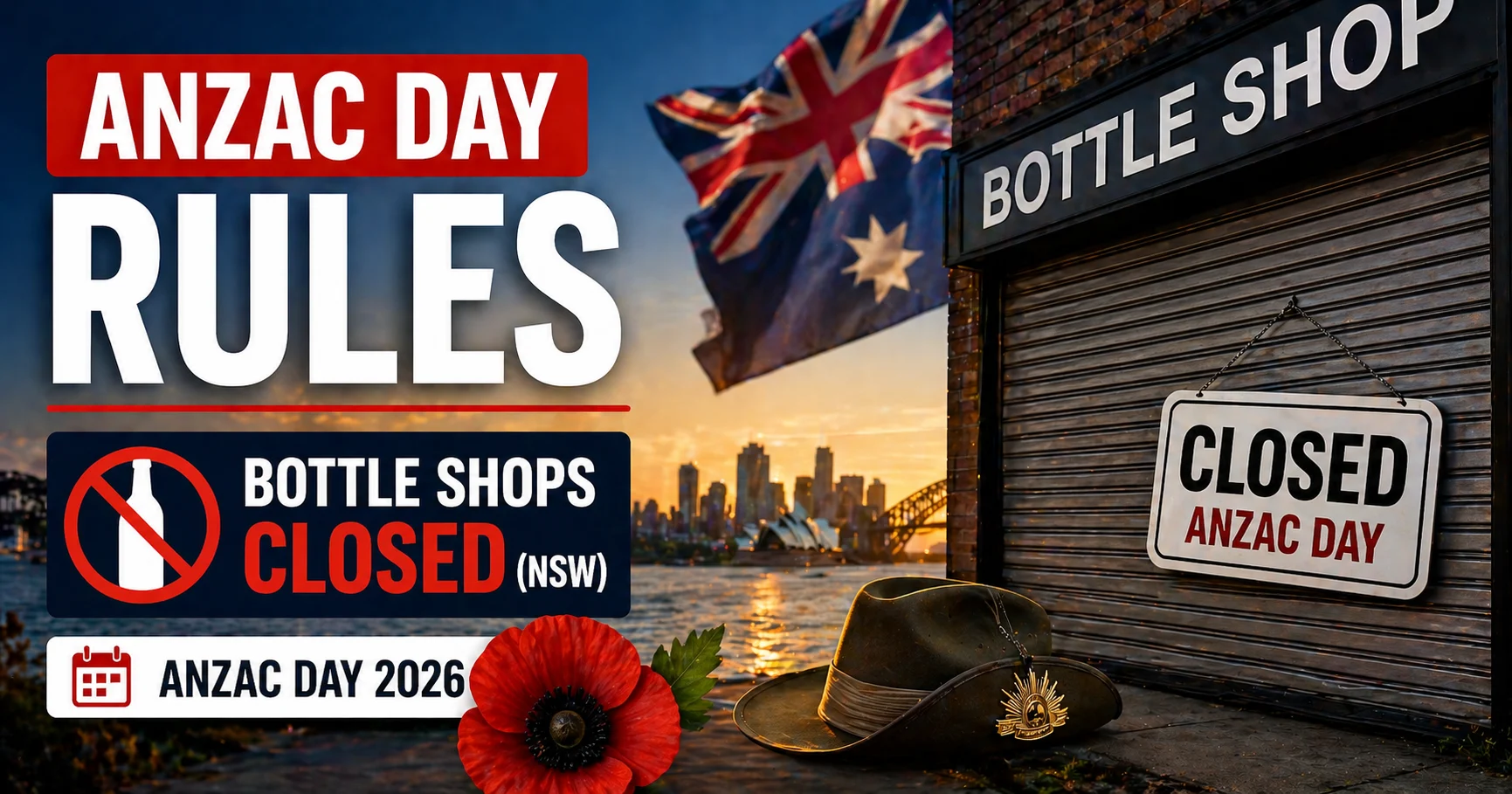
Few retail compliance questions generate more confusion per square metre than what a NSW bottle shop can legally do on Anzac Day. The rules are genuinely odd — and the gap between what operators assume and what the law actually requires has cost some retailers real money.
With Anzac Day falling on Saturday 25 April this year, and an additional public holiday declared for Monday 27 April, the regulatory picture became even more layered. The Monday trading restrictions did not carry over, which meant operators who closed unnecessarily on both days left revenue on the table for no legal reason.
What the NSW Anzac Day Liquor Laws Actually Say
Under the Retail Trading Amendment (Anzac Day Trading Hours) Act, large retailers and major shopping centres in NSW are required to remain closed for the entirety of Anzac Day. That restriction applies to bottle shops attached to or operating within those larger retail formats — which captures a significant share of the BWS and Dan Murphy’s network.
Smaller, independent liquor retailers operate under a different set of conditions. Historically, most bottle shops could trade from 1pm on Anzac Day, allowing commemorative morning services to conclude before retail activity resumed. The newer legislative framework tightened that for larger operators while leaving the 1pm provision in place for qualifying independents.
The practical result is a two-tier system that many operators — particularly those managing multi-site portfolios — find difficult to navigate without legal advice.
The Retailer Pushback and What It Signals
Independent liquor retailers in NSW have been vocal about what they describe as discriminatory treatment under the current framework. Their argument is straightforward: the rules create an uneven playing field where smaller operators can trade in the afternoon while major chains cannot, but the compliance burden and reputational risk of getting it wrong falls disproportionately on independents who lack in-house legal teams.
There is also a revenue and employment dimension. Anzac Day closures across the broader liquor retail sector generate measurable losses in daily turnover, and for stores that rely on casual staff, a mandated closure day affects take-home pay for workers who are already on variable hours.
Endeavour Group, which operates both BWS and Dan Murphy’s and recently appointed Jayne Hrdlicka as CEO and Managing Director, has not publicly detailed its compliance position for this year’s trading period. But with approximately 80 per cent of NSW bottle shops required to remain closed under the current rules, the commercial impact across the Endeavour network alone is material.
How the Rules Compare Across Key Trading Days
| Day | Large Retailers / Majors | Independent Bottle Shops | Anzac Day Restrictions Apply? |
|---|---|---|---|
| Anzac Day (Sat 25 Apr) | Closed all day | Closed until 1pm; may trade from 1pm | Yes |
| Additional Public Holiday (Mon 27 Apr) | Normal public holiday rules apply | Normal public holiday rules apply | No |
| Good Friday | Closed all day | Closed all day | Yes (separate legislation) |
| Easter Sunday | Restricted hours | Restricted hours | Partial |
What These Laws Do Not Cover
The Anzac Day trading restrictions in NSW apply specifically to retail liquor sales from bottle shops and attached retail formats. They do not govern on-premise liquor service — pubs, clubs, and licensed venues operate under separate conditions set by their individual licences and NSW Liquor and Gaming oversight.
The restrictions also do not extend to the additional Monday public holiday declared this year. Operators who treated 27 April as a second Anzac Day trading blackout were applying rules that simply did not exist for that date. NSW Liquor and Gaming confirmed the Anzac Day provisions were limited to 25 April only.
Petrol stations and convenience stores with liquor licences sit in a separate category again, and their trading conditions on Anzac Day depend on the specific licence class they hold.
Who Feels the Impact Most
The operators most exposed to compliance risk are mid-size independent chains — large enough to be uncertain whether they qualify as a “major retailer” under the Act, but without the legal infrastructure of an Endeavour Group to get a definitive answer quickly. For FMCG suppliers with ranging agreements tied to promotional windows over the Anzac Day long weekend, a retailer closure that wasn’t anticipated in the promotional calendar creates a direct sales gap that is rarely recoverable.
NSW’s Liquor Retail Rules in a Broader Context
NSW maintains some of the most restrictive public holiday trading conditions for liquor retail of any Australian state. The policy rationale — preserving the solemnity of Anzac Day — has broad community support, but the legislative architecture that delivers it has grown piecemeal over decades. The result is a compliance environment where the answer to “can I open?” genuinely depends on your store format, licence class, and precise location.
As Endeavour Group moves into a new leadership chapter under Hrdlicka, and as independent retailers continue to press for a review of what they see as structurally unequal rules, the pressure to simplify and standardise NSW’s Anzac Day liquor framework is building. A cleaner, single-tier rule would reduce compliance cost for everyone — and make the policy intent easier to communicate to the public it’s designed to serve.
If you operate a liquor retail business in NSW, or manage a ranging or promotional calendar that spans public holidays, now is the time to get clarity on your specific licence conditions before the next restricted trading period arrives — not the morning of.