
In Dindori district’s Karanjia village, a Baiga tribal woman named Sukhiyabai earned ₹47,000 in a single season selling processed mahua flowers and sal seeds — nearly three times what middlemen paid her just four years ago. Her story is not an outlier. It is the direct result of a cooperative infrastructure quietly reshaping how India’s tribal heartland does business with the world.
I have been tracking the cooperative movement across India’s most underserved districts for years now, and what is unfolding in Madhya Pradesh’s tribal belt through TRIFED — the Tribal Cooperative Marketing Development Federation of India — deserves far more attention than it gets. The federation, operating under the Ministry of Tribal Affairs, has built a pipeline that takes raw forest produce from remote hamlets and channels it toward premium domestic and international markets. The numbers are starting to tell a real story.
Why Madhya Pradesh Sits at the Centre of India’s Tribal Economy
Madhya Pradesh has India’s largest tribal population — approximately 2.13 crore people, constituting over 21% of the state’s residents. Districts like Mandla, Dindori, Jhabua, Barwani, and Alirajpur are overwhelmingly tribal, and for generations, their primary livelihood has been the collection of Minor Forest Produce (MFP). Mahua flowers, tendu patta, sal seeds, lac, honey, tamarind, and chironji — these are not just forest items. They are currency in the tribal economy.
The problem, historically, was brutal. Tribal collectors had zero bargaining power. Middlemen — locally called kochias — would buy mahua at ₹8-10 per kg and sell it at ₹40-50 in urban markets. The value addition happened elsewhere. The profits went elsewhere. The tribal collector remained trapped in a cycle of poverty despite sitting on what is essentially a gold mine of organic, forest-sourced raw material.
How TRIFED Built the Cooperative Pipeline
TRIFED was established in 1987 under the Multi-State Cooperative Societies Act, but its transformation into a serious market-facing institution began in the last decade. The real acceleration came through two mechanisms: the Minimum Support Price (MSP) for MFP scheme, launched in 2014 and expanded significantly since, and the Van Dhan Vikas Yojana (VDVY), launched in 2018.
Under Van Dhan, TRIFED set up Van Dhan Vikas Kendras (VDVKs) — essentially tribal enterprise clusters. Each VDVK groups approximately 300 tribal gatherers into 15 Self-Help Groups of 20 members each. These kendras provide processing equipment, training in value addition, and a cooperative marketing channel. By early 2026, Madhya Pradesh alone had over 490 VDVKs operational, the highest among all Indian states.
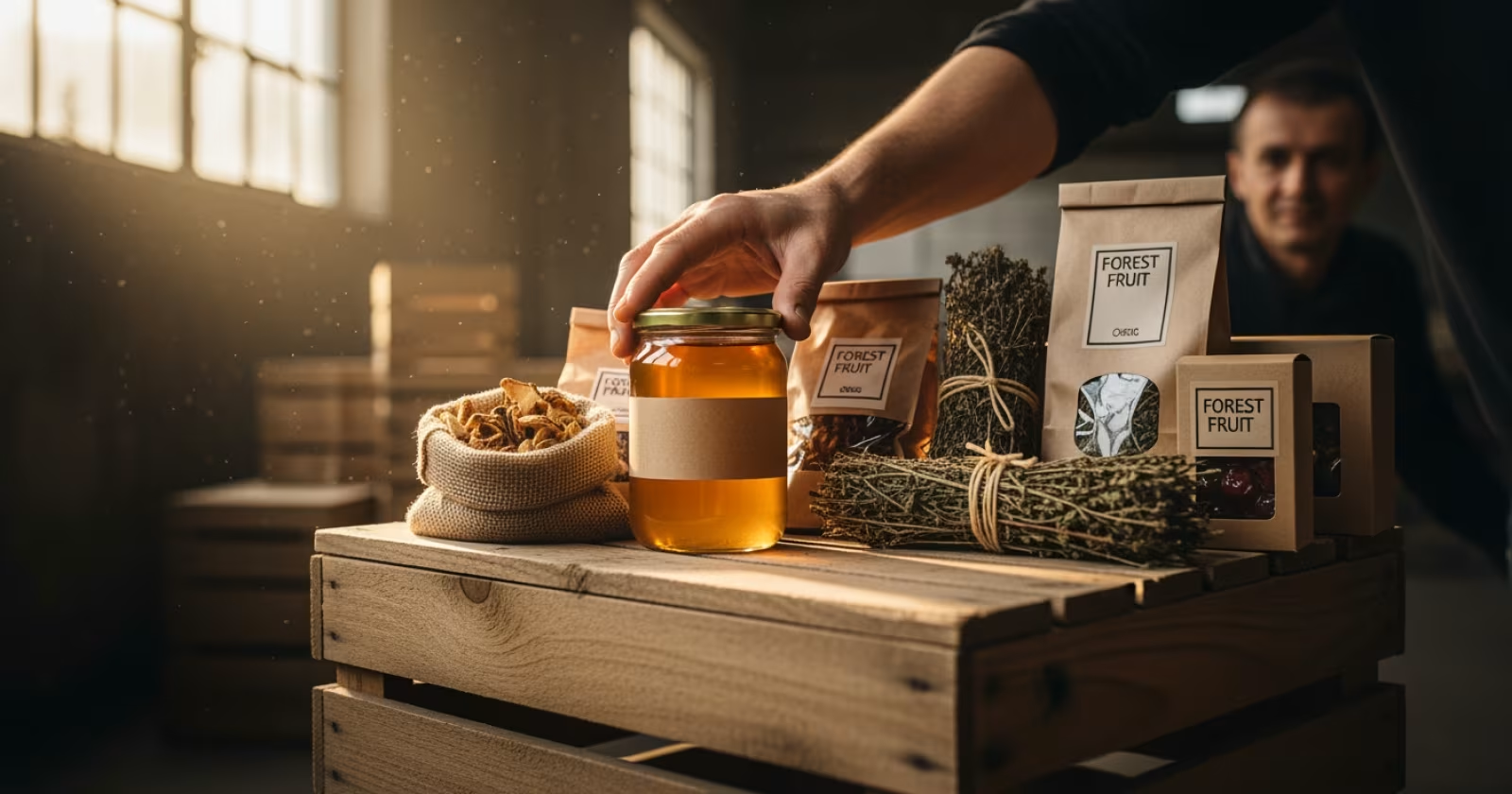
The model works like this: tribal collectors bring raw MFP to the kendra, where it is cleaned, graded, processed, and packaged. Mahua flowers are dried and powdered for health food markets. Sal seeds are pressed into butter used in cosmetics. Wild honey is filtered and bottled under the Tribes India brand. The cooperative structure ensures that the collector receives the MSP at minimum, and any additional margin from value-added processing flows back to the SHG members.
The Export Push: From Forest Floor to Foreign Shelves
This is where the story gets genuinely interesting. TRIFED has been working with NABARD, the Export Inspection Council, and private export partners to get tribal products certified for international markets. Organic certification, FSSAI compliance, and GI tagging efforts are underway for products like Madhya Pradesh’s wild honey, Bastar sal butter, and Vindhyan mahua.
In 2026-26, TRIFED reportedly facilitated trial export consignments of processed tribal products to the United Kingdom, UAE, and Singapore. While the volumes are still modest — estimates suggest approximately ₹35-40 crore worth of products in the export pipeline — the margins are extraordinary. Wild forest honey that fetches ₹200 per kg domestically can command ₹800-1,200 per kg in European organic markets.
| Product | Raw Price (per kg) | Processed Price (per kg) | Export Price (per kg) | Key Districts |
|---|---|---|---|---|
| Mahua Flower | ₹17-25 | ₹80-120 | ₹250-400 | Dindori, Mandla, Chhindwara |
| Sal Seed Butter | ₹12-15 | ₹150-200 | ₹500-700 | Balaghat, Seoni |
| Wild Honey | ₹120-150 | ₹350-500 | ₹800-1,200 | Jhabua, Alirajpur |
| Chironji | ₹400-500 | ₹900-1,100 | ₹1,500-2,000 | Sheopur, Mandla |
| Lac/Shellac | ₹200-250 | ₹600-800 | ₹1,000-1,400 | Betul, Hoshangabad |
What Is Still Broken
I would be dishonest if I painted this as a seamless success story. The challenges are real and structural. First, procurement delays under the MSP scheme remain chronic. Many tribal collectors in remote tehsils report waiting 60 to 90 days for MSP payments, which pushes them back toward middlemen who pay cash on the spot. Second, the quality infrastructure at VDVKs is uneven. Some kendras in Mandla have functional dehydrators and packaging units; others in Barwani are essentially sheds with little usable equipment.
Third, there is the governance question. TRIFED operates at the national level, but state-level implementation depends on bodies like the MP State Minor Forest Produce Federation, which has its own bureaucratic complexities. Political interference in appointments and procurement priorities is an open secret. Finally, climate variability is hitting MFP yields — erratic monsoons in 2024 and 2026 reduced mahua flowering significantly in parts of the Satpura range.
A District-Level Comparison That Sharpens the Picture
Consider two districts: Mandla and Jhabua. Mandla, with strong NGO presence from organisations like PRADAN and better road connectivity, has VDVKs processing and packaging products that reach Tribes India outlets and online portals within weeks. Average tribal household income from MFP in Mandla has risen to approximately ₹65,000-80,000 annually. Jhabua, equally tribal but more remote and with weaker institutional support, sees far lower throughput. Many SHGs there remain on paper. The difference is not in the scheme design — it is in execution density, local leadership, and infrastructure.
Internationally, the comparison with Brazil’s cooperative model for açaí berry exports is instructive. Brazil turned a forest fruit into a billion-dollar global superfood industry through cooperative processing and aggressive branding. India’s tribal produce has the same potential — if the cooperative chain holds.
What the Next Five Years Could Look Like
The Ministry of Cooperation, established in 2021, and the Ministry of Tribal Affairs are reportedly collaborating on a convergence framework that would bring NCDC funding directly to VDVKs for cold storage and processing upgrades. The PACS (Primary Agricultural Credit Societies) revamp, which aims to make each PACS a multi-service hub, could also be extended to tribal cooperatives in MFP-heavy districts.
Technology is entering slowly. TRIFED’s Tribes India e-marketplace and its partnership with platforms like GeM (Government e-Marketplace) are creating digital demand channels. If GI tags are secured for products like Vindhyan mahua and Satpura honey by 2027-28, the export premium could multiply further. The target TRIFED has reportedly set is ₹200 crore in export revenue from tribal MFP by 2028. Ambitious, but not impossible if the cooperative infrastructure scales.
Back to Karanjia Village
Sukhiyabai in Dindori does not think in terms of export pipelines or GI tags. She knows that the kendra near her village pays her fairly, pays her on time most months, and that her daughter is now in Class 10 instead of collecting tendu leaves. That is what a functioning cooperative looks like at the last mile — not a policy document, but a measurable change in what a family can afford to dream about.
If you are tracking India’s cooperative movement, the tribal MFP story in Madhya Pradesh is one of the most consequential and underreported threads. I encourage you to explore IICTF’s coverage of cooperative transformation across India’s tribal regions — and if you work in this space, share what you are seeing on the ground. The data improves only when the people closest to these kendras start telling their stories.