
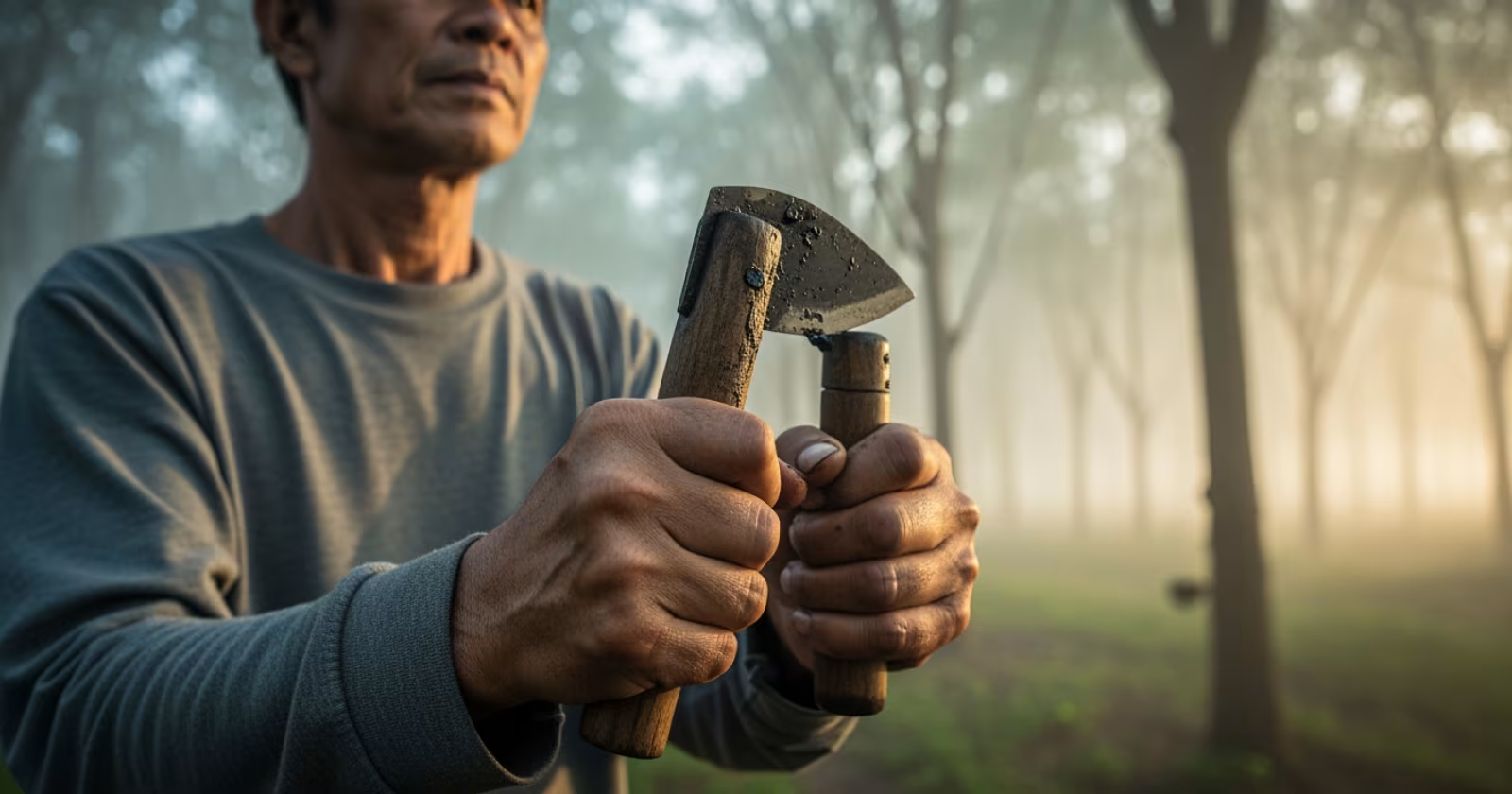
In Pala taluk of Kottayam district, a 58-year-old rubber tapper named Thankachan rolls a sheet of smoked rubber between his fingers and shakes his head. The price he received last month — approximately ₹155 per kilogram — barely covers his cost of production. Five years ago, it was ₹180. Meanwhile, Thai RSS-3 grade rubber lands at Indian ports at prices Indian smallholders simply cannot match. I travelled through Kerala’s rubber belt recently, and what I found was not despair — but a quiet, cooperative-led reinvention that deserves national attention.
Why the Southeast Asian Price War Matters for Indian Rubber
India is the world’s fourth-largest natural rubber producer, yet it is also a massive net importer. In 2026-26, the country imported an estimated 6.5 lakh tonnes of natural rubber, much of it from Thailand, Vietnam, and Indonesia — nations where plantation-scale economies, lower labour costs, and government subsidies create a price floor Indian growers cannot reach. Kerala alone accounts for nearly 75% of India’s rubber output, and the vast majority of that comes from smallholdings under two hectares. The cooperative rubber sector here is not a policy ornament — it is the economic spine of entire districts like Kottayam, Ernakulam, and Pathanamthitta.
When global rubber prices crash, it is not some abstract commodity chart. It means families in Mundakayam and Thodupuzha skip fertiliser applications, pull children from private schools, and consider uprooting trees for more profitable crops.
The Cooperative Rubber Architecture Kerala Built Over Decades
Kerala’s cooperative rubber model traces back to the Rubber Board of India, established under the Rubber Act of 1947, but the real cooperative infrastructure emerged in the 1970s and 1980s. The Rubber Producers’ Societies (RPS) — village-level cooperatives — were designed to aggregate smallholder output, provide technical guidance on tapping and processing, and negotiate better prices collectively. By the 1990s, the Kerala State Cooperative Rubber Marketing Federation, known as RUBBERMARK, had become the apex marketing body, branding cooperative rubber and linking it to domestic tyre manufacturers and export markets.
The genius of this structure was decentralisation. Each RPS operates at the panchayat or ward level, with elected leadership and modest processing infrastructure — smoking chambers, crepe rollers, and grading facilities. RUBBERMARK then aggregates, grades to Bureau of Indian Standards (BIS) specifications, and sells. At its peak, this system covered over 3,200 registered RPS units and more than 10 lakh smallholder families.
The model was never perfect — political patronage in RPS elections, delayed payments, and inconsistent quality control have been recurring complaints. But it gave small growers something they never had alone: market access and a collective voice in price negotiations.
How the Cooperative Model Operates in 2026
Today, a rubber smallholder in Kerala typically sells through one of three channels: the local RPS, a private dealer, or directly at a Rubber Board-licensed market. The cooperative channel works like this: the farmer delivers latex or sheet rubber to the RPS collection centre. The RPS processes it — converting field latex into ribbed smoked sheets (RSS) or technically specified rubber (TSR) — and forwards it to RUBBERMARK or directly to bulk buyers. The farmer receives a base price plus any premium the cooperative secures.
NABARD refinance supports RPS modernisation loans, while the Rubber Board provides replanting subsidies (approximately ₹40,000 per hectare for approved clones) and rain-guarding support. The Price Stabilisation Fund, a scheme the central and state governments have intermittently funded, is supposed to bridge the gap when market prices fall below ₹170/kg — but disbursements have been erratic.
| Parameter | Kerala Cooperative Rubber | Thailand (Benchmark) |
|---|---|---|
| Average Holding Size | 0.5–2 hectares | 5–20 hectares |
| Labour Cost (per kg) | ₹45–55 | ₹18–25 (equivalent) |
| Yield per Hectare | ~1,500 kg | ~1,800 kg |
| Govt Subsidy Support | Intermittent PSF | Direct income support |
| Processing Level | RSS dominant | TSR-20 dominant |
| Export Orientation | Low (~8%) | High (~85%) |
The table makes the structural disadvantage obvious. Kerala’s cooperative growers are competing against a system built for export-scale efficiency.
What Threatens Survival — And What Might Save It
The challenges are layered. First, import duty arbitrage: India’s import duty on natural rubber stands at 25% or ₹30/kg (whichever is lower), but tyre companies have successfully lobbied for concessional imports under advance licence schemes, effectively undercutting domestic prices. Second, climate disruption — unseasonal rainfall in 2026 caused widespread panel disease (abnormal bark necrosis) across Kottayam and Idukki, reducing yields by an estimated 12%. Third, generational exit: younger members of rubber-growing families increasingly prefer urban employment, leaving ageing tappers without successors.
But there are counter-moves. Several progressive RPS units in Pala and Changanassery have invested in centrifuged latex processing — a value-added product that commands ₹20–30 per kg more than sheet rubber and is in growing demand from the foam mattress and glove manufacturing industries. RUBBERMARK has initiated a block-chain based traceability pilot for sustainable rubber certification, targeting European buyers who will pay premiums under the EU Deforestation Regulation (EUDR) compliance requirements taking effect in 2026.
The Ministry of Cooperation has also signalled interest in bringing rubber cooperatives under the national PACS digitalisation programme, which could streamline payments and reduce the 15–30 day lag that currently pushes growers toward private dealers offering instant cash.
A District-Level Turnaround Worth Watching
In Ernakulam district, a cluster of 14 RPS units formed an informal consortium in 2024 to pool resources for a shared TSR (Technically Specified Rubber) processing plant. The plant, funded partly through NCDC soft loans and partly through member contributions, began trial production in early 2026. TSR-20 — the grade most demanded by tyre manufacturers globally — fetches better and more stable prices than traditional RSS grades. If this consortium model works, it could be replicated across Kerala’s rubber belt, giving cooperatives the processing muscle to compete directly with Southeast Asian imports rather than merely surviving on protection.
Compare this with Vietnam, where the state rubber corporation controls vertically integrated plantations and processing. Kerala’s cooperative model cannot replicate that scale — but it can leverage quality, traceability, and the growing global appetite for ethically sourced natural rubber.
What the Next Five Years Look Like
I see two scenarios. In the optimistic one, the PACS digitalisation rollout reaches rubber cooperatives by 2027, RUBBERMARK’s traceability system secures EUDR-compliant export contracts, and TSR processing expands through the consortium model. Rubber cooperatives become viable again — not by matching Thai prices, but by moving up the value chain. The National Rubber Policy review expected in 2026 could also reclassify natural rubber as an agricultural commodity (it is currently an industrial raw material), unlocking MSP-like support mechanisms.
In the pessimistic scenario, import concessions expand under tyre industry pressure, the Price Stabilisation Fund remains underfunded, and another two to three years of depressed prices push a critical mass of smallholders to abandon rubber entirely — converting to oil palm, cocoa, or real estate. That would be an irreversible loss for Kerala’s cooperative infrastructure.
Back in Pala — A Story Still Being Written
Thankachan, the tapper I met in Kottayam, is cautiously hopeful. His RPS recently began collecting latex for centrifuged processing instead of the old smoking method. The price differential is small so far — about ₹12 more per kilogram — but it is something. His son, who works in Kochi’s IT sector, has started attending RPS meetings, curious about the traceability premium story. If Kerala’s cooperative rubber sector survives this price war, it will not be because of government bailouts alone. It will be because thousands of small institutions like Thankachan’s RPS chose to adapt rather than surrender. That quiet resilience, I believe, is the most underreported story in India’s cooperative movement today.