A professional body representing thousands of Indian chartered accountants across the UAE capital has just reshuffled its leadership — and the timing says as much as the names on the roster. The ICAI Abu Dhabi Chapter’s new managing committee arrives at a moment when the accounting profession in the Gulf is being asked to do far more than audit balance sheets.
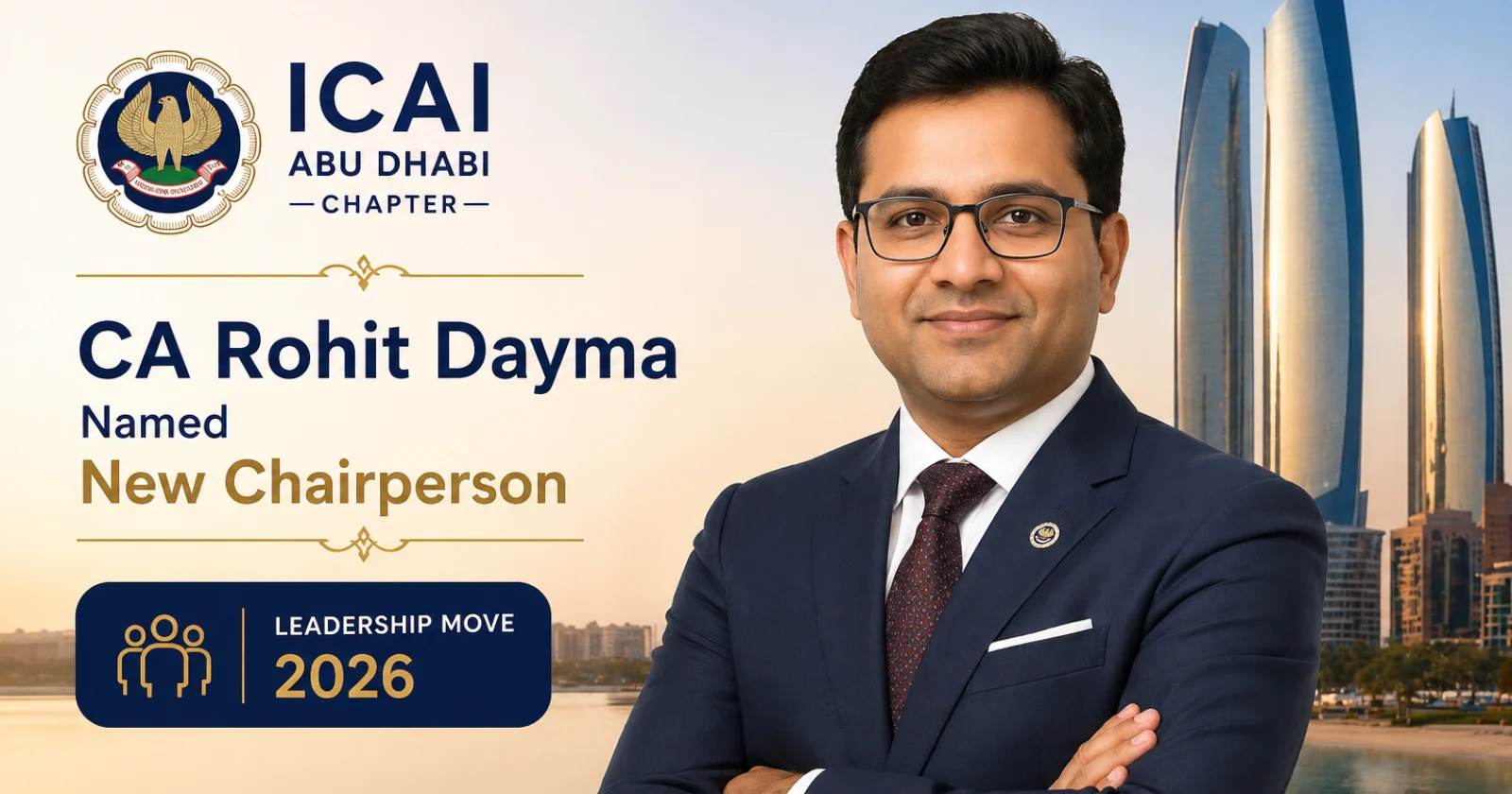
The Institute of Chartered Accountants of India’s Abu Dhabi Chapter has formally announced its new managing committee for the upcoming term. CA Rohit Dayma takes the chair, supported by a structured executive team spanning professional development, membership, media, and communications. The transition matters because ICAI chapters in the UAE serve as critical networking and compliance hubs for a large segment of the emirate’s finance workforce.
What the ICAI Abu Dhabi Chapter Does and Why It Matters for MENA
I find that many people outside the accounting world underestimate the influence of ICAI chapters in the Gulf. The Institute of Chartered Accountants of India is one of the largest accounting bodies globally, with members embedded deeply in the financial infrastructure of the UAE. From audit firms and banks to free zone enterprises and government-linked entities, Indian CAs occupy a significant share of mid-to-senior finance roles across Abu Dhabi and Dubai.
The Abu Dhabi Chapter functions as a local arm of ICAI, organising continuing professional education, facilitating regulatory awareness, and connecting members with opportunities in the emirate’s expanding economy. In a market where corporate tax implementation is still maturing and ESG reporting requirements are tightening, the chapter’s role in upskilling its members carries real commercial weight. It is not merely a social club — it is a professional infrastructure node.
ICAI Abu Dhabi Chapter’s New Managing Committee Takes Charge
CA Rohit Dayma will serve as Chairperson, with CA Priyanka Birla stepping in as Vice Chairperson. CA Mohammed Shafeek assumes the role of General Secretary, while CA Shafeekh Neelayil takes on the Treasurer’s portfolio. The committee structure distributes responsibilities across five clearly defined verticals.
The Professional Development Committee will be led by CA Rajesh Reddy alongside CA Hemlatha Lingamoorthy. The Social Team falls under CA Anu Thomas and CA Prasad Amara. Membership is handled by CA Suma Rajesh with CA Ankit Somani, while Media and Student Affairs are managed by CA Ankit Kothari and CA Satish Jeksani. Communications sit with CA Nirmal Kumar Agarwal and CA Prashant Nathvani.
Speaking after the announcement, Dayma acknowledged the foundation laid by previous committees and signalled a forward-looking agenda. He noted that the new term begins during a period of rapidly evolving global economic and geopolitical conditions, and praised the UAE’s governance environment for providing stability and opportunity for professionals.
| Role | Lead | Co-Lead |
|---|---|---|
| Chairperson | CA Rohit Dayma | — |
| Vice Chairperson | CA Priyanka Birla | — |
| General Secretary | CA Mohammed Shafeek | — |
| Treasurer | CA Shafeekh Neelayil | — |
| Professional Development | CA Rajesh Reddy | CA Hemlatha Lingamoorthy |
| Social Team | CA Anu Thomas | CA Prasad Amara |
| Membership | CA Suma Rajesh | CA Ankit Somani |
| Media & Student Affairs | CA Ankit Kothari | CA Satish Jeksani |
| Communications | CA Nirmal Kumar Agarwal | CA Prashant Nathvani |
How the Committee Structure Reflects Shifting Professional Priorities
I think the committee design tells a story on its own. The inclusion of a dedicated Media and Student Affairs vertical signals an intent to engage younger professionals and CA aspirants based in the UAE. That is a meaningful shift. Historically, Gulf-based ICAI chapters focused primarily on CPE events and networking dinners. A structured student affairs function suggests the chapter is positioning itself as a pipeline — not just a gathering point.
The Professional Development Committee, meanwhile, will likely carry the heaviest workload. The UAE’s corporate tax regime, introduced in 2023, continues to generate compliance questions for businesses of all sizes. VAT audits remain a recurring concern. And with Abu Dhabi’s push toward sustainable finance and digital reporting frameworks, chartered accountants are being asked to advise on areas that barely existed in their original training. The chapter’s ability to deliver relevant, timely upskilling will define its credibility this term.
The Communications and Membership verticals also deserve attention. Growing the chapter’s reach among Abu Dhabi’s expanding Indian professional community — and keeping existing members engaged — requires more than quarterly newsletters. I expect this committee to lean into digital engagement more aggressively than its predecessors.
What This Leadership Change Does Not Alter
A new committee does not change the regulatory landscape CAs operate within. The UAE’s Ministry of Finance and the Federal Tax Authority set the rules; ICAI chapters facilitate understanding but hold no regulatory authority locally. Members still answer to their employers, their clients, and UAE law — not to the chapter.
It is also worth noting that ICAI chapters operate under the broader governance of ICAI’s head office in New Delhi. Strategic decisions about membership standards, examination frameworks, and mutual recognition agreements with other accounting bodies remain outside the local chapter’s direct control. The Abu Dhabi committee’s influence is real but bounded.
For professionals expecting immediate programmatic changes, patience is warranted. New committees typically take one to two quarters to establish their rhythm and roll out signature initiatives. The real measure of this team will come in the second half of 2026.
The professionals who stand to benefit most are mid-career chartered accountants in Abu Dhabi looking for structured CPE, peer networking, and visibility within the emirate’s finance community. Students pursuing the CA qualification from the UAE also gain a more defined support channel. Employers across Abu Dhabi’s financial services, real estate, and energy sectors — who rely heavily on Indian CAs — benefit indirectly from a better-organised professional body keeping their teams current on compliance and best practices.
Abu Dhabi’s Growing Demand for Governance Professionals
I see this committee transition as a small but telling indicator of a larger trend. Abu Dhabi is scaling its financial ecosystem rapidly — from ADGM’s expanding regulatory perimeter to Mubadala’s global investment footprint to the emirate’s push into AI-driven financial services. Every layer of that growth requires governance, audit, and financial reporting infrastructure. The ICAI Abu Dhabi Chapter sits at the intersection of talent supply and institutional demand.
As the emirate’s economy diversifies and its regulatory expectations mature, the professional bodies that organise and upskill the people doing the actual compliance work become quietly essential. This is not a headline-grabbing appointment. But for the thousands of chartered accountants building careers in Abu Dhabi, it shapes the professional environment they operate in every day.
If you are a chartered accountant based in Abu Dhabi or considering a move to the emirate, now is a good time to engage with the ICAI Abu Dhabi Chapter directly. Reach out to the membership team, attend the first events of the new term, and make sure your professional development keeps pace with what the UAE market increasingly demands.
The committee CA Rohit Dayma now leads will be judged not by its structure on paper but by whether Abu Dhabi’s CA community feels measurably better equipped when this term ends.