
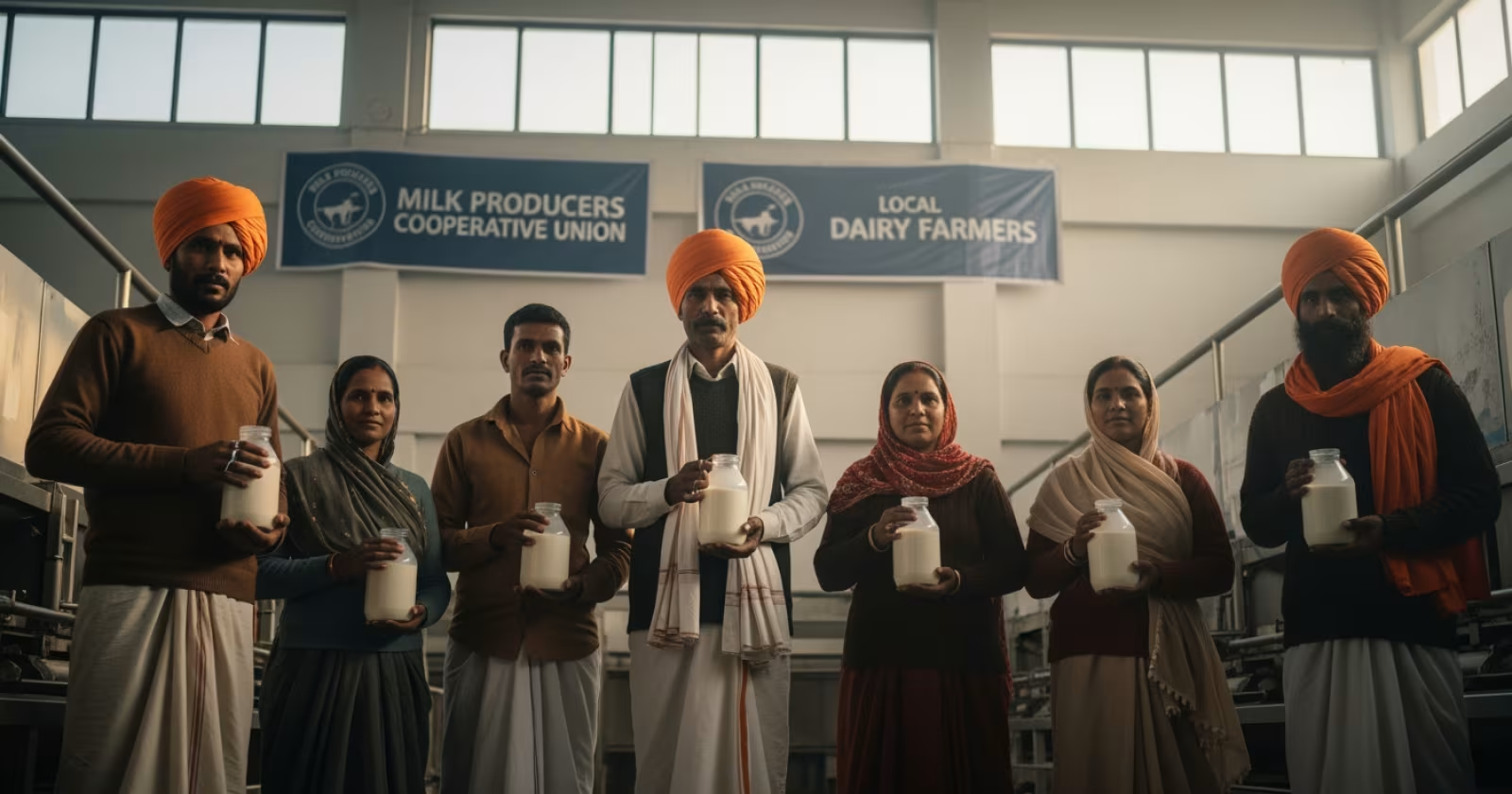
In a tin-roofed collection shed on the outskirts of Adampur village, Hisar district, a 54-year-old buffalo farmer named Ramkishan watched the electronic milk analyser blink its reading — 6.8% fat, 9.1% SNF. Two years ago, he sold his evening yield to a private contractor for ₹38 per litre with no quality testing at all. That morning in January 2026, the Haryana Dairy Development Cooperative Federation, better known by its brand name VITA, paid him ₹62 per litre, transferred directly to his bank account within 48 hours. The difference — ₹24 per litre, roughly ₹700 a day for his modest 30-litre output — meant his daughter could stay in her private coaching centre in Bhiwani for one more year.
Why This Fight Matters Beyond Haryana
I have been tracking India’s dairy cooperative landscape for over a decade, and what is unfolding in Haryana deserves national attention. This is a state that produces approximately 11.2 million tonnes of milk annually, ranking among India’s top five milk-producing states. Yet for decades, private dairy companies — from regional players like Parag and Kwality to multinational-backed brands — captured the lion’s share of procurement. The cooperative channel, despite its roots in the Operation Flood era, had withered to near irrelevance in several Haryana districts by 2018.
Now, backed by aggressive state policy, a revamped technology stack, and the Union Ministry of Cooperation’s push to strengthen cooperative infrastructure, VITA and its network of district milk unions are fighting back. The stakes are enormous — not just for Haryana’s estimated 9 lakh dairy farming households, but for the broader question of whether cooperatives can still compete in a market increasingly dominated by private capital.
From Operation Flood to Near Collapse
The story of Haryana’s dairy cooperatives begins, like most Indian dairy stories, with Dr Verghese Kurien and the National Dairy Development Board (NDDB). VITA was established in 1970 as part of the Operation Flood programme, modelled on Gujarat’s spectacularly successful AMUL structure. The federation was designed as a three-tier system — village-level dairy cooperative societies feeding into district milk unions, which in turn fed the state-level federation.
For a while, it worked. By the mid-1980s, VITA operated processing plants in Hisar and Jind, with a daily handling capacity of roughly 3 lakh litres. But what happened next is a cautionary tale I have seen repeated across several northern states. Political appointments replaced professional management. Procurement prices stagnated while private players offered marginally better rates with cash-in-hand convenience. Plant infrastructure aged without upgrades. By 2015, VITA’s daily milk procurement had reportedly fallen below 1.5 lakh litres — a fraction of its potential in a state swimming in buffalo milk.
The private sector filled the vacuum eagerly. Companies set up their own collection networks, often employing the same village agents the cooperatives had trained. The farmer got a slightly better spot price but lost every other benefit — no cattle insurance linkage, no veterinary support, no input supply chain.
The Turnaround Machinery in 2026
What changed? I would point to three converging forces. First, the Ministry of Cooperation, established in 2021, began channelling dedicated funds toward reviving state dairy federations. Under the National Programme for Dairy Development (NPDD) and supplementary NABARD refinance schemes, VITA received approximately ₹340 crore between 2022 and 2026 for plant modernisation, cold chain expansion, and bulk milk cooler installation at the village level.
Second, the Haryana state government restructured VITA’s board governance in 2023, mandating that at least three of seven directors be practising dairy farmers elected directly by village societies. This was not a radical step — AMUL has operated this way for decades — but for Haryana, it marked a significant departure from the era of bureaucratic chairpersons.
Third, and perhaps most critically, VITA adopted an end-to-end digital procurement system. Every collection centre now uses electronic milk analysers linked to a centralised ERP platform. Farmers receive SMS confirmations of quantity, fat content, and payment calculations within minutes of pouring. Payments are processed via direct bank transfer on a 48-hour cycle — faster than most private operators in the region.
The results are showing. VITA’s daily procurement crossed 4.2 lakh litres in early 2026, a nearly threefold increase from its 2019 low. The number of active village dairy cooperative societies has risen from approximately 1,800 to over 3,400 across all 22 districts.
| Parameter | 2019 | 2026 (Estimated) |
|---|---|---|
| Daily Milk Procurement (Lakh Litres) | 1.5 | 4.2 |
| Active Village Dairy Societies | 1,800 | 3,400+ |
| Average Procurement Price (₹/Litre, Buffalo) | 42 | 60-65 |
| Processing Plant Capacity (Lakh Litres/Day) | 3.0 | 5.5 |
| Farmer Payment Cycle | 7-10 days | 48 hours |
What the Private Giants Are Doing Differently
I do not want to paint a simplistic picture of cooperative good versus private bad. The truth is that companies like Mother Dairy, which itself is an NDDB subsidiary operating commercially, and large private processors have invested heavily in Haryana’s cold chain. Some private players offer farmers advance payment, input credit for cattle feed, and even informal insurance arrangements. Their supply chains are lean and responsive.
The cooperative model’s advantage lies elsewhere — in aggregating bargaining power, linking farmers to government veterinary and breeding programmes, and ensuring that processing margins flow back to producers rather than to shareholders. The challenge for VITA is proving it can match private efficiency while delivering these structural benefits. In districts like Fatehabad and Sirsa, where private procurement networks are deeply entrenched, cooperative market share remains below 20%.
A District-Level Story Worth Watching
The Bhiwani District Milk Union offers a compelling micro-case. Revived from near-dormancy in 2023 with NABARD infrastructure support, this union now operates 14 bulk milk coolers and procures from 280 village societies. What makes Bhiwani interesting is its aggressive push into value-added products — flavoured lassi, paneer, and ghee under the VITA brand sold through both retail outlets and an online direct-to-consumer channel launched in late 2026. The union reported a 32% increase in farmer-level payout over 18 months, driven primarily by these higher-margin products rather than raw milk sales alone. If this model scales, it could serve as a template for other Haryana districts still trapped in the commodity milk cycle.
The Road Ahead — Technology, Climate, and Trust
Looking forward, three factors will determine whether Haryana’s dairy cooperative revival sustains or stalls. First, climate stress — Haryana’s summer temperatures now routinely exceed 47°C in western districts, directly impacting buffalo milk yields and raising the cost of fodder and cooling infrastructure. VITA’s cold chain must expand faster than the warming climate degrades it.
Second, feed cost inflation remains a structural challenge. Cooperative societies that can organise collective fodder procurement and link farmers to silage-making technology will survive; those that cannot will lose farmers back to private collectors offering spot-price convenience.
Third, the intangible factor — trust. Decades of mismanagement eroded farmer confidence in cooperative institutions across Haryana. Rebuilding that trust requires consistent on-time payments, transparent quality testing, and visible reinvestment in village-level infrastructure. The digital payment trail is helping, but it is a long road.
Back to Adampur
When I last checked on Ramkishan’s situation through a cooperative field officer in Hisar, his daily output had increased to 35 litres — he had purchased a second buffalo using a NABARD-linked cooperative loan. His daughter was still attending coaching in Bhiwani. He told the officer that for the first time in twenty years, he felt like the milk price was not a surprise announced by a private agent on a motorcycle, but a number he could predict and plan around. That predictability — boring as it sounds — is the cooperative movement’s most powerful product. If VITA can keep delivering it, Haryana’s dairy map will look very different by 2030.
If you are connected to dairy farming, a cooperative society, or policy research in North India, I would encourage you to follow IICTF’s ongoing coverage of the cooperative dairy revival. These shifts do not just affect procurement prices — they reshape entire rural economies. The story is still being written, and it is worth your attention.