Forty-two kilometres of tunnel, 40 metres below the surface, connecting districts that didn’t exist a decade ago with ones that have defined Dubai for generations. That single sentence captures why the newly approved Dubai Metro Gold Line is more than a transport project — it’s a statement about where the emirate’s next phase of growth actually lives.
His Highness Sheikh Mohammed bin Rashid Al Maktoum, Vice President and Prime Minister of the UAE and Ruler of Dubai, has approved the AED 34 billion metro corridor, making it the largest sustainable transport initiative in the emirate’s history. Work has been instructed to begin immediately, with a completion target of 9 September 2032.
What the Dubai Metro Gold Line Means for the Emirate’s Urban Future
I’ve covered infrastructure announcements across the Gulf for years, and what stands out here isn’t just the price tag. It’s the intent behind the route design. Dubai’s existing Red and Green Lines were built to serve the city as it was. The Gold Line is being built to serve the city as it’s becoming.
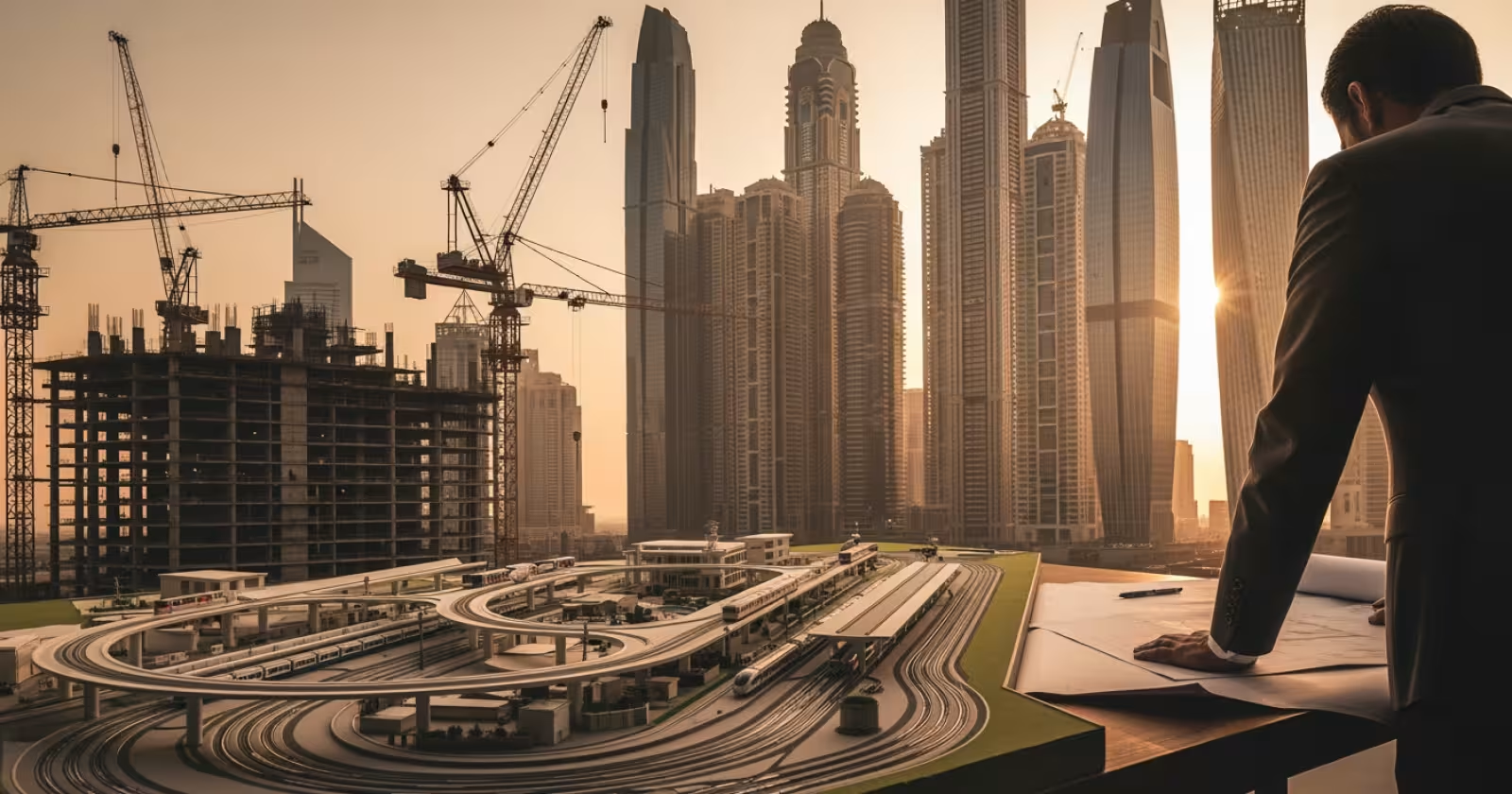
The emirate has 55 major developments currently under construction along the planned corridor. That’s not a coincidence — it’s coordinated urban planning at a scale few cities attempt. The Gold Line will be Dubai’s first fully underground metro, running beneath areas where surface-level rail would be impractical given the density of new construction above.
For the roughly 1.5 million residents the line is projected to serve, this fills a genuine mobility gap. Areas like Jumeirah Village Circle, Meydan, and Mohammed Bin Rashid City have grown rapidly but remain car-dependent. Underground rail changes that equation fundamentally.
AED 34 Billion Gold Line: Route, Scale, and Delivery Timeline
The confirmed route runs from Al Ghubaiba — one of Dubai’s oldest commercial districts — through to Jumeirah Golf Estates in the south-west. Along the way, it passes through Mina Rashid, City Walk, Business Bay, Mohammed Bin Rashid City, Nad Al Sheba, Meydan, Al Barsha South, and Jumeirah Village Circle. That’s 18 stations across 15 major locations.
The line will integrate directly with both the Red and Green Lines, creating a three-line metro network for the first time. Critically, it will also connect with Etihad Rail, the UAE’s national rail system, linking Dubai’s urban transit to the broader inter-emirate corridor.
Sheikh Mohammed stated that the Gold Line will expand the Dubai Metro network by 35%. The delivery timeline of September 2032 is approximately 30% faster than the schedule set for the Dubai Metro Blue Line, signalling a deliberate acceleration in execution.
| Detail | Dubai Metro Gold Line |
|---|---|
| Total Investment | AED 34 billion (approx. USD 9.3 billion) |
| Route Length | 42 kilometres |
| Depth | 40 metres underground |
| Number of Stations | 18 |
| Key Locations Served | 15 |
| Residents Served | Approximately 1.5 million |
| Network Expansion | 35% increase to Dubai Metro |
| Target Completion | 9 September 2032 |
| Delivery Speed vs Blue Line | Approximately 30% faster |
How the Gold Line Reshapes Connectivity Across Dubai
Think of Dubai’s current metro map as two vertical spines running through the city. The Gold Line adds a diagonal, stitching together residential clusters in the south with commercial centres closer to the coast. That geometry matters because it reduces transfer dependency — riders moving between, say, Business Bay and JVC won’t need to route through a central interchange.
The Etihad Rail integration is the detail I find most significant for long-term planning. It means a resident in Abu Dhabi could eventually travel by rail to a Gold Line station in Dubai without switching systems. That kind of interoperability is what turns individual projects into a national transport network.
The approval was made in the presence of senior leadership including Sheikh Hamdan bin Mohammed, Crown Prince of Dubai; Sheikh Maktoum bin Mohammed, First Deputy Ruler; and Mattar Al Tayer, Director General of the Roads and Transport Authority. The breadth of leadership present signals this is being treated as a priority across Dubai’s governance structure, not just an RTA initiative.
What the Gold Line Does Not Resolve
A 42-kilometre underground line is substantial, but it doesn’t eliminate Dubai’s last-mile challenge. Many of the areas along the route — Meydan, Nad Al Sheba, parts of MBR City — are low-density by design. Without feeder bus networks or micro-mobility solutions at each station, ridership could underperform relative to the population served.
The project’s cost has been confirmed at AED 34 billion, but financing details, contractor selection, and phased delivery milestones have not been disclosed. For investors watching Dubai’s fiscal position, those details will matter as the project moves from approval to execution. Construction timelines for fully underground corridors also carry inherent geological and logistical risk, though Dubai has prior tunnelling experience from the Green Line extension.
Who Gains Most from This Approval
Property developers along the corridor stand to benefit immediately. Areas like JVC and Al Barsha South, which have seen strong residential supply but limited transit access, should see valuation support. Residents in those communities gain the most practical benefit — shorter commutes, reduced car dependency, and better access to employment hubs in Business Bay and the older city centre. Construction and engineering firms with Gulf experience will be watching for tender announcements in the coming months.
Dubai’s Infrastructure Spending Signals a Structural Shift
I see the Gold Line as part of a broader pattern that’s easy to miss if you look at each project in isolation. Dubai is systematically building the physical infrastructure for a city of 7 to 8 million people. The Blue Line, the Gold Line, Etihad Rail connectivity, and the expansion of Al Maktoum International Airport all point in the same direction — a city that’s planning for density, not just growth. For the MENA region, this level of sustained capital deployment into public transit is rare and worth watching closely.
The September 2032 target will be the real test. If Dubai delivers the Gold Line on schedule, it won’t just have a new metro corridor — it will have proven that large-scale underground infrastructure can be executed in the Gulf at a pace that rivals anywhere in the world.