
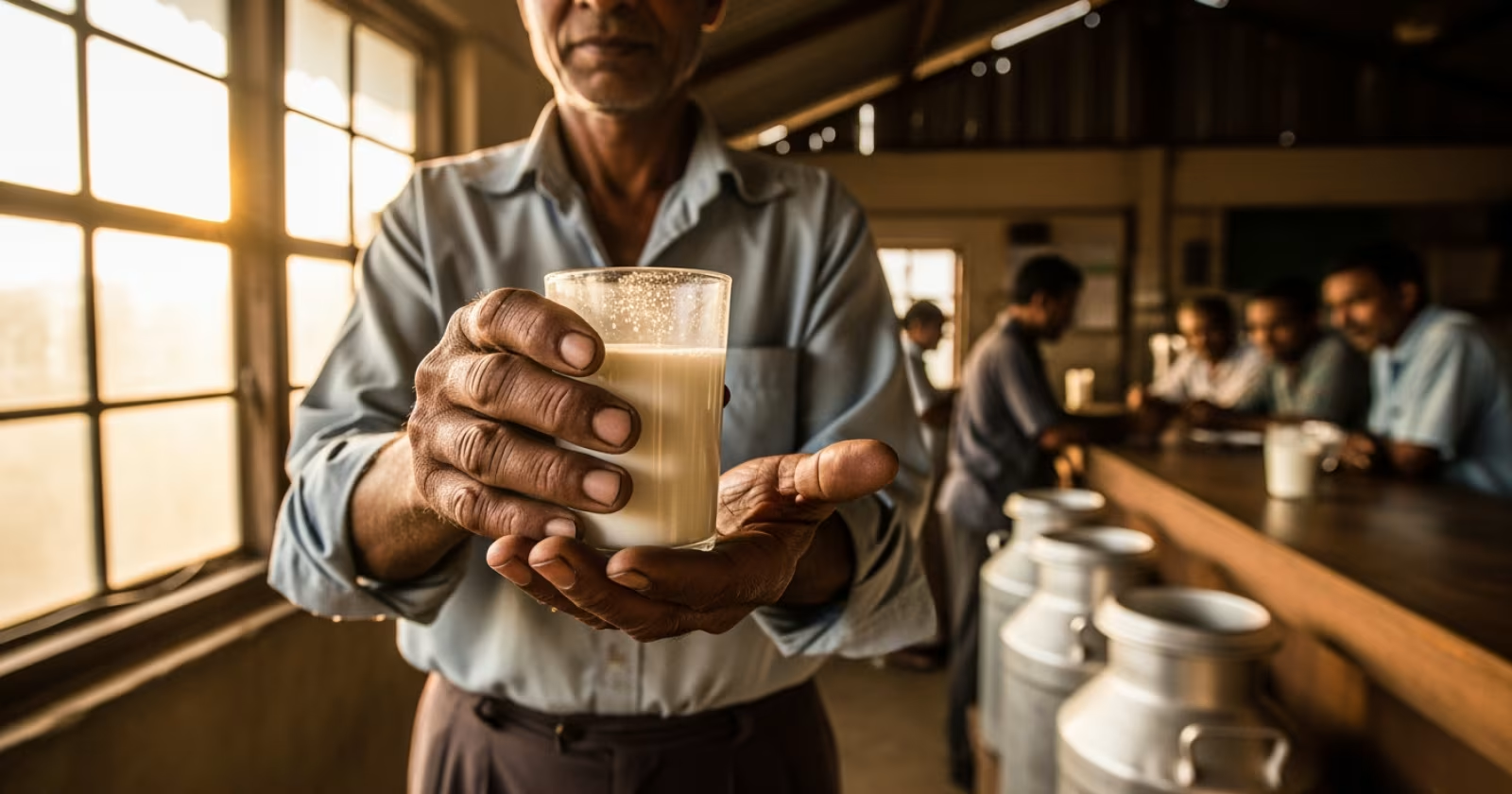
In a village of barely 800 households in Kheda district, Gujarat, the local dairy cooperative society processes approximately 12,000 litres of milk every single day — and channels annual revenues that would make a Series-A funded startup blush. I first encountered this story not through a business journal but through a farmer named Rameshbhai, who told me his family’s monthly milk income had crossed ₹45,000, more than what his brother earns as a clerk in Ahmedabad. That single detail rewired how I think about rural enterprise.
Why a Village Milk Booth Matters More Than You Think
India is the world’s largest milk producer, crossing 230 million tonnes annually as of 2026-26 estimates. But here is what rarely makes headlines: the backbone of this output is not corporate dairies or venture-funded D2C milk brands. It is roughly 1.9 lakh village-level dairy cooperative societies spread across states, each one a micro-business run by farmers themselves. The cooperative dairy model, born out of desperation in post-Independence India, has quietly scaled into a system with combined turnover rivalling that of major FMCG conglomerates.
The village I am writing about sits in the shadow of a much larger legend — Amul, or more formally, the Gujarat Cooperative Milk Marketing Federation (GCMMF). But this is not the Amul story you already know. This is about the granular unit, the single village society, and how its economics actually work.
The Origin: When Farmers Refused to Be Cheated
The story begins in the late 1940s. Milk farmers across Kheda district were at the mercy of private contractors and the Polson Dairy monopoly. Prices were dictated, quality standards were absent, and farmers had zero bargaining power. In 1946, under the guidance of Tribhuvandas Patel and later the visionary engineer Verghese Kurien, farmers in Anand organised themselves into the Kaira District Cooperative Milk Producers’ Union. The idea was radical for its time — eliminate the middleman entirely, let farmers own the supply chain from collection to processing to marketing.
What followed was Operation Flood, launched in 1970 by the National Dairy Development Board (NDDB), which replicated the Anand model across India. By 1996, India had overtaken the United States as the world’s top milk producer. The village-level society became the atomic unit of this revolution — a place where every farmer, regardless of caste or landholding, could pour milk into a common collection centre and receive payment based on fat content.
The particular village society I visited was registered in 1963. It started with 40 members and two aluminium cans. Today it has over 600 active pour members, a bulk milk cooler, an electronic milk testing machine, and a monthly payout cycle that runs with near-bank-like punctuality.
How the Economics Actually Work
Let me break down the numbers because they are genuinely surprising. Each member brings milk twice a day. The society tests fat and SNF (solids-not-fat) content electronically, records the quantity, and pays fortnightly. The milk is then chilled and transported to the district union’s processing plant.
| Parameter | Village Society Data (2026-26 est.) |
|---|---|
| Active pour members | 620 |
| Daily milk collection | ~12,000 litres |
| Average price paid to farmer | ₹55-65 per litre (buffalo milk) |
| Annual milk revenue throughput | Approximately ₹24-26 crore |
| Annual bonus/dividend to members | ₹3-5 per litre (paid yearly) |
| Veterinary services provided | Free AI, vaccination, cattle feed at subsidised rates |
That annual throughput figure — approximately ₹25 crore — is what stops you in your tracks. Most Indian startups that raise seed funding are valued at less. This village society moves that kind of money with no venture capital, no equity dilution, no pitch decks. The “investors” are the farmers themselves, each holding a nominal share of ₹10-100.
Beyond the milk price, the society provides artificial insemination services, cattle feed at below-market rates, and veterinary care. These ancillary benefits often save a farmer ₹8,000-12,000 per year — money that would otherwise leak to private vendors. The district union also distributes a year-end bonus based on the society’s performance, which typically adds another ₹3-5 per litre retroactively.
The Cracks Beneath the Surface
It would be dishonest to paint this as a frictionless utopia. Village dairy societies face real structural challenges. First, governance quality varies wildly. In Gujarat, the system works because of decades of institutional culture, but replicate this in eastern Uttar Pradesh or Jharkhand and you find societies that exist only on paper — registered with the Registrar of Cooperative Societies but controlled by local political figures who siphon funds.
Second, climate stress is squeezing yields. Heat waves in 2024 and 2026 reduced per-animal output across western India. Cattle feed prices have risen approximately 18% in two years. Farmers absorb this cost directly, and the cooperative price mechanism, while fair, cannot always adjust fast enough.
Third, there is the competitive threat from private dairy companies — firms that offer spot premiums to lure farmers away from cooperative collection centres. In Maharashtra, this has already fragmented the cooperative supply chain in several districts. The Ministry of Cooperation, established in 2021, has signalled intent to strengthen PACS and dairy cooperatives, but policy intent and ground-level execution remain distant cousins.
A District-Level Contrast That Sharpens the Story
Consider the contrast between Anand district in Gujarat and Vaishali district in Bihar. Both are significant milk-producing regions. In Anand, more than 85% of dairy farmers pour into cooperatives. The district union processes over 35 lakh litres daily. In Vaishali, despite comparable cattle populations, cooperative penetration is below 20%. Most milk flows through informal channels — local doodhwalas, unregistered contractors — at prices 15-20% lower than what cooperatives would pay. The gap is not about milk; it is about institutional trust and managerial capacity. Bihar’s COMFED (Bihar State Milk Cooperative Federation) has made progress but remains decades behind GCMMF in infrastructure and farmer loyalty.
What Comes Next: Technology and the 2030 Horizon
The NDDB and NABARD are now pushing digital milk procurement systems across cooperatives. Automated collection units, IoT-enabled bulk milk coolers, and mobile-based payment tracking are being piloted in several states. The goal is to bring the transparency and efficiency of a Gujarat-model society to every state by 2030.
The National Programme for Dairy Development (NPDD) has allocated significant funds for strengthening village-level infrastructure in the current plan period. If even half of India’s registered dairy cooperative societies could operate at the efficiency of the Kheda village I described, the sector’s collective throughput would rival that of India’s entire organised retail dairy market. That is not a fantasy — it is an engineering and governance problem with a known solution.
Back to Rameshbhai’s Doorstep
When I asked Rameshbhai whether he had ever considered stopping dairy farming, he looked at me as if I had asked something absurd. His four buffaloes, he explained, are his retirement plan, his children’s education fund, and his daily cash flow — all wrapped into one. The cooperative society is not a government scheme to him. It is the institution he trusts more than his bank. That trust, multiplied across 600 families in one village, is what built a ₹25 crore business without a single investor meeting. If India’s cooperative movement can bottle that trust and replicate it, the implications go far beyond milk.
If you are involved in the cooperative sector — as a member, administrator, or policymaker — I would encourage you to study these village-level models closely. The answers to rural India’s economic future might not be in Bangalore’s startup corridors. They might be in a milk collection booth that opens at five in the morning.