
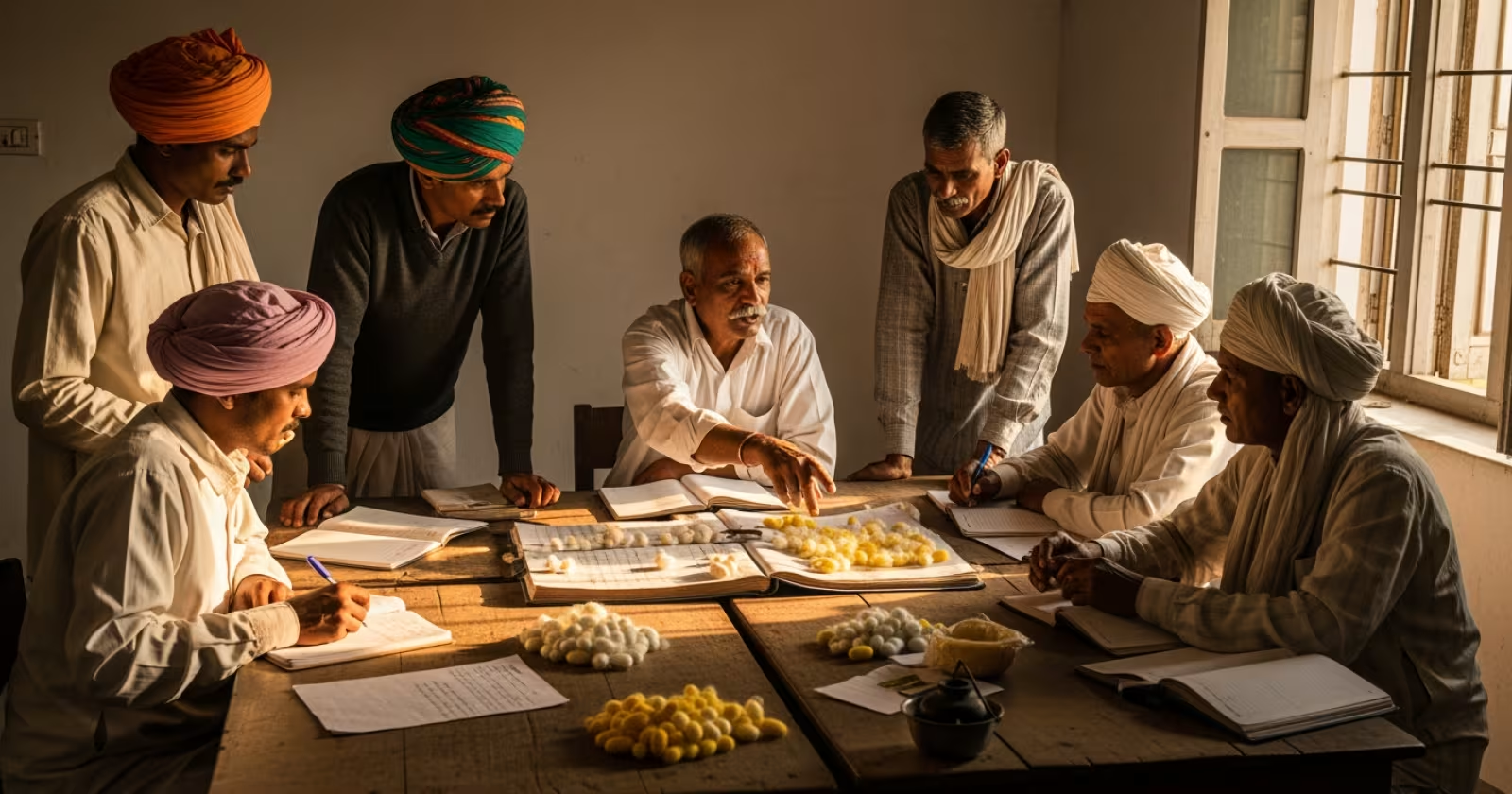
On a Monday morning in the Ramanagara Cocoon Market, the largest raw silk cocoon trading hub in Asia, a farmer named Manjunath from Channapatna taluk watches as his weekly harvest of bivoltine cocoons fetches ₹485 per kilogram — nearly ₹70 more than what he earned this time last year. He credits his local sericulture cooperative for the difference. Without their grading assistance and collective bargaining, he says, middlemen would have paid him half.
That scene repeats itself thousands of times each week in this dusty Karnataka district, barely 50 kilometres southwest of Bengaluru. I’ve been tracking India’s cooperative silk story for years, and Ramanagara remains, without exaggeration, the single most important geography in the country’s silk economy. Approximately 60% of India’s total raw silk output traces its origin to the mulberry farms and reeling units clustered across this district and its neighbouring taluks.
Why Ramanagara’s Silk Cooperatives Matter Beyond Karnataka
India is the world’s second-largest silk producer after China, generating roughly 35,000 metric tonnes of raw silk annually. Yet despite this output, India remains a net silk importer — the domestic handloom and powerloom sector’s demand far outstrips supply. Within that gap lies Ramanagara’s strategic importance. The district’s cooperative infrastructure doesn’t just serve local reelers; it feeds raw material to weavers in Varanasi, Kanchipuram, Pochampally, and Murshidabad.
The cooperative model here is not a government afterthought. It is the backbone of a supply chain that touches an estimated 12 lakh sericulture families across Karnataka. When Ramanagara’s cooperatives function well, silk prices stabilise nationally. When they stumble, ripple effects reach weavers thousands of kilometres away.
A Silk Heritage Rooted in Centuries of Practice
Sericulture in the Ramanagara belt didn’t begin with a government scheme. Mulberry cultivation in this region dates back to the era of Tippu Sultan, who actively encouraged silk production in Mysore state during the late 18th century. The modern cooperative structure, however, took shape after Independence. The Central Silk Board, established in 1948, began organising fragmented growers into primary cooperative societies during the 1960s and 1970s.
By the 1980s, the Karnataka Silk Industries Corporation (KSIC) — famous for its Mysore Silk brand — was sourcing heavily from cooperative-linked growers in Ramanagara. The Ramanagara Cocoon Market itself was formalised during this period, evolving from informal roadside trading into a structured auction system where cooperative-registered farmers could sell directly. The district was carved out of the old Bangalore Rural district in 2007, partly in recognition of its distinct economic identity built around silk.
Today, the cooperative ecosystem here includes primary sericulture cooperative societies at the village level, taluk-level federations, and connections upward to KSIC and NCDC-funded programmes. NABARD has also channelled significant credit lines into bivoltine sericulture development across the district.
How the Cooperative Silk Economy Actually Functions
Let me break down how a farmer like Manjunath actually benefits from this system. At the base level, a grower joins a primary sericulture cooperative society in their village. Membership costs are nominal — often ₹100 to ₹500. Through the cooperative, the farmer accesses subsidised disease-free layings (silkworm eggs), technical guidance from the Department of Sericulture, and critically, a guaranteed entry into the Ramanagara auction system.
The Ramanagara Cocoon Market operates on specific days of the week. Farmers bring their cocoons, which are graded by quality. The cooperative identity card ensures they can sell directly rather than through a commission agent. Prices are determined by open auction, and payments are typically settled within 24 to 48 hours — a significant advantage over informal channels where delays of weeks are common.
| Parameter | Cooperative Member | Non-Member (Informal Channel) |
|---|---|---|
| Average price per kg (bivoltine cocoon, 2026) | ₹450–₹500 | ₹320–₹380 |
| Payment settlement | 24–48 hours | 7–21 days |
| Access to subsidised DFLs | Yes | No |
| Technical extension support | Regular | Rare |
| Market access | Ramanagara auction (direct) | Middlemen |
| Crop insurance linkage | Available via cooperative | Self-arranged |
Above the village level, reeling cooperatives purchase cocoons and convert them into raw silk yarn. Karnataka’s reeling sector is a mix of traditional charkha reelers and modern automatic reeling machines — the latter producing higher-grade silk demanded by premium handloom clusters. The state government and Central Silk Board have been pushing automatic reeling adoption through cooperative channels, though the transition remains slow.
The Cracks in Ramanagara’s Silk Cooperative Model
For all its strengths, the system faces serious pressure. The most immediate threat is urbanisation. Ramanagara’s proximity to Bengaluru means agricultural land — including prime mulberry plots — is being converted for real estate and industrial use at an alarming rate. Young farmers increasingly see software jobs in the city as more attractive than tending silkworm trays.
Then there’s the competition from cheap Chinese silk imports. Despite anti-dumping duties, Chinese raw silk enters Indian markets at prices that undercut domestic producers. The cooperative reeling units, especially those still using traditional methods, cannot match these prices. Climate variability adds another layer of risk — silkworms are extraordinarily sensitive to temperature and humidity fluctuations, and erratic monsoons in recent years have caused periodic crop failures across the district.
Political interference in cooperative governance is another persistent issue. Board elections in some sericulture cooperatives have become proxies for local political battles, diverting attention from farmer welfare to patronage networks. Several cooperatives in the Magadi and Kanakapura taluks have reported governance disputes that have frozen their operations for months.
Lessons from Suzhou and What Ramanagara Could Borrow
China’s Suzhou silk district offers an instructive comparison. There, cooperative-like producer collectives were systematically upgraded with automatic reeling technology in the 2000s, backed by massive state investment. The result was a quality leap that allowed Chinese silk to dominate global markets. Ramanagara has the farmer base and the institutional history to attempt something similar, but the capital investment has been a fraction of what China deployed.
Closer to home, the Dharwad silk cluster in northern Karnataka attempted a cooperative-led branding initiative, marketing silk directly to garment manufacturers under a collective trademark. The results were mixed but showed that cooperatives can move up the value chain if given the right support. Ramanagara’s cooperatives, with their scale advantage, are better positioned for such experiments.
What the Next Five Years Could Look Like
The Ministry of Cooperation’s push to computerise and professionalise PACS (Primary Agricultural Credit Societies) across India could indirectly benefit sericulture cooperatives if the model extends to non-credit primary societies. The Silk Samagra integrated scheme, with its focus on bivoltine silk production and automatic reeling, has earmarked funds specifically for Karnataka’s silk belt through 2026-27.
If Ramanagara’s cooperatives can solve three problems — retaining young farmers through better incomes, upgrading reeling technology, and cleaning up governance — the district could realistically increase its raw silk output by 15-20% within five years. The demand is there. India’s handloom silk consumption continues to grow, driven by wedding markets and premium fashion. The question is whether the cooperative infrastructure can keep pace.
Back at the Cocoon Market
Manjunath, the Channapatna farmer I mentioned at the start, has been growing mulberry and rearing silkworms for 22 years. His two sons work in Bengaluru. He doesn’t expect them to return to sericulture. But his cooperative society recently helped him install a drip irrigation system for his mulberry plot, subsidised through a NABARD-linked programme. His yield per acre has increased by roughly 18% over two seasons.
His story captures the cooperative silk economy’s central tension: the model works, often remarkably well, but it’s running against demographic and economic headwinds that no single cooperative can solve alone. Ramanagara’s silk farms don’t just supply cocoons — they hold together a national value chain. Whether India’s policymakers treat them with that level of seriousness will determine if this cooperative success story survives another generation.
If you’re involved in sericulture, cooperative governance, or rural development, I’d urge you to follow Ramanagara’s story closely. The lessons here — about collective bargaining power, quality upgrades, and the fragility of cooperative institutions under urbanisation pressure — apply far beyond silk. They speak to the future of India’s entire cooperative movement.