
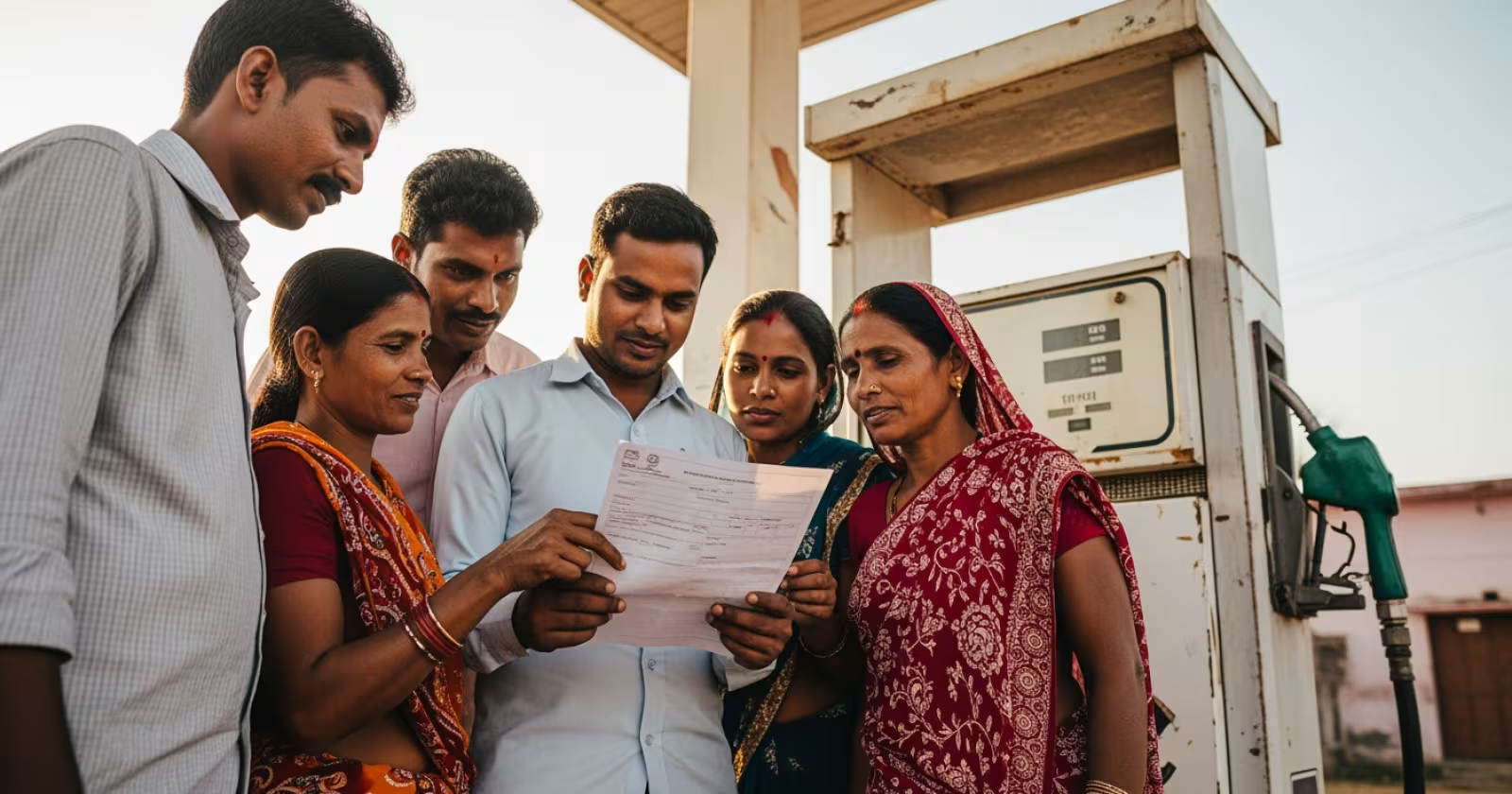
In Barmer district, Rajasthan, a dairy cooperative society runs a fuel station off National Highway 15. The nearest private petrol pump is 38 kilometres away. For the roughly 4,200 member-households of this cooperative, the pump isn’t just a convenience — it’s the reason their tractors run during sowing season without a full day lost to fuel runs. I first heard about this setup not from any oil marketing company brochure, but from a cooperative federation official who mentioned it almost as an afterthought.
Why Cooperative Petrol Pumps Stay Under the Radar
India has over 80,000 retail fuel outlets operated by the three public-sector oil marketing companies — Indian Oil Corporation (IOC), HPCL, and BPCL. A small but significant fraction of these are allotted to cooperative societies. The exact number is difficult to pin down because none of the three OMCs break out cooperative-held dealerships in their annual reports. Estimates from cooperative sector insiders suggest the figure sits somewhere between 3,500 and 5,000 outlets nationally.
This isn’t accidental. The cooperative petrol pump model exists because government guidelines have, for decades, reserved a quota of fuel retail dealerships for cooperative societies — particularly in rural and semi-urban areas. Yet oil companies rarely promote this channel. The reasons are structural and worth understanding.
The Origin: A Quiet Policy Decision from the 1970s
The roots of cooperative fuel dealerships go back to the 1970s, when the Indian government decided that oil marketing companies must allocate a portion of new retail outlets to specific categories — defence personnel, Scheduled Castes and Tribes, and cooperatives. The cooperative quota was designed to serve two goals: extending fuel access to underserved rural areas, and giving cooperative societies a reliable non-agricultural income stream.
The National Cooperative Development Corporation (NCDC) played a facilitative role, helping state-level cooperative federations understand the application process and capital requirements. In states like Maharashtra, Gujarat, and Rajasthan, sugar cooperatives and dairy cooperatives were among the first to apply. A sugar cooperative in Kolhapur district, Maharashtra, reportedly secured an IOC dealership as early as 1978 — and that outlet is still operational today.
The policy logic was sound. Cooperatives already had physical infrastructure — godowns, collection centres, office buildings — often located on arterial roads. They had institutional credibility and a captive customer base of farmer-members who consumed diesel in large quantities. A petrol pump was a natural fit.
How the Model Actually Works in 2026
The mechanics are straightforward but capital-intensive. A cooperative society applies for a dealership during an OMC’s advertised selection round. If selected, the cooperative must invest in land (often already owned), construction of the retail outlet to OMC specifications, and working capital for fuel inventory. The total setup cost for a rural outlet ranges from ₹40 lakh to ₹80 lakh depending on location and format.
The cooperative earns a dealer margin on every litre sold — currently around ₹3.60-₹3.80 per litre for diesel and slightly less for petrol. For a pump selling 4-5 kilolitres daily, this translates to monthly gross revenue of roughly ₹4.5-₹5.7 lakh before operating expenses.
| Parameter | Cooperative Pump (Rural) | Private Dealer (Urban) |
|---|---|---|
| Average daily throughput | 3-5 kilolitres | 8-15 kilolitres |
| Setup cost | ₹40-80 lakh | ₹80 lakh-₹1.5 crore |
| Dealer margin (diesel) | ₹3.60-3.80/litre | ₹3.60-3.80/litre |
| Primary customers | Farmer-members, local transport | General public, commercial fleets |
| Employment generated | 6-10 local jobs | 10-20 jobs |
| Profit distribution | Reinvested or distributed to members | Retained by dealer-owner |
The critical difference is what happens to profits. A private dealer retains earnings personally. A cooperative pump channels surplus back — either into member dividends, or more commonly, into the society’s other activities: better milk collection infrastructure, warehouse upgrades, or educational programmes. In one Anand district cooperative in Gujarat, fuel station profits reportedly fund an annual scholarship programme for members’ children.
The Challenges Nobody Talks About
The model sounds elegant on paper. In practice, it faces serious friction. The biggest problem is the application process itself. OMC dealership rounds are notoriously competitive, and cooperative societies — especially smaller PACS (Primary Agricultural Credit Societies) — often lack the documentation rigour and political connections that smooth the process.
Then there’s the capital barrier. NABARD and NCDC offer financing for cooperative infrastructure, but fuel station construction doesn’t always qualify cleanly under existing loan categories. Many cooperatives end up funding the setup through internal reserves or state cooperative bank loans at higher interest rates.
Political interference is the elephant in the room. In several states, cooperative petrol pump allotments have become patronage tools. A 2019 CAG report flagged irregularities in dealership allotments in Madhya Pradesh, where some cooperatives that received pumps existed largely on paper. This undermines the genuine cooperatives that could benefit.
Competition from private fuel retailers — Reliance BP and Nayara Energy now operate over 10,000 outlets combined — further squeezes rural demand. And the long-term threat of electric vehicles, while distant for rural India, is already shaping OMC investment priorities away from new rural outlets.
A District-Level Success Worth Studying
The Ahmednagar District Central Cooperative Bank in Maharashtra offers a compelling counter-narrative. Through its affiliated societies, the district has approximately a dozen cooperative-run fuel outlets. These pumps collectively serve over 50,000 farmer-members and generate enough surplus to subsidise agricultural input costs for member societies. The federation treats fuel retail not as a standalone business but as an integrated service — farmers buy diesel at the cooperative pump, and the margins reduce the effective cost of cooperative credit.
This bundling approach — fuel, credit, input supply, and output marketing under one cooperative umbrella — is arguably the most powerful version of the model. It’s similar to what agricultural cooperatives in parts of Scandinavia and South Korea have done for decades, where fuel retail is simply one service node in a cooperative ecosystem.
What the Next Five Years Could Look Like
The Ministry of Cooperation, established in 2021 under Amit Shah, has signalled interest in strengthening PACS as multi-service enterprises. A 2023 model by-law revision explicitly envisions PACS operating fuel outlets, LPG distribution, and even EV charging stations. If implemented seriously, this could open the door for thousands of new cooperative fuel outlets at the village level.
The NCDC has also floated a scheme to provide concessional financing for cooperative infrastructure diversification, which could ease the capital barrier. And the digitisation of cooperative governance — Aadhaar-linked membership, digital accounting — makes it harder for paper cooperatives to game the system.
I think the realistic scenario is modest but meaningful: perhaps 1,000-1,500 new cooperative fuel outlets over the next five years, concentrated in states with strong cooperative ecosystems — Maharashtra, Gujarat, Karnataka, Kerala, and Rajasthan.
Back to Barmer
That cooperative pump on NH-15 in Barmer still operates with a modest daily throughput. It will never match the volumes of a highway fuel plaza. But it employs eight people from the village, it keeps farmer-members from losing a working day to fuel procurement, and its annual surplus — approximately ₹6-7 lakh after expenses — funds the cooperative’s veterinary services for livestock.
This is the cooperative petrol pump model in its truest form: not glamorous, not scalable in the venture-capital sense, but deeply functional. The fact that HPCL and BPCL don’t advertise it tells you something about whose stories get told in India’s energy economy. If you’re involved in a cooperative society, I’d encourage you to explore whether a fuel dealership could work for your members — the next OMC advertisement round might be your opening.