
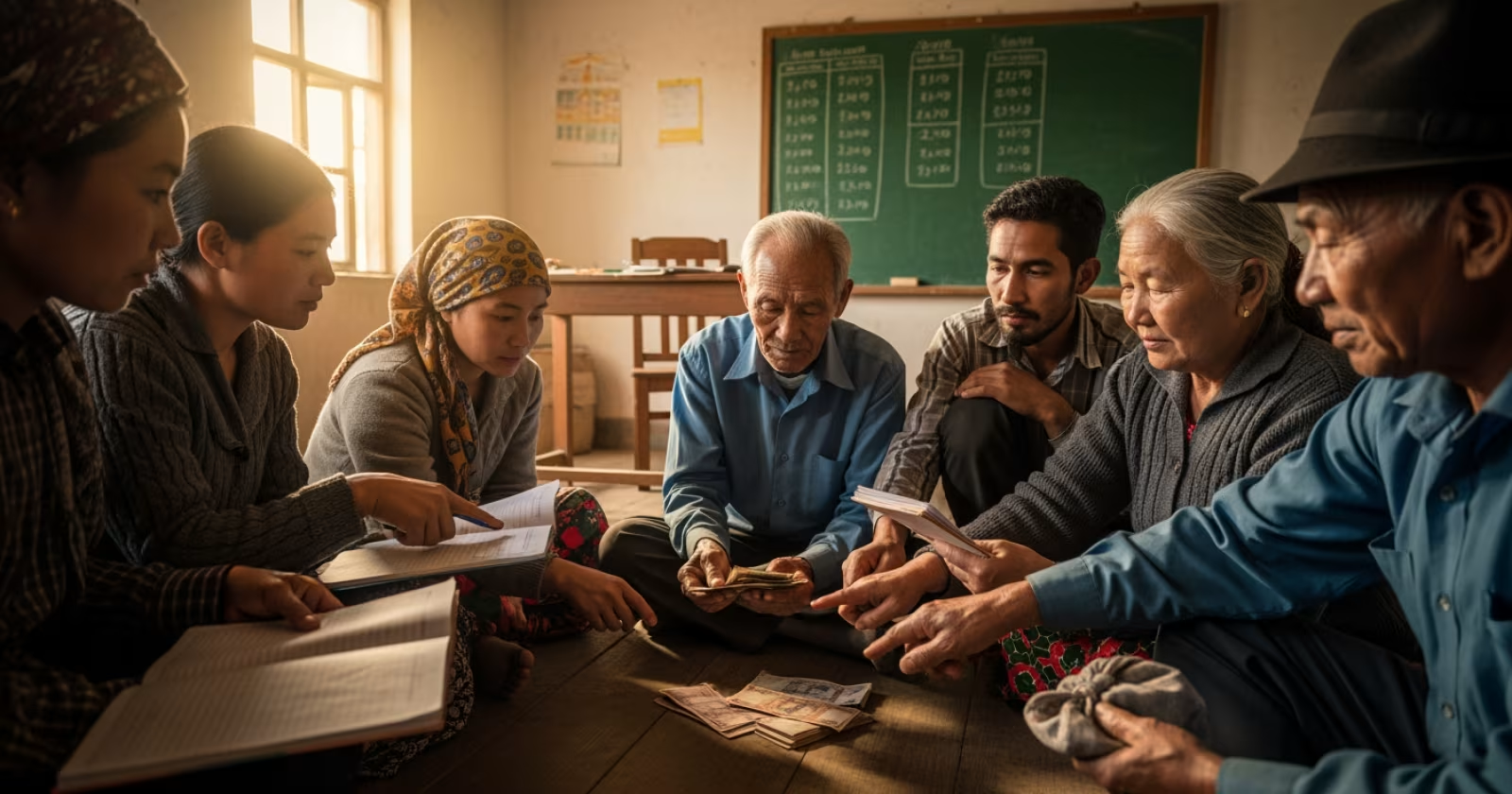
In Karimnagar, Telangana, a cotton farmer named Ramaiah once walked away from a government procurement centre with ₹18,000 less than he expected — the difference swallowed by middlemen, commission agents, and processing fees he never fully understood. Three years later, after joining a primary agricultural cooperative society, he received not just a fair price at the gate but a year-end surplus distribution cheque of ₹6,400. That second payment is what separates a cooperative from every other business model in India‘s rural economy.
I’ve spent considerable time studying how cooperatives structure their financial returns, and what strikes me most is how poorly this mechanism is understood — even by the members who benefit from it. The idea is deceptively simple: when a cooperative earns a surplus, it does not hand that money to shareholders sitting in Mumbai or Bengaluru. It returns it, proportionately, to the very people who grew the crop, spun the yarn, or deposited the milk. That is the cooperative difference, and in 2026, it is more relevant than ever.
Where This Idea Came From — and Why India Took to It
The cooperative profit-sharing model India inherited traces its intellectual lineage to Rochdale, England, in 1844, where a group of weavers created the first modern consumer cooperative. But India made it entirely its own. Tribhuvandas Patel and later Verghese Kurien built AMUL in Anand, Gujarat, on the principle that dairy farmers — not private dairies — should capture the value their milk created. By the 1970s, AMUL was proving that cooperative surplus distribution could lift entire village economies, not just individual households.
The legal architecture supporting this today runs through the Cooperative Societies Acts across states, the Multi-State Cooperative Societies Act of 2002 (amended in 2023), and the constitutional recognition cooperatives received under the 97th Amendment. The newly established Ministry of Cooperation, formed in 2021, has since accelerated policy attention on making surplus distribution more transparent and equitable.
How Surplus Sharing Actually Works in a Cooperative
Most people assume cooperatives simply give members a discount or a better price. That is only part of the picture. The real mechanism is the patronage dividend — a distribution of year-end surplus calculated in proportion to how much each member transacted with the cooperative during the year. The more milk Ramaiah poured into the chilling centre, the larger his year-end share.
Here is a simplified structure of how a functioning agricultural cooperative in India typically allocates its annual surplus:
| Surplus Allocation Category | Typical Percentage | Purpose |
|---|---|---|
| Statutory Reserve Fund | 25% | Mandatory legal reserve under cooperative law |
| Member Patronage Dividend | 30–40% | Returned to members based on transaction volume |
| Cooperative Education Fund | 2–5% | Literacy, training, and awareness programmes |
| Common Development Fund | 10–15% | Infrastructure, cold chains, shared equipment |
| Board-Discretionary Welfare | 5–10% | Member health, insurance, emergency support |
This architecture means a well-run cooperative is simultaneously a business, a bank, a training institution, and a welfare body. NABARD’s own assessments suggest that cooperatives with transparent surplus-sharing records report significantly higher member retention and participation than those where financial statements remain opaque.
Where the Model Breaks Down
I want to be honest here: the cooperative profit-sharing model is only as good as the governance behind it. Across India, thousands of PACS (Primary Agricultural Credit Societies) are technically cooperatives but functionally captured by local political interests. Surplus that should flow to members gets parked in reserve accounts, redirectised toward board-favoured projects, or simply under-reported. The 2023 amendment to the Multi-State Cooperative Societies Act introduced independent auditors and mandatory digital disclosure of surplus distribution — but implementation at the district level remains patchy in 2026.
There is also the structural problem of weak federations. A village-level cooperative may generate a small surplus, but without connecting to a district or state-level federation, it cannot access the economies of scale that make AMUL’s model so powerful. Estimates from the NCDC suggest that fewer than 30% of India’s approximately 8.5 lakh cooperatives are operationally linked to a functioning federal structure. That isolation limits both their market access and their ability to generate meaningful surpluses to share.
The AMUL Blueprint — Still the Gold Standard
Returning to Anand for a moment: what AMUL demonstrated, and what its affiliated model under the National Dairy Development Board replicated across fourteen state milk federations, is that profit-sharing only becomes transformative at scale. A single village cooperative sharing ₹6,000 among 40 farmers is meaningful but limited. A state-level federation processing millions of litres daily and distributing bonuses twice a year changes the economic baseline of entire districts.
The Amul model also pioneered something that Indian cooperatives are only now widely adopting: the separation of professional management from member governance. Members elect boards; boards hire professionals. The surplus belongs to members, but the decisions that generate that surplus are made by trained managers. This is the balance that transforms cooperatives from welfare schemes into competitive enterprises — and competitive enterprises generate real surpluses worth sharing.
What the Next Five Years Must Deliver
In 2026, India’s cooperative sector is at an inflection point. The government’s push to computerise all PACS, backed by a ₹2,516 crore scheme, is creating the data infrastructure needed for genuine surplus transparency. When every member can check, on their phone, what the cooperative earned, what was reserved, and what was returned to them — that accountability alone will discipline poorly governed societies.
The deeper opportunity lies in FPOs (Farmer Producer Organisations) adopting cooperative surplus-sharing norms more rigorously. Many FPOs are structured as companies, not cooperatives, which means dividend distribution follows share capital rather than patronage. The Ministry of Cooperation is actively exploring hybrid models that blend the capital-raising advantages of company law with the member-first distribution ethos of cooperative law. If that policy architecture matures correctly, the cooperative profit-sharing model could reach 150 million additional farming households by 2030.
Ramaiah’s ₹6,400 cheque may seem modest against the scale of India’s agrarian economy. But it represents a principle that no private company, no matter how well-intentioned, is structurally capable of honouring — that the people who create value should be the first to receive it. If you are part of a cooperative society, I’d encourage you to ask your board, at the next general meeting, for a full breakdown of last year’s surplus and how it was distributed. That single question is the most powerful act of cooperative governance any member can perform.