
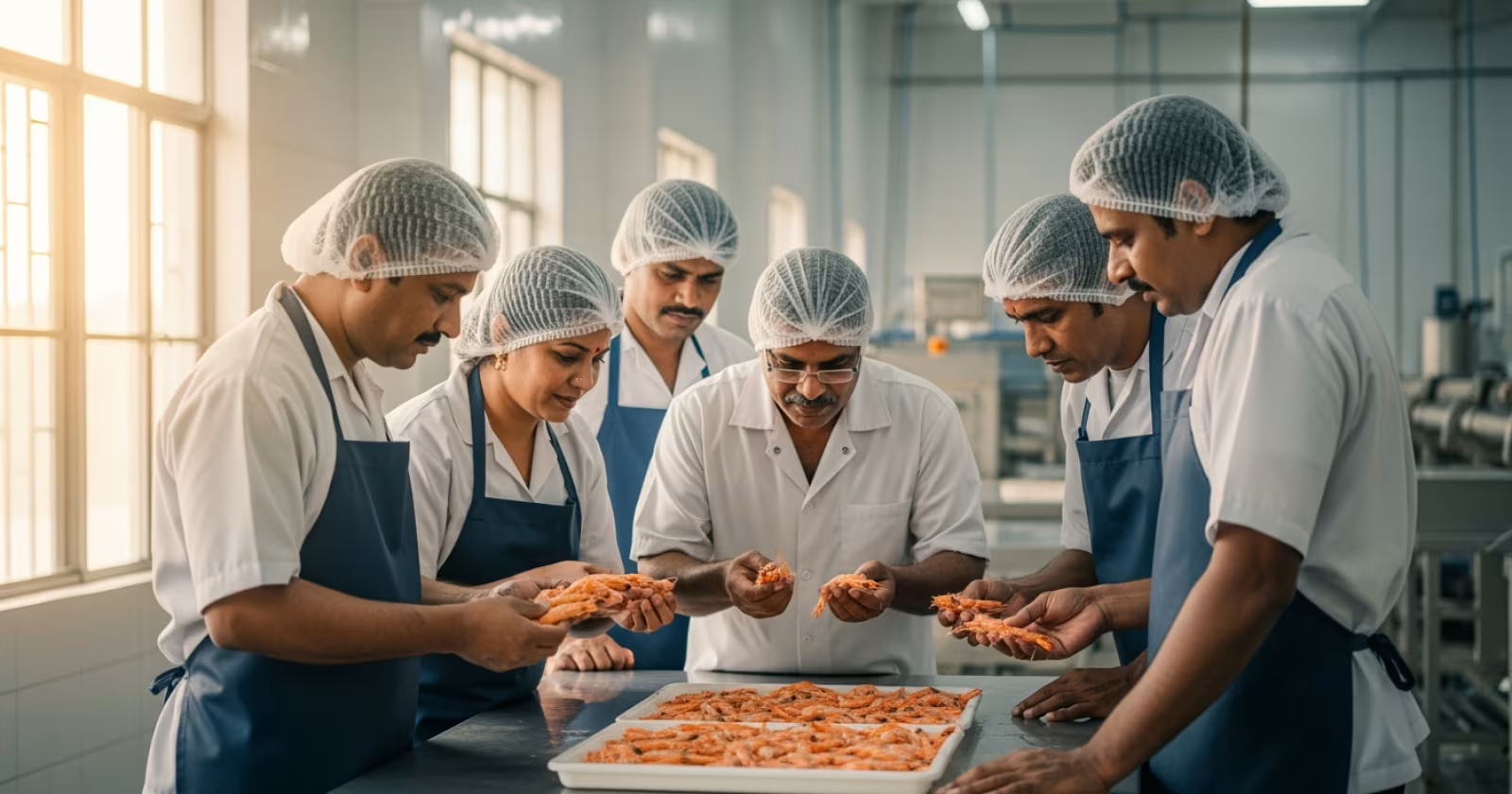
In Nagayalanka mandal, at the southern tip of Krishna district where the river meets the Bay of Bengal, a 62-year-old farmer named Ramaiah tends to 12 acres of shrimp ponds that earn him more than his rice paddies ever did. His cooperative society — one of over 400 fishermen cooperatives scattered across Andhra Pradesh — negotiated a collective input price for Vannamei shrimp seed that saved each member approximately ₹15,000 per acre per cycle in 2026. I first heard about Nagayalanka’s transformation from a colleague covering rural Andhra, and the numbers stunned me enough to dig deeper.
What I found was not a single success story but an entire economic ecosystem — one where cooperative aquaculture has quietly turned a coastal district into the engine room of India’s ₹52,000 crore shrimp export industry. Krishna district alone accounts for an estimated 30-35% of Andhra Pradesh’s total shrimp output, and the state itself produces roughly 70% of India’s farmed shrimp. Those are not small numbers. They represent a cooperative-driven revolution that most of India has barely noticed.
Why This Story Matters Beyond Krishna’s Coastline
India became the world’s largest producer of farmed shrimp in recent years, overtaking Ecuador and China in key export categories. The Marine Products Export Development Authority (MPEDA) reported that marine product exports crossed $7.3 billion in the last full fiscal year. A disproportionate share of that wealth originates from Andhra Pradesh’s cooperative aquaculture belt — particularly from Krishna, West Godavari, and Nellore districts. For anyone tracking the cooperative sector’s economic impact, shrimp is arguably the most commercially successful cooperative story outside dairy.
The Origins of Cooperative Aquaculture in Coastal Andhra
The story begins in the 1970s, when brackish water aquaculture was still an experimental idea along India’s eastern coast. The Andhra Pradesh State Fishermen Cooperative Societies Federation (APSFCSF), established to organise traditional fishing communities, began encouraging members to look beyond marine catch towards pond-based farming. Early efforts focused on tiger prawns (Penaeus monodon), cultivated in rudimentary ponds carved out of marshy, saline-affected land that was largely useless for rice cultivation.
The real inflection point came in 2009, when the Indian government permitted the culture of Litopenaeus vannamei — the Pacific white shrimp — on a commercial scale. Vannamei was a game-changer: faster growth, higher survival rates, and better disease resistance than tiger prawns. Cooperative societies in Krishna district were among the earliest adopters. Through collective procurement of SPF (Specific Pathogen Free) seed from certified hatcheries and shared technical knowledge, cooperatives reduced the individual farmer’s risk dramatically.
By 2015, Krishna district’s landscape had visibly changed. Satellite imagery showed thousands of hectares of rectangular aquaculture ponds glinting across the deltaic plain — from Machilipatnam to Avanigadda, from Ghantasala to Koduru. What was once marginal agricultural land had become some of the most productive acreage in the state, measured by revenue per hectare.
How the Cooperative Model Actually Works Here
I want to be specific about the mechanics, because this is where most coverage of cooperatives gets vague. In Krishna district, the typical shrimp farmer operates on 2-15 acres of pond area. They belong to a Primary Fishermen Cooperative Society (PFCS) at the village or mandal level. These societies are federated under the district cooperative structure and ultimately linked to the state federation.
| Parameter | Individual Farmer | Cooperative Member |
|---|---|---|
| Seed cost per lakh (Vannamei PL) | ₹900-1,100 | ₹700-850 (bulk negotiated) |
| Feed procurement cost per kg | ₹85-95 | ₹72-82 |
| Access to NABARD/NCDC credit | Limited | Priority lending via cooperative banks |
| Average yield per hectare per crop | 6-8 tonnes | 8-11 tonnes (better technical support) |
| Market linkage | Local middlemen | Direct processor/exporter tie-ups |
The cooperative advantage is clearest in two areas: input cost reduction and market access. Societies negotiate directly with feed companies like Avanti, Waterbase, and CP Aquaculture for bulk rates. On the output side, cooperatives aggregate harvest volumes to negotiate with processing plants in Bhimavaram, Ongole, and Visakhapatnam, cutting out at least one layer of intermediaries. The National Cooperative Development Corporation (NCDC) has extended working capital loans to several Krishna district societies under its fisheries development programmes.
What Threatens the Shrimp Capital
Not everything is gleaming in Krishna’s aquaculture belt. I spoke with sector analysts who flagged several serious risks. First, disease outbreaks — particularly White Spot Syndrome Virus (WSSV) and EHP (Enterocytozoon hepatopenaei) — can wipe out entire crop cycles. In 2023, localised outbreaks in Avanigadda mandal reportedly caused losses exceeding ₹200 crore across affected farmers.
Second, environmental degradation is a ticking bomb. Unregulated pond expansion into mangrove areas, excessive groundwater extraction for maintaining salinity levels, and effluent discharge into local waterways have drawn criticism from the Coastal Aquaculture Authority. Some cooperative societies have been better than individual operators at enforcing biosecurity protocols, but compliance remains patchy.
Third, global price volatility hits hard. When international shrimp prices dropped sharply in late 2023 due to oversupply from Ecuador, Indian farmers — including cooperative members in Krishna — saw farmgate prices crash from ₹350/kg to under ₹250/kg for 30-count Vannamei. Cooperatives cushioned the blow somewhat through collective holding and staggered sales, but smaller members still suffered.
The Kakkinada Contrast: What Happens Without Strong Cooperatives
A useful comparison exists barely 200 kilometres north, in Kakinada and East Godavari district. Aquaculture is booming there too, but with a weaker cooperative structure and more dominance by private corporate players. Individual farmers in East Godavari report higher dependence on middlemen, less access to institutional credit, and more volatile income cycles. A NABARD district credit plan from 2024 noted that cooperative lending penetration in East Godavari’s aquaculture sector was approximately 18%, compared to over 40% in Krishna district. The difference in farmer bargaining power is palpable. Krishna’s cooperative density — not just in numbers but in active engagement — gives its farmers a structural advantage that neighbouring districts lack.
Where This Heads Next
The Ministry of Cooperation, established in 2021, has signalled interest in strengthening fisheries cooperatives under the broader PACS digitalisation and diversification agenda. If primary agricultural credit societies in coastal areas are equipped to handle aquaculture inputs and credit — as pilot projects in Andhra Pradesh are already exploring — the cooperative backbone could extend further into processing and value addition.
Technology adoption is accelerating. Several Krishna district cooperatives have started using IoT-based water quality monitoring systems, shared across members, that track dissolved oxygen, pH, and temperature in real time. The Blue Revolution — Neel Kranti Mission continues to fund infrastructure for cooperatives willing to invest in biosecurity and effluent treatment. In five years, the societies that survive and thrive will be those that combine collective economics with precision aquaculture — a transition that is already underway in pockets of Machilipatnam and Nagayalanka.
Back to Nagayalanka
Ramaiah, the farmer I mentioned at the start, harvested approximately 9.5 tonnes of Vannamei shrimp per hectare in his last crop cycle — well above the district average for non-cooperative farmers. His society collectively sold to a Bhimavaram-based processor at ₹290/kg when individual farmers in the same mandal were accepting ₹260. That ₹30/kg difference, multiplied across his entire harvest, translated to roughly ₹3.5 lakh in additional income for one season. It is not life-changing wealth by urban standards, but in a coastal Andhra village, it is the difference between debt and dignity. His story is the cooperative argument made flesh — not in theory, but in shrimp ponds and rupee figures.
If you are tracking India’s cooperative movement, I urge you to look beyond dairy and sugar. Aquaculture cooperatives in Andhra Pradesh represent one of the most commercially dynamic — and underreported — success stories in the sector. Follow IICTF for deeper coverage of how cooperatives are reshaping India’s rural economy, and share this story with anyone who believes collective action still has economic power in 2026.