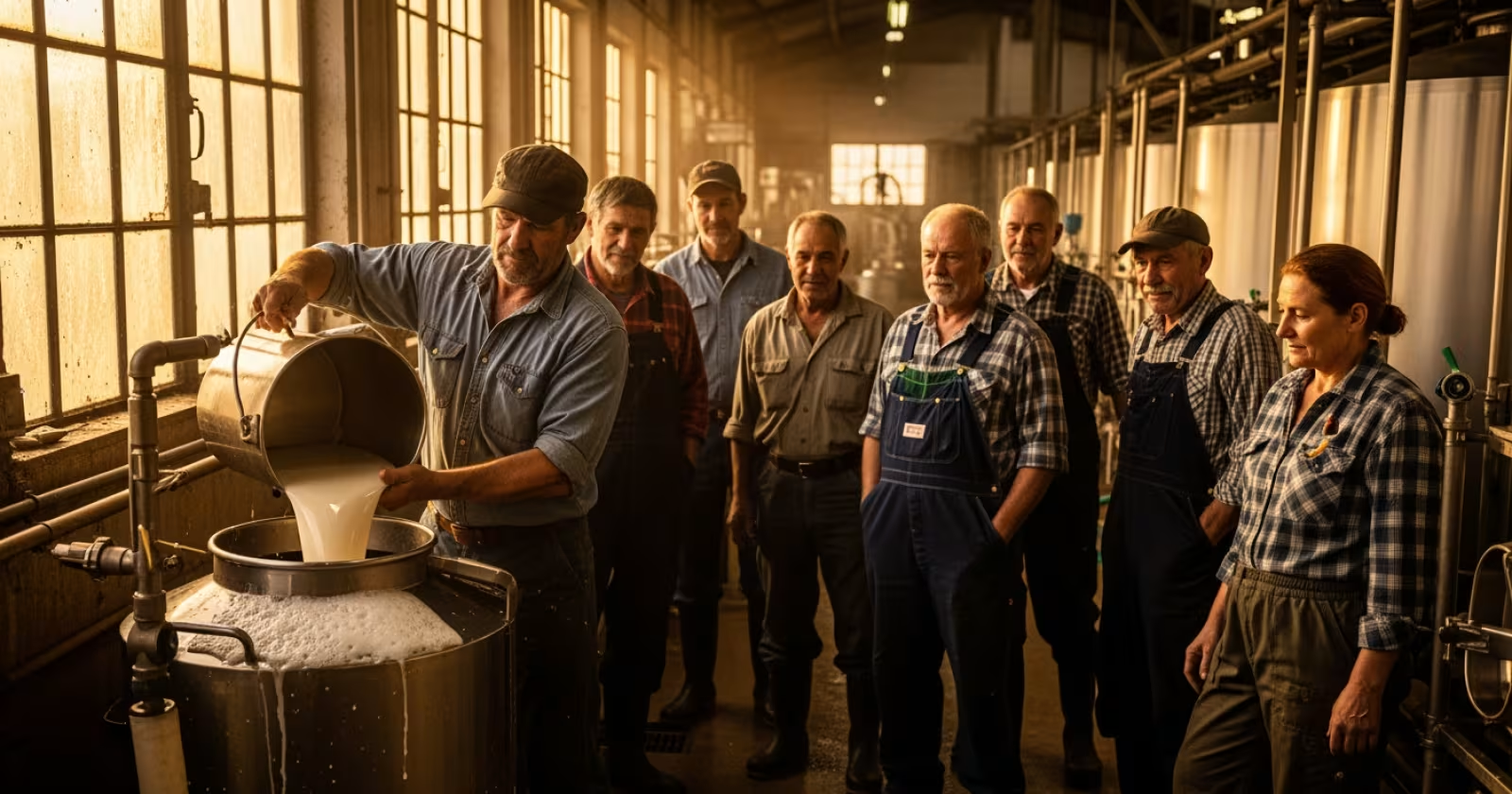
When a small group of farmers in Anand, Gujarat handed their milk cans to a barely-organized cooperative in 1946, they weren’t launching a brand — they were staging a revolt. That act of collective defiance against exploitative middlemen became the seed of what is now India’s largest food products organization, one whose annual turnover has crossed ₹72,000 crore and whose cooperative structure has been studied and replicated by development economists across four continents.
The Gujarat Cooperative Milk Marketing Federation, better known to the world as Amul, doesn’t just sell butter and ice cream. It operates as living proof that agricultural economies can be built around farmers’ dignity rather than corporate profit. What makes the Amul story extraordinary is not merely its size — it’s that its founding logic keeps finding new places to take root, again and again, eighty years on.
A Cooperative Born from Fury, Not Strategy
The origins of Amul trace to 1945, when the farmers of Kaira District in Gujarat grew exhausted by the Polson Dairy’s monopoly over their milk supply. Polson, backed by the colonial government, was buying milk at artificially low prices and reselling it at steep markups to the Bombay Milk Scheme. Sardar Vallabhbhai Patel, who would later become India’s first Home Minister, advised these farmers to form their own cooperative and cut out the middleman entirely.
That advice gave birth to the Kaira District Cooperative Milk Producers’ Union in 1946, with Tribhuvandas Patel as its founding chairman. Within two years, the union had wrested control of the local milk supply from Polson and secured a direct contract with the Bombay government. It was a stunning organizational victory achieved not through political muscle but through collective economic action — something no agricultural community in colonial India had quite managed before at that scale.
The Man Who Refused to Let It Stay Small
Dr. Verghese Kurien arrived in Anand in 1949, fresh from a dairy technology program at Michigan State University, obligated to serve out a government scholarship bond. He planned to stay for a few months and left 48 years later. Kurien, who won the World Food Prize in 1989 and the Ramon Magsaysay Award in 1963, saw in this modest cooperative something most government planners had completely missed: a scalable model for ending rural poverty that required no charity and no subsidy.
Under Kurien’s leadership, Amul developed the technology to produce milk powder and condensed milk from buffalo milk — something European dairy science had previously declared impossible, since processing infrastructure was almost entirely designed for cattle. This technical breakthrough, achieved by Kurien’s own team in Anand, allowed the cooperative to process surplus milk rather than watch it spoil, creating a year-round market for farmers whose production was deeply and unavoidably seasonal.
Operation Flood and the Blueprint That Travelled
In 1970, Kurien and the National Dairy Development Board launched Operation Flood — the world’s largest dairy development program — which explicitly took the Anand cooperative model and replicated it district by district across rural India. By the time the program concluded in 1996, it had created a national milk grid connecting over 700 towns and cities, with 15 state cooperative dairy federations mirroring the exact structure that Tribhuvandas Patel and Kurien had built in Gujarat.
The numbers that emerged from Operation Flood remain genuinely striking even now. India went from being a milk-deficit nation in 1970 to the world’s largest milk producer, generating over 230 million metric tonnes annually by 2026. The program lifted incomes for tens of millions of small and marginal farmers without displacing a single one in favor of corporate consolidation — a combination that no comparable agricultural initiative anywhere on earth has matched at similar scale.
| Year | Milestone |
|---|---|
| 1946 | Kaira District Cooperative Milk Producers’ Union established in Anand, Gujarat |
| 1949 | Dr. Verghese Kurien joins the cooperative as dairy engineer |
| 1955 | Amul brand name officially adopted for cooperative products |
| 1966 | Amul Girl advertising mascot created by artist Eustace Fernandes for daCunha Communications |
| 1970 | Operation Flood launched by NDDB to replicate the Anand model nationwide |
| 1973 | GCMMF (Gujarat Cooperative Milk Marketing Federation) formally constituted |
| 1996 | Operation Flood concludes; India becomes the world’s largest milk producer |
| 2026 | Amul exports to over 50 countries; annual turnover exceeds ₹72,000 crore |
Why the Pattern Keeps Finding New Ground
What is remarkable is that the Amul model is not a relic preserved under glass in some policy museum. Across India in 2026, new cooperatives are being formed in sectors ranging from oilseeds to organic vegetables, all drawing explicitly from the three-tier Anand Pattern — village-level collection, district-level processing, and state-level marketing — that Kurien documented and the NDDB institutionalized over decades. In Odisha and Jharkhand, tribal women’s cooperatives are adopting this exact hierarchy to build sustainable dairy and forest produce enterprises without waiting for outside capital.
The Amul brand itself continues growing in directions those Kaira farmers of 1946 could never have imagined. The cooperative now exports to over 50 countries, has extended into premium organic dairy ranges, and its iconic Amul Girl — created by Eustace Fernandes and still managed by daCunha Communications — remains one of the longest-running advertising campaigns on earth, commenting on political and cultural events with a wit that has made her a genuine institution, not just a mascot.
What Amul has taught successive generations of economists is a lesson that resists easy simplification: markets work better for the poor when the poor own the market. The cooperative model doesn’t function because it is charitable. It functions because it aligns incentives, distributes risk, and gives producers collective bargaining power they could never hold individually. That’s not sentiment. That’s architecture — and architecture, unlike goodwill, can be reproduced.
I find myself returning to this story whenever someone argues that rural poverty is solved primarily by investment and infrastructure. Amul’s eight decades prove otherwise. The missing ingredient in most development efforts isn’t money — it’s ownership. If that logic is being rediscovered today by cooperatives in Jharkhand, dairy federations in Kenya, and agricultural economists in Bangladesh all studying the Anand model, then the story isn’t repeating itself by accident. It’s repeating itself because it works — and the people building something new are wise enough to recognize a proven foundation when they see one.