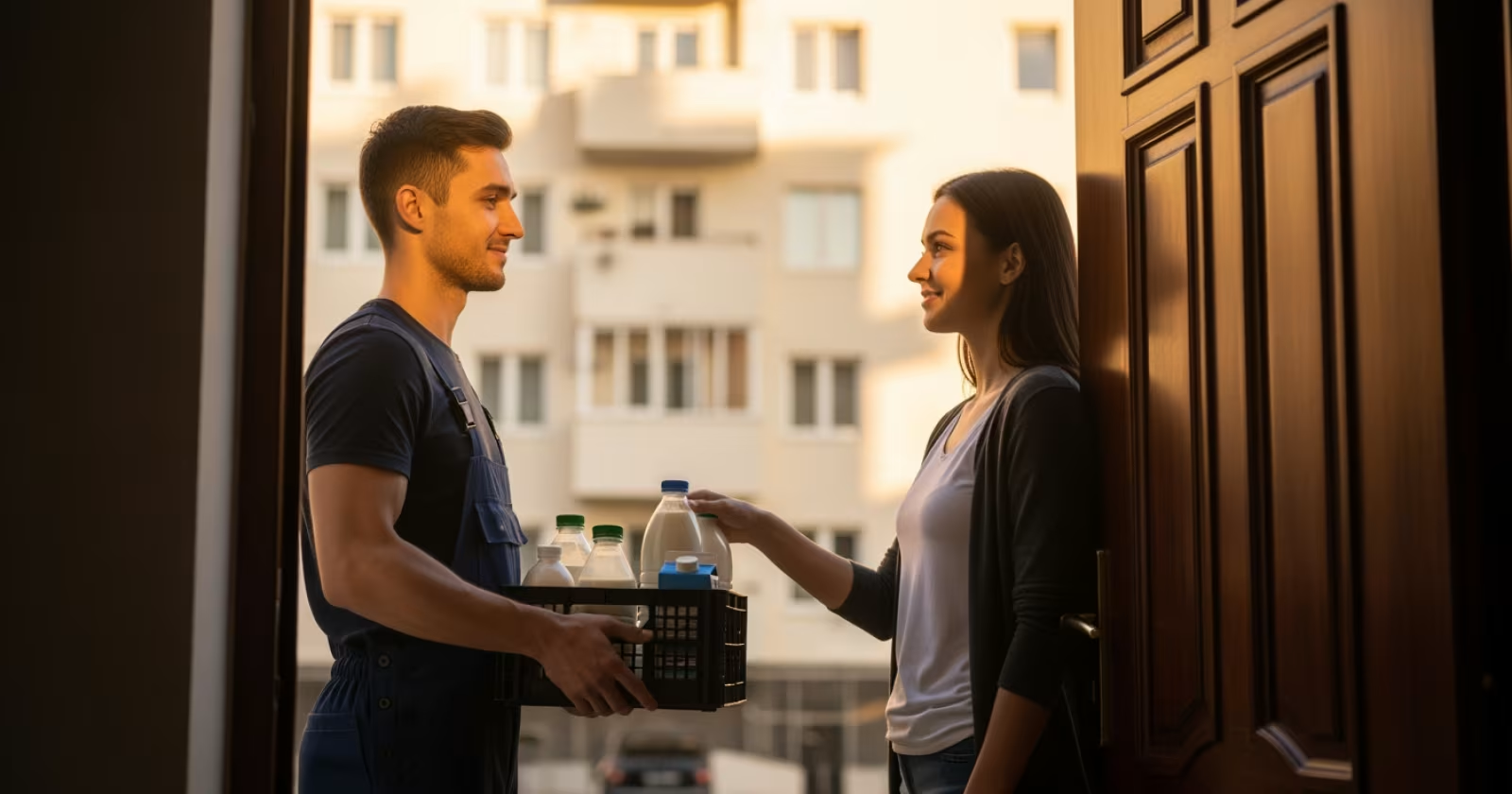
Last month, a dairy farmer named Ramesh Chaudhary in Kalol, Gujarat, opened an app on his phone and ordered a 50-kg bag of IFFCO Nano DAP — delivered to his doorstep within 48 hours, no dealer visit required. Two kilometres away, his neighbour’s wife ordered a carton of Amul Gold milk, Amul dark chocolate, and a block of paneer through the Amul direct-to-consumer portal. Neither transaction involved a single traditional middleman. I find this remarkable because both Amul and IFFCO were themselves born as cooperative alternatives to exploitative intermediaries. Now, they are quietly eliminating the very distribution layer that once helped them scale.
Why This Shift Matters for India’s Cooperative Economy
India’s cooperative sector touches over 270 million members across roughly 800,000 registered societies. For decades, the supply chain model was straightforward: cooperatives aggregated from members, sold through wholesale distributors, and reached consumers via retail counters. That architecture is now crumbling. Amul, managed by the Gujarat Cooperative Milk Marketing Federation (GCMMF), reported revenues exceeding Rs 72,000 crore in FY2024-25, and a growing percentage of that now flows through digital-first, direct-to-consumer channels. IFFCO, India’s largest fertiliser cooperative, has similarly embraced e-commerce, farm-gate delivery, and its own branded app ecosystem. The implications for lakhs of distributors and stockists are significant — and largely undiscussed.
The Origins of a Distribution Empire
To understand why this is disruptive, I need to take you back to Anand, 1946. When Tribhuvandas Patel organised dairy farmers against the monopoly of Polson Dairy, the entire point was disintermediation — cutting out the middleman who paid farmers a pittance. Verghese Kurien scaled that model through Operation Flood in 1970, creating a three-tier structure: village-level dairy cooperative societies, district-level unions, and a state-level marketing federation. IFFCO followed a parallel path after its founding in 1967, building a network of cooperative society-linked dealers to move fertiliser from plant to farm.
By the 1990s, both organisations had built arguably the most extensive rural distribution networks in the developing world. Amul’s cold chain alone covered over 10,000 distributors and a million retail outlets. IFFCO’s dealer network spanned every agricultural district in the country. These intermediaries were not parasites — they were essential infrastructure in an era before digital payments, GPS-tracked logistics, and smartphone penetration. But eras change.
How Direct-to-Consumer Actually Works Now
Amul launched its e-commerce push aggressively during 2020, accelerated by the pandemic. Today, the model operates through multiple channels. The Amul web store and app allow consumers in over 50 cities to order the full product range — milk, ice cream, cheese, beverages, chocolates — with home delivery. In select cities, Amul has partnered with quick-commerce platforms like Blinkit and Zepto, but critically, it has also invested in its own last-mile fleet in metros.
IFFCO’s approach is different but equally ambitious. Through its IFFCO iMandi platform and partnerships with the Ministry of Cooperation’s PACS convergence programme, the cooperative now enables farmers to order fertiliser, seeds, and agri-inputs online. Delivery routes are optimised using warehouse hubs near PACS centres. The Nano Urea and Nano DAP products — lighter, cheaper, and easier to ship — were practically designed for direct delivery.
| Feature | Amul D2C Model | IFFCO D2C Model |
|---|---|---|
| Primary platform | Amul app, website, quick-commerce | IFFCO iMandi, PACS hubs |
| Target customer | Urban and semi-urban consumers | Farmers and rural cooperatives |
| Key products pushed | Milk, paneer, ice cream, beverages | Nano Urea, Nano DAP, seeds |
| Delivery timeline | Same-day to 48 hours | 48-72 hours via PACS network |
| Middlemen bypassed | Distributors, retail stockists | Dealers, district stockists |
| Estimated D2C revenue share | Approximately 5-8% and growing | Approximately 3-5% of nano product sales |
The numbers are still small relative to total turnover, but the trajectory is unmistakable. NABARD’s 2026 annual report flagged digital direct sales as one of the top trends reshaping cooperative commerce.
What This Means for the Traditional Middleman
Here is where it gets uncomfortable. I have spoken to distributors in Gujarat and Maharashtra who have handled Amul products for two or three decades. Their margins, typically 2.5-4% on milk products, were already razor-thin. Now, they see Amul actively promoting its own delivery channels — sometimes in the same pin codes. The cooperative has not formally announced any distributor rationalisation, but volumes through traditional channels in metro areas have reportedly plateaued.
IFFCO’s dealer network faces a different pressure. The government’s push to make PACS into multi-service centres — handling everything from banking to input sales — means the village cooperative society itself becomes the last-mile point. Why would a farmer drive 15 kilometres to a dealer when his PACS can stock the product? The Ministry of Cooperation has targeted computerisation of all 63,000 functional PACS by 2026-27, and many of these will double as cooperative retail points. The middleman is not being eliminated overnight — but his economic justification is eroding steadily.
A Lesson from Dairy in Karnataka
Consider what happened with Nandini (KMF) in Karnataka. When Karnataka Milk Federation launched its own parlour-plus-delivery network in Bengaluru, traditional distributors initially protested. But KMF offered them a transition: become franchise operators of Nandini parlours instead. Some adapted; many could not afford the parlour investment and exited. The result was a 15% increase in KMF’s direct retail margin by 2024, according to federation data, alongside a consolidation of distribution points. Amul appears to be studying this model closely. The question is whether GCMMF will offer its distributors a similar bridge — or simply outgrow them.
Where This Is Heading by 2030
Several forces are converging. The NCDC has earmarked fresh funding for cooperative digital infrastructure. The Open Network for Digital Commerce (ONDC) now allows cooperatives to list products without depending on Amazon or Flipkart. And consumer behaviour, especially in tier-2 and tier-3 cities, is shifting decisively toward app-based ordering. Industry estimates suggest that by 2030, cooperatives like Amul and IFFCO could route 15-20% of consumer-facing revenue through direct channels.
The policy architecture supports this. The Multi-State Cooperative Societies (Amendment) Act, 2023, explicitly encourages cooperatives to diversify into retail and technology-driven services. If PACS computerisation hits its targets, India will have a rural digital retail backbone that no private company can replicate — because no private company has 63,000 last-mile nodes already embedded in villages.
Back to Ramesh’s Doorstep
When I think about Ramesh Chaudhary in Kalol, ordering fertiliser on his phone, I see the cooperative movement completing a circle. It began by eliminating exploitative middlemen between producers and markets. Now it is eliminating the distribution middlemen between itself and the end customer. Whether this is progress or a loss depends on where you stand in the supply chain. For Ramesh, it is cheaper inputs and fresher milk. For the dealer down the road, it is an existential question. The cooperative sector must navigate this transition thoughtfully — supporting those it displaces, even as it modernises the way it serves 270 million members.
If you are tracking how India’s cooperatives are evolving — from village dairies to digital platforms — I encourage you to explore more on IICTF and follow the policy shifts that will shape this sector through the decade. The middleman may be disappearing, but the story is just beginning.