A single farmer with five buffaloes can only do so much, but when an entire village pools its milk together, the bargaining power shifts dramatically. I have seen firsthand how cooperative dairy farming has turned struggling households into stable, income-generating units — and the model is far simpler to replicate than most people assume.
Why Cooperative Dairy Farming Works for Small Producers
The cooperative model eliminates the middleman and gives farmers direct access to processing, marketing, and fair pricing. India‘s dairy cooperative movement, pioneered by Dr. Verghese Kurien through the Anand Pattern, turned the country into the world’s largest milk producer. The success of AMUL in Gujarat became the blueprint for Operation Flood, which linked rural milk producers to urban consumers across the nation.
When farmers form a cooperative, they collectively own the infrastructure — chilling plants, bulk coolers, testing equipment, and transport vehicles. This shared ownership drastically reduces individual capital expenditure. Each member contributes milk daily, the cooperative handles procurement and quality testing, and profits are distributed proportionally based on volume and fat content supplied.
According to the National Dairy Development Board (NDDB), India has over 1.9 lakh village-level dairy cooperative societies covering more than 17 million farmer members. These cooperatives handle roughly 20 percent of the total milk produced in the country, proving the model’s scalability and resilience even in remote areas.
Step-by-Step Process to Register a Dairy Cooperative Society
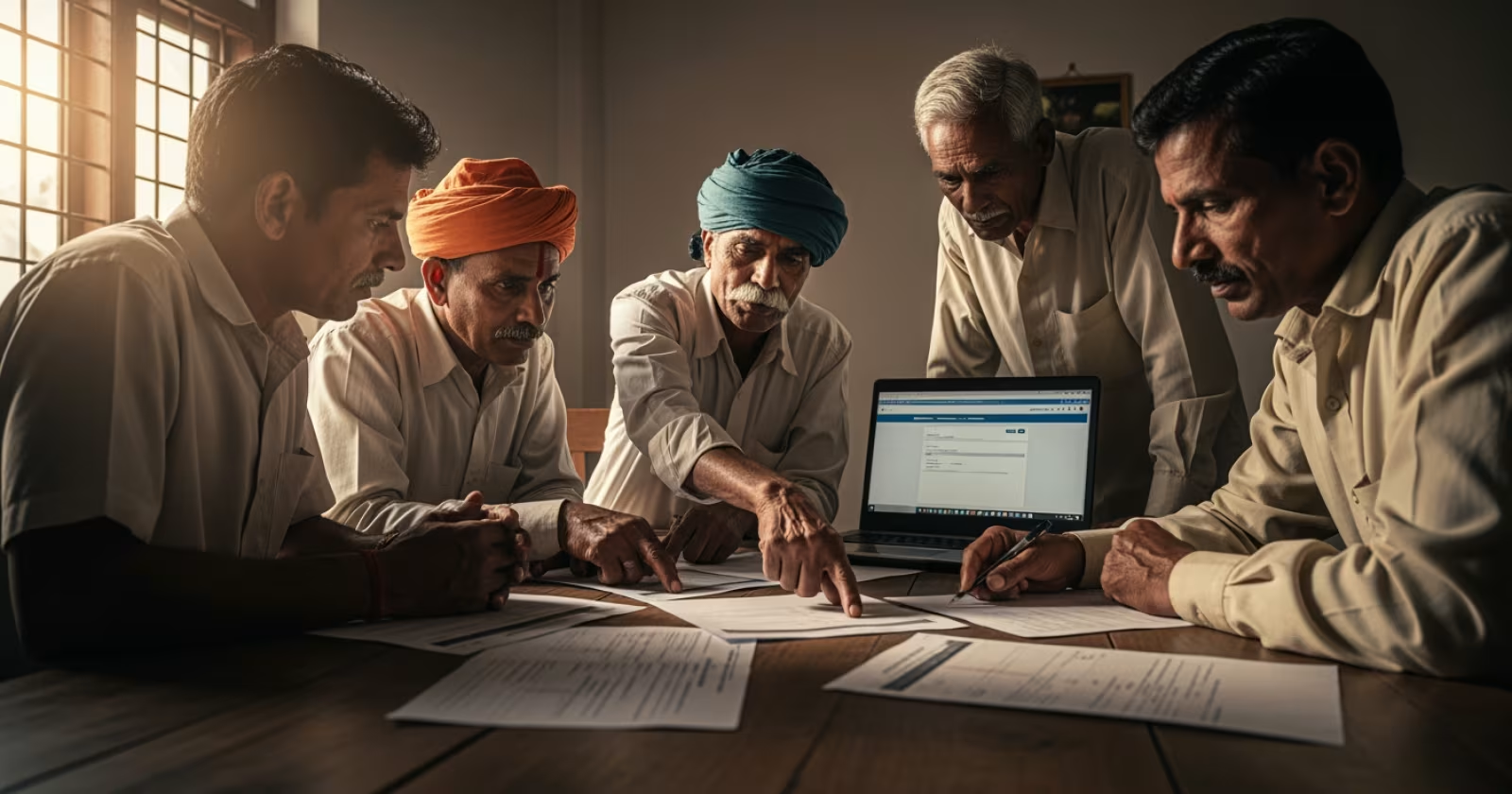
The first step is gathering a minimum number of interested dairy farmers in your area. Most state cooperative laws require at least 10 founding members, though some states set the bar at 25. I recommend starting with at least 15 to 20 committed farmers to ensure consistent milk supply from day one. Hold a preliminary meeting to discuss objectives, expected contributions, and governance rules.
Next, you need to draft the bylaws of your cooperative society. These bylaws outline membership criteria, share capital structure, voting rights, milk pricing formula, and profit-sharing mechanisms. Every member typically purchases one or more shares at a nominal value, and this pooled capital becomes the society’s initial working fund. Bylaws must comply with the Multi-State Cooperative Societies Act, 2002 or your respective state cooperative societies act.
Once bylaws are finalized and approved by founding members in a general body meeting, you file an application for registration with the Registrar of Cooperative Societies in your state. Required documents usually include the application form, bylaws, list of members with addresses, minutes of the formation meeting, and proof of share capital collection. Registration typically takes 30 to 60 days depending on the state.
After registration, you must open a bank account in the cooperative’s name, obtain a PAN and GST number if applicable, and begin formal operations. I strongly suggest applying for financial assistance from NABARD or the National Cooperative Development Corporation (NCDC), both of which offer subsidized loans and grants specifically for dairy cooperative infrastructure development.
Essential Infrastructure and Equipment Requirements
A functional dairy cooperative needs a milk collection center at the village level, equipped with at least one bulk milk cooler (BMC) to maintain cold-chain integrity. The BMC capacity should match your expected daily collection volume — a 500-liter unit works for smaller groups, while established cooperatives may need 2,000- to 5,000-liter units. Milk testing equipment, including a lactometer, Gerber fat testing apparatus, and electronic milk analyzers, ensures transparent and quality-based pricing.
You will also need stainless steel collection cans, weighing scales, receipt books or digital billing systems, and a small office space for record-keeping. Many state governments provide subsidies of 50 to 75 percent on dairy equipment under schemes like the National Programme for Dairy Development (NPDD) administered by the Ministry of Fisheries, Animal Husbandry and Dairying. The Ministry of Cooperation, established in 2021, has further streamlined support channels for new cooperative ventures.
| Item | Approximate Cost (INR) | Subsidy Available |
|---|---|---|
| Bulk Milk Cooler (1,000 liters) | 2,50,000 – 3,50,000 | Up to 50% under NPDD |
| Electronic Milk Analyzer | 40,000 – 80,000 | State scheme dependent |
| Stainless Steel Cans (20 units) | 30,000 – 50,000 | Partial under NCDC loans |
| Weighing Scale (Digital) | 5,000 – 10,000 | Usually self-funded |
| Collection Center Construction | 1,50,000 – 3,00,000 | Up to 75% in tribal/hilly areas |
| Transport Vehicle (Mini Insulated) | 4,00,000 – 6,00,000 | NABARD RIDF financing |
Building Membership and Ensuring Milk Quality Standards
Growing your cooperative’s membership is an ongoing effort. I have found that the most effective strategy is demonstrating results — when existing members receive timely payments at fair rates, neighboring farmers naturally want to join. Conduct awareness camps in surrounding villages explaining the cooperative’s pricing model, profit distribution, and veterinary support services. Partnering with local Krishi Vigyan Kendras (KVKs) for training on clean milk production practices boosts credibility.
Quality control is non-negotiable. Every liter of milk received must be tested for fat content, SNF (solids-not-fat), adulteration, and bacterial count. Pricing should follow a transparent fat-plus-SNF formula so that members producing richer milk earn proportionally more. The cooperative must reject adulterated milk firmly and consistently — this builds trust among genuine producers and protects the cooperative’s reputation with processing plants and buyers.
Maintaining detailed records of each member’s daily supply, quality parameters, and payments is critical. Many cooperatives in 2026 are adopting digital platforms and mobile apps to automate this process. NDDB’s Information Network for Animal Productivity and Health (INAPH) system offers free tools for cooperatives to digitize their operations, track animal health, and manage artificial insemination records.
Financial Management and Profit Distribution
Revenue in a dairy cooperative comes primarily from the margin between the procurement price paid to members and the selling price received from district or state-level dairy unions or private processors. A well-managed cooperative retains 5 to 10 percent of this margin for operational expenses, reserve funds, and community welfare activities. The remainder is distributed to members as a bonus or dividend, typically calculated annually.
I recommend maintaining at least three separate funds: a general reserve fund (mandatory under most state cooperative acts), an education and training fund, and a development fund for expanding infrastructure. Annual audits by a certified cooperative auditor are legally required and ensure financial transparency. Members should receive audited financial statements and participate in annual general meetings to approve budgets and elect managing committee members.
Cooperatives can also generate additional income by selling cattle feed, mineral mixtures, and veterinary medicines to members at subsidized rates procured in bulk. Some advanced cooperatives set up their own pasteurization units or value-added product lines like curd, paneer, and flavored milk, significantly increasing profit margins for all members.
Government Schemes and Financial Support Available in 2026
The Indian government offers robust financial backing for dairy cooperatives through multiple channels. NABARD’s Rural Infrastructure Development Fund (RIDF) finances cold chain and processing infrastructure. NCDC provides long-term loans at concessional interest rates for cooperative development projects. The Dairy Processing and Infrastructure Development Fund (DIDF), with a corpus of Rs 10,881 crore, supports modernization of existing cooperative dairy plants.
State-level schemes vary widely. In Rajasthan, cooperatives can access the Rajasthan Cooperative Dairy Federation’s support programs, while in Karnataka, the Karnataka Milk Federation (KMF) provides technical guidance and marketing linkages. I suggest visiting your district cooperative office and the nearest NABARD regional office to get a full list of applicable schemes and eligibility criteria specific to your area.
If you have been thinking about starting a cooperative dairy in your village, there has never been a better time. Gather your fellow farmers, draft your bylaws, and walk into your district Registrar’s office this month. The infrastructure support, government subsidies, and proven cooperative model are all waiting — the only missing piece is your initiative to bring it together.