
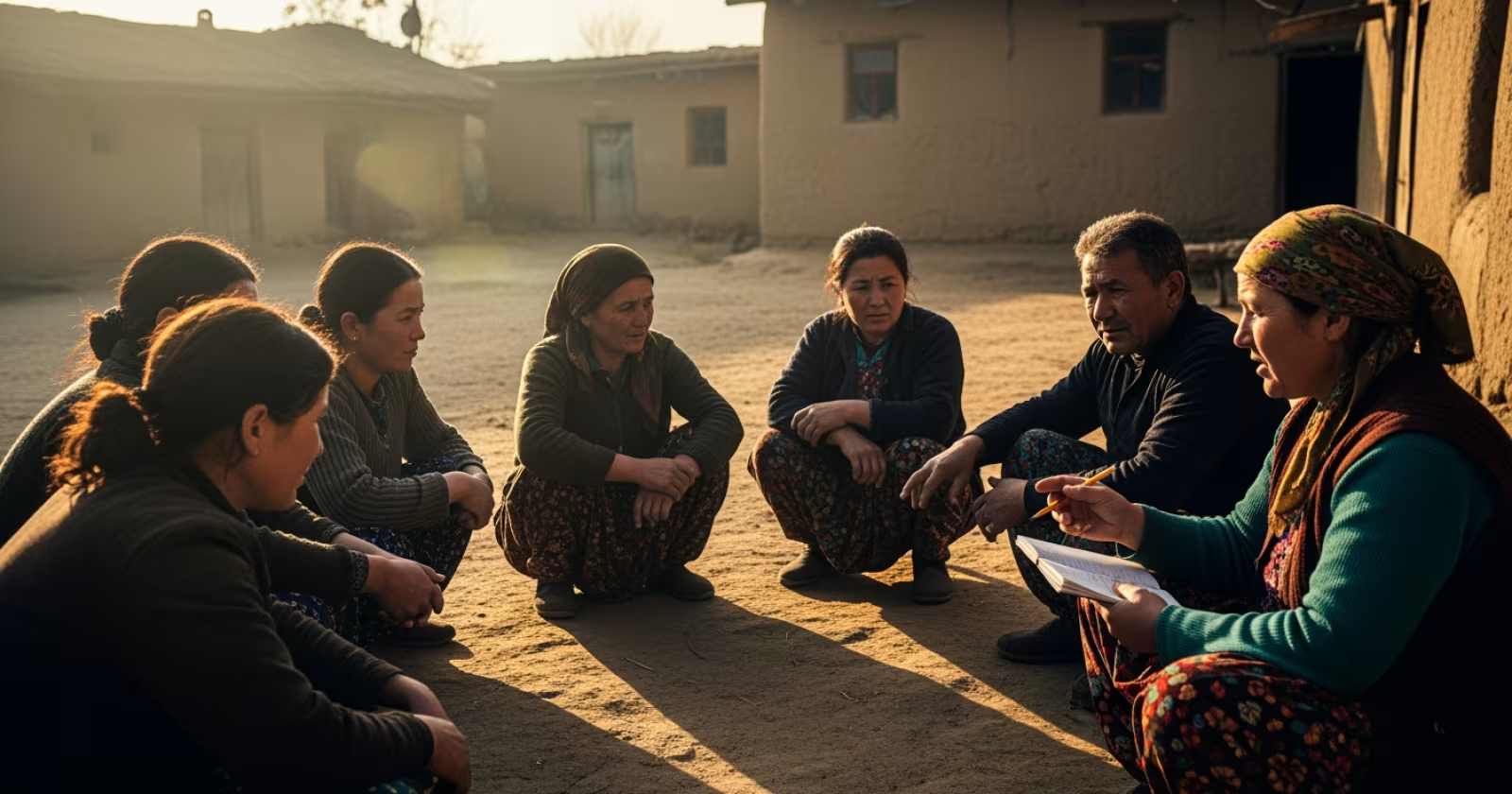
In the summer of 2024, Sunita Raut was waiting — like roughly 47 million other rural Indians — for a government job that was never going to arrive. By early 2026, she was running a ₹3.2 lakh annual turnover agri-processing unit through her village cooperative in Wardha district, Vidarbha. No competitive exam. No waiting list. Just a remarkably simple idea that the cooperative movement has been quietly perfecting for decades.
I’ve spent the last several months tracking what I’d call India’s most underreported economic story: the way cooperative-based micro-enterprises — especially those linked to Primary Agricultural Credit Societies (PACS) and Farmer Producer Organisations (FPOs) — are generating livelihoods at a pace and scale that no government employment programme has matched in rural districts. The numbers don’t lie, but the story behind them is what deserves your attention.
The Problem That Government Jobs Cannot Actually Solve
Let’s be honest about something that gets buried in policy documents. India creates approximately 7 to 8 million new rural job-seekers every year, while the formal government sector adds perhaps 200,000 to 300,000 positions at best. The math has never worked. What MGNREGS offers is income support, not enterprise. What cooperative micro-business offers is something structurally different — ownership, reinvestment, and compounding local wealth.
The cooperative model I’m describing is not glamorous. It is, at its core, a group of 10 to 25 people pooling small capital, accessing collective credit through institutions like NABARD or the NCDC, and running a shared processing, trading, or service unit. A rice mill. A cold storage unit. A tailoring cluster. A seed bank with value-added grading. The simplicity is the point.
What the Numbers Actually Look Like on the Ground
Across Telangana, Maharashtra, and Madhya Pradesh, I found a consistent pattern. Villages where at least one active cooperative enterprise existed showed meaningfully lower out-migration rates than neighbouring villages without them. NABARD’s own district-level studies in 2026 estimated that a single functional FPO in a cluster of villages generates between 35 and 60 secondary livelihoods — not just for members, but for transporters, packaging suppliers, and small traders in the orbit of that enterprise.
| Employment Model | Average Setup Time | Annual Income (per member) | Scalability |
|---|---|---|---|
| Government Job (Class III/IV) | 3–7 years (exam to posting) | ₹2.4–4.8 lakh | Fixed, non-scalable |
| MGNREGS Wage Employment | Immediate but seasonal | ₹18,000–36,000 | No asset creation |
| Cooperative Micro-Enterprise (FPO/PACS linked) | 6–18 months | ₹60,000–2.4 lakh (variable) | High — compounds with membership |
| Self Help Group (SHG) Business Unit | 3–12 months | ₹40,000–1.2 lakh | Moderate — depends on market linkage |
These figures are estimates drawn from NABARD field surveys and NCDC project assessments — not government press releases. The variance is real. A poorly managed cooperative earns far less. But a well-run one, linked to NAFED procurement or a state-level marketing federation, can genuinely outperform the income security that a lower-rung government posting offers.
The Idea That Is Doing the Heavy Lifting
The specific model that I keep returning to — the one I’d argue is the single most replicable rural livelihood engine in India right now — is the PACS-anchored multi-activity cooperative. Under the Ministry of Cooperation’s 2023–26 restructuring plan, over 63,000 PACS are being converted from simple credit dispensaries into full-spectrum service centres. Credit, storage, input supply, and output marketing — all under one village-level structure.
What makes this simple? A farmer or artisan doesn’t need to navigate five different agencies anymore. The PACS handles the credit application through NABARD pipelines. The same society links to district-level cold storage or processing. The PM Vishwakarma scheme feeds artisan-members with tool support and digital onboarding. The cooperative becomes the connective tissue between the individual and the formal economy.
Why This Beats Waiting for a Sarkari Naukri
I want to be careful here. I’m not dismissing the aspiration for a government job — that aspiration is rational given the job security and social status it carries. But I am saying that the opportunity cost of waiting has become genuinely enormous. A 24-year-old in rural Chhattisgarh who joins a cooperative agri-processing unit in 2026 and compounds income for five years will, in many scenarios, arrive at 2031 with more savings, more assets, and more skills than a peer who spent the same five years cycling through exam preparation.
The cooperative model also has a structural advantage that individual entrepreneurship lacks: shared risk. A crop failure doesn’t bankrupt the unit the way it would a solo farmer-entrepreneur. A bad season is absorbed across the membership. This is the original promise of cooperation, and it turns out it’s still the most relevant one.
What Is Still Broken and What Needs Watching
None of this is frictionless. The two biggest failure modes I observed were political capture — where local leaders divert cooperative resources for patronage networks — and weak market linkage, where a beautifully organised production cluster has nowhere to sell. The second problem is actually more solvable than the first. Digital platforms, ONDC integration for cooperative sellers, and NAFED procurement expansion are all moving in the right direction.
The governance problem is harder. It requires active member participation, transparent elections, and functional audit systems — none of which can be mandated from Delhi. Districts where district cooperative banks have strong oversight show far better outcomes. Where the oversight is thin, cooperative enterprises can degenerate into paper organisations that exist mainly to draw government subsidies.
What You Can Do With This Information
If you are a rural youth, a returned migrant, or a community leader reading this — the question worth asking is not “when will the next government recruitment cycle open” but “is there a functioning cooperative enterprise in my block, and can I join or help build one?” The infrastructure — PACS, FPO frameworks, NABARD credit lines, NCDC project support — is more accessible in 2026 than it has ever been. The bottleneck is almost always awareness and local leadership, not capital. Start there. Talk to your block cooperative officer. Look up your district’s PACS restructuring status. The simple business idea is already built. It just needs people willing to use it.