
India has one of the largest cooperative movements in the world, with over 8.5 lakh registered cooperative societies serving more than 290 million members. If you have ever wondered how ordinary citizens band together to form dairy cooperatives, credit societies, or housing cooperatives that reshape entire communities, the answer lies in a structured but surprisingly accessible legal process that I am going to walk you through step by step.
Understanding the Cooperative Structure in India
A cooperative society is a voluntary association of individuals who come together for mutual economic, social, or cultural benefit. The foundational principle is democratic member control — one member, one vote — regardless of capital contribution. The International Cooperative Alliance (ICA) defines seven globally accepted cooperative principles, and Indian law aligns closely with these values through both central and state legislation.
Cooperatives in India operate under a dual regulatory framework. Single-state cooperatives fall under the respective State Cooperative Societies Act, while cooperatives operating across two or more states are governed by the Multi-State Cooperative Societies Act, 2002. The 97th Constitutional Amendment of 2011 added Part IXB to the Indian Constitution, ensuring the right to form cooperative societies as a fundamental right under Article 19(1)(c) and establishing guidelines for democratic elections, audits, and transparency.
The Ministry of Cooperation, established in 2021 under the leadership of Union Minister Amit Shah, now serves as the apex body responsible for strengthening the cooperative movement. This ministry coordinates with state-level registrars, the National Cooperative Development Corporation (NCDC), and NABARD to provide financial and technical support to new and existing cooperatives.
Types of Cooperatives You Can Register
Before filing any paperwork, I recommend identifying which type of cooperative aligns with your community’s needs. India recognizes several categories, each with slightly different bylaws and compliance requirements. Choosing the right type at the outset saves significant time during registration and avoids future restructuring costs.
| Type of Cooperative | Primary Purpose | Notable Example |
|---|---|---|
| Consumer Cooperative | Procure and distribute goods at fair prices | Kendriya Bhandar |
| Producer Cooperative | Pool production resources for better market access | Amul (GCMMF) |
| Credit Cooperative | Provide savings and lending services to members | Saraswat Cooperative Bank |
| Housing Cooperative | Construct and allocate housing units collectively | Various state housing cooperatives |
| Marketing Cooperative | Collectively market agricultural or handloom products | NAFED |
| Farming Cooperative | Joint farming and resource sharing among cultivators | Various state farming societies |
| Multi-State Cooperative | Operations spanning two or more states | Indian Farmers Fertiliser Cooperative (IFFCO) |
Eligibility and Minimum Member Requirements
Most state laws require a minimum of 10 adult members to form a primary cooperative society. For multi-state cooperatives registered under the central act, the requirement is a minimum of 50 members from each of the states where the cooperative intends to operate. All founding members must be Indian residents, and membership is open to any person who satisfies the criteria laid down in the society’s proposed bylaws.
There is no minimum capital requirement fixed uniformly across states, but each cooperative must define its share capital structure in the bylaws. States like Maharashtra, Karnataka, and Gujarat have well-developed cooperative frameworks, and their registrars often provide model bylaws that new societies can adopt. I strongly suggest reviewing your state’s specific requirements through the office of the Registrar of Cooperative Societies before drafting documents.
Step-by-Step Registration Process
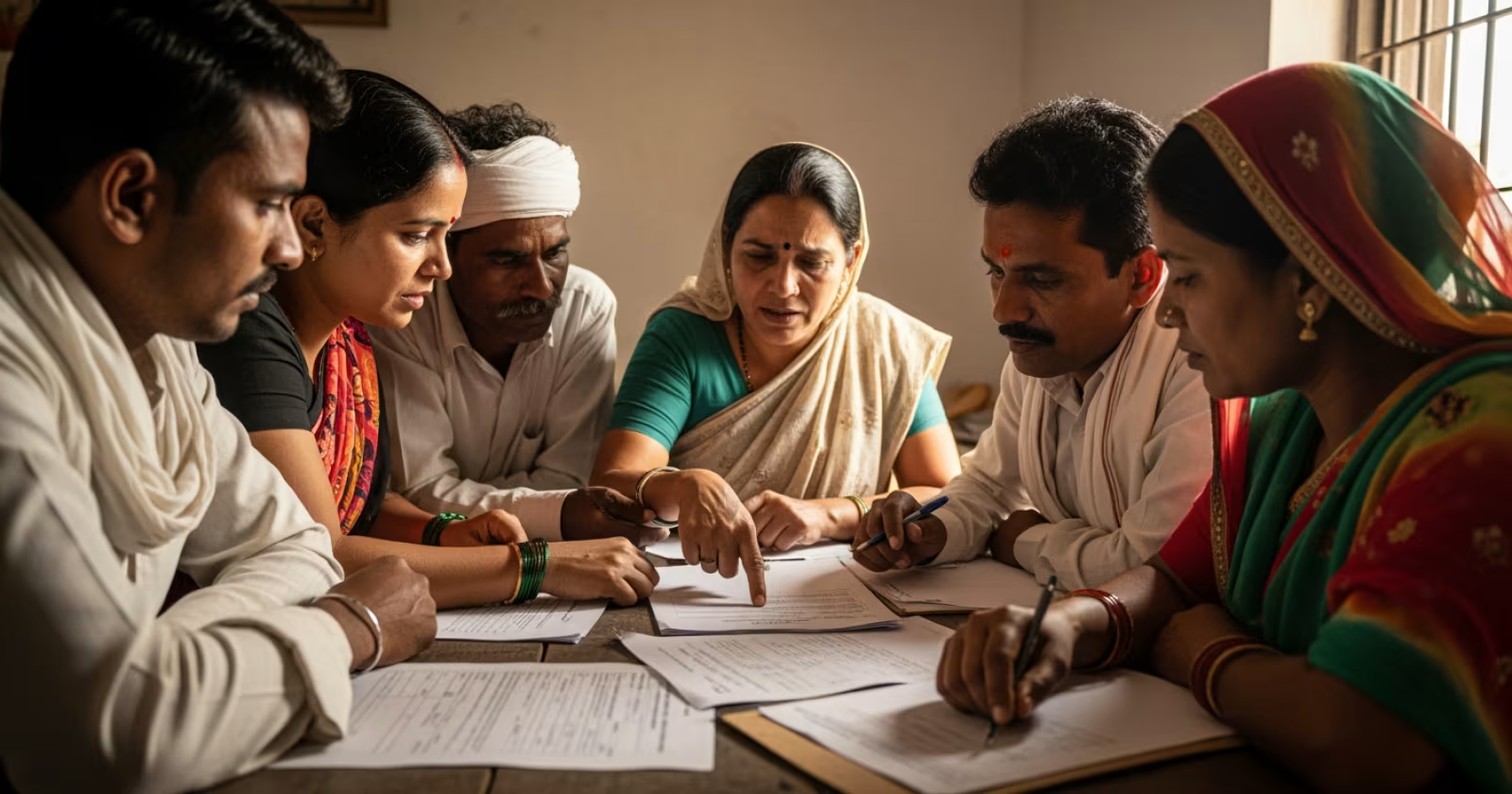
The registration journey begins with organizing a preliminary meeting of all proposed members. During this meeting, members elect a provisional committee, decide on the name of the society, finalize the area of operation, and agree on the draft bylaws. Minutes of this meeting must be formally recorded and signed by all attendees, as they form a critical part of the application file.
Next, prepare and submit the application for registration to the Registrar of Cooperative Societies in your state or to the Central Registrar if forming a multi-state cooperative. The application must include the following documents:
- Four copies of the proposed bylaws signed by all founding members.
- A list of members with full names, addresses, occupations, and signature or thumb impression.
- Minutes of the first general meeting with resolutions passed.
- Proof of address for the registered office of the cooperative.
- A feasibility report or economic viability statement outlining the cooperative’s objectives and financial projections.
- The prescribed registration fee, which varies by state (typically ranging from ₹500 to ₹5,000).
Once the Registrar receives the application, an inquiry officer may be deputed to verify the genuineness of the application, the economic viability of the proposed society, and whether the bylaws comply with the governing act. If everything is in order, the Registrar issues a Certificate of Registration, typically within 30 to 60 days. This certificate gives the cooperative a distinct legal identity as a body corporate with perpetual succession and a common seal.
Drafting Bylaws That Comply With State and Central Acts
Bylaws are the internal constitution of your cooperative. They must cover the name and registered address, objects and area of operation, membership criteria, share capital structure, voting rights, management committee composition, audit provisions, dispute resolution mechanisms, and profit-sharing or surplus distribution policy. I have found that using the model bylaws provided by NABARD or the state registrar’s office reduces back-and-forth with the authorities considerably.
The bylaws must explicitly state how the managing committee or board of directors will be elected, with term limits as prescribed by the state act. After the 97th Constitutional Amendment, most states mandate elections every five years, conducted by the state cooperative election authority. The bylaws should also include provisions for the annual general meeting, where members approve audited accounts, elect office-bearers, and amend bylaws if necessary.
Post-Registration Compliance and Financial Obligations
Registration is not the finish line — it is the starting point of continuous compliance. Every cooperative must maintain proper books of accounts and undergo a statutory audit annually by an auditor appointed or approved by the Registrar. Failure to complete the annual audit can lead to supersession of the management committee or even dissolution of the society under most state acts.
Cooperatives must file annual returns with the Registrar, hold at least one general body meeting per year, and ensure that elections are conducted on schedule. Tax obligations depend on the nature of activities. Under Section 80P of the Income Tax Act, 1961, cooperative societies engaged in certain activities — such as banking, cottage industries, marketing of agricultural produce, and collective farming — can claim deductions on profits. However, cooperative banks with total income exceeding ₹1 crore do not qualify for this deduction after amendments made through the Finance Act.
Financial support for new cooperatives is available through NCDC schemes that provide loans and subsidies for infrastructure, working capital, and capacity building. NABARD also extends refinance facilities to cooperative credit institutions, making it easier for newly registered cooperatives to access affordable capital during their formative years.
Common Pitfalls and How to Avoid Them
From my experience reviewing cooperative registrations, the most common reason for rejection is incomplete documentation or bylaws that contradict the governing act. Another frequent issue is proposing an area of operation that overlaps significantly with an existing cooperative of the same type, which some state registrars may refuse. I recommend conducting a search with the registrar’s office before finalizing your cooperative’s scope.
Internal disputes among founding members during the early stages can also derail the process. Establish clear communication protocols and define roles within the provisional committee from day one. Remember, a cooperative thrives on collective ownership and democratic governance — if the founding team cannot reach consensus on basic bylaws, the society’s long-term sustainability is at risk.
If you have been considering forming a cooperative — whether for dairy farming, housing, credit, or marketing agricultural produce — I encourage you to take the first step today. Gather your community, schedule that preliminary meeting, and reach out to your state’s Registrar of Cooperative Societies for guidance. The cooperative model has transformed millions of livelihoods across India, and with the right preparation and legal compliance, your society can be the next success story.