In the harbour of Copenhagen, twenty turbines rise from the shallow waters of the Øresund strait, each one owned not by a corporation but by ordinary citizens — teachers, nurses, retired dock workers. The Middelgrunden Wind Cooperative, established in 2000, has approximately 8,553 member-shareholders who collectively invested in a 40 MW offshore wind farm. Each share cost around 4,250 Danish kroner (roughly ₹52,000 at current rates), and members have received annual dividends ever since. Now consider this: in Tirunelveli district, Tamil Nadu, a cluster of five villages still depends on erratic grid supply while surrounded by some of India‘s strongest wind corridors. The contrast tells us something uncomfortable about how we’ve structured our renewable energy story.
Why Community-Owned Energy Changes Everything
I’ve been following India’s cooperative movement for years, and the energy question keeps surfacing. India targets 500 GW of non-fossil fuel capacity by 2030, yet almost all of it flows through corporate developers and state utilities. The citizen, the farmer, the panchayat — they remain consumers, never owners. Denmark decided differently four decades ago, and the results have reshaped how Europeans think about energy democracy. For India’s cooperative sector, this isn’t an abstract lesson. It’s a blueprint we’ve barely opened.
How Denmark’s Wind Cooperatives Were Born
The story begins in the 1970s oil crisis. Denmark, heavily dependent on imported petroleum, faced blackouts and price shocks. A grassroots movement led by figures like Preben Maegaard, a renewable energy pioneer, pushed for decentralised wind power. The Danish government responded with a framework that actively encouraged community ownership — tax incentives for local investors, guaranteed grid access for small producers, and a rule that turbines had to be owned by people living within a certain radius.
By the mid-1990s, roughly 80% of Denmark’s wind turbines were cooperatively owned. Farmers pooled savings. Town councils allocated land. Local banks offered low-interest turbine loans. The cooperative model wasn’t charity — it was economics. Members earned returns, communities retained wealth locally, and political resistance to turbines dropped dramatically because the people who lived near them were the same people profiting from them.
The Danish Wind Turbine Owners’ Association, founded in 1978, became one of the most influential energy bodies in Europe. At its peak, it represented over 100,000 individual turbine co-owners. Denmark now generates more than 55% of its electricity from wind, and while corporate developers have taken a larger share in recent years, the cooperative DNA still shapes policy and public acceptance.
The Danish Model — Structure and Returns
Understanding how these cooperatives actually function is critical before we talk about India. Here’s a simplified comparison of the Danish cooperative wind model versus India’s current approach:
| Parameter | Denmark (Cooperative Model) | India (Current Model) |
|---|---|---|
| Ownership | Community shareholders | Corporate developers / state utilities |
| Typical Investment per Member | ₹50,000–₹3,00,000 | Not applicable (no member model) |
| Annual Return to Members | 6–8% average | None (consumers pay tariff) |
| Grid Access | Guaranteed by law | Complex approval process |
| Local Wealth Retention | High — dividends stay local | Low — profits flow to developers |
| Community Acceptance | Very high | Mixed — land acquisition conflicts |
| Policy Support | Dedicated cooperative energy law | PM-KUSUM (partial, solar-focused) |
In Denmark, a typical cooperative member buys shares equivalent to their household’s annual electricity consumption. The cooperative sells power to the grid at a fixed feed-in tariff, and profits are distributed proportionally. Some cooperatives reinvest a portion into community projects — schools, sports facilities, local broadband. The model creates what economists call a “virtuous cycle” of local investment.
Where India Stands — And What’s Missing
India’s renewable energy push has been extraordinary in scale — over 190 GW of installed renewable capacity as of early 2026 — but cooperative ownership remains almost invisible. The PM-KUSUM scheme, launched by the Ministry of New and Renewable Energy (MNRE), allows farmers to install solar pumps and sell surplus power to DISCOMs. It’s a step toward decentralised energy, but it’s individual, not cooperative.
The missing piece is institutional. India has no dedicated policy framework for energy cooperatives. NABARD finances agricultural cooperatives and even some solar infrastructure, but there is no equivalent of Denmark’s guaranteed grid access for community-owned generation. State electricity regulatory commissions rarely account for cooperative producers. Land acquisition — the perennial Indian headache — becomes simpler when communities own the project, yet no state government has seriously piloted this approach for wind energy.
Political interference in cooperatives is another concern I hear repeatedly from sector experts. If a wind cooperative in Gujarat or Rajasthan generates crores in annual revenue, the risk of capture by local political interests is real. Denmark mitigated this through transparent share registries and independent audits — governance structures India’s cooperative sector often lacks.
A Tamil Nadu Village That Almost Got There
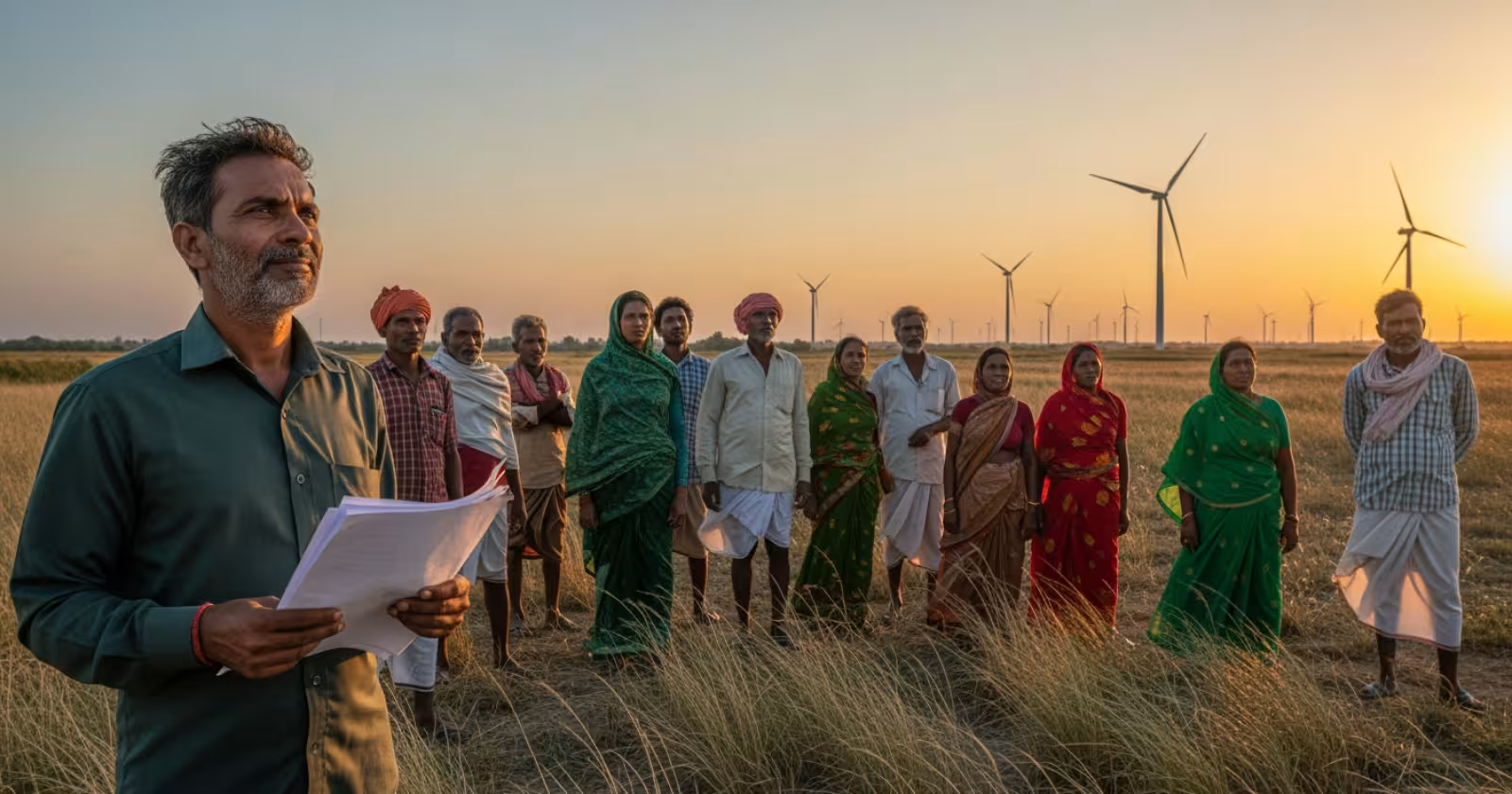
In 2019, a group of farmers near Kayathar in Thoothukudi district, Tamil Nadu — one of India’s windiest regions — explored the idea of pooling resources to install a small wind turbine cluster. The area already hosts hundreds of corporate-owned turbines. The farmers calculated that a 2 MW installation could serve five villages and generate surplus revenue of approximately ₹15–20 lakh annually. They approached the district cooperative bank for financing.
The project stalled. There was no regulatory template for a cooperative to sell wind power to the Tamil Nadu Generation and Distribution Corporation (TANGEDCO). The bank had no product category for cooperative energy lending. The farmers returned to buying grid power at ₹7 per unit while turbines owned by a Mumbai-based company spun overhead. The irony was not lost on anyone.
What the Next Five Years Could Look Like
The Ministry of Cooperation, established in 2021, has signalled interest in expanding cooperatives beyond agriculture and dairy. If the ministry collaborates with MNRE to create a pilot framework — even for 50 cooperative wind or solar projects across high-potential states like Tamil Nadu, Gujarat, Rajasthan, and Karnataka — the demonstration effect could be powerful. Germany, which modelled its Energiegenossenschaften (energy cooperatives) on the Danish template, now has over 800 such entities.
Technology costs help India’s case. A 1 MW wind turbine that cost ₹6–7 crore a decade ago now costs closer to ₹4–5 crore. Distributed energy storage is becoming viable. Digital platforms could manage cooperative share registries and transparent dividend distribution — problems that plagued older Indian cooperatives. The National Cooperative Development Corporation (NCDC) could potentially offer concessional financing for energy cooperatives, just as it does for sugar and dairy.
The real question isn’t technology or economics. It’s political will. Denmark made a deliberate choice in the 1980s to put citizens at the centre of its energy transition. India, in 2026, still treats renewable energy as a corporate-scale game.
Back to the Harbour — And the Fields
Those twenty turbines in Copenhagen’s harbour have generated power for over two decades. The members of Middelgrunden didn’t just invest in electricity — they invested in agency. They decided what their energy future looked like. In Tirunelveli, in Kutch, in Jaisalmer, Indian farmers and communities live alongside wind farms they have no stake in. The cooperative movement has transformed India’s dairy sector, its sugar industry, its credit landscape. Energy is the next frontier — if we choose to build the rails for it.
If you work in India’s cooperative sector, or if you’re a panchayat leader, a district cooperative officer, or simply someone who believes communities should own their energy — start the conversation locally. Study the Danish model, push your state government for pilot frameworks, and follow IICTF for deeper coverage of how cooperatives can reshape India’s energy transition. The turbines are already spinning. The question is who they spin for.