
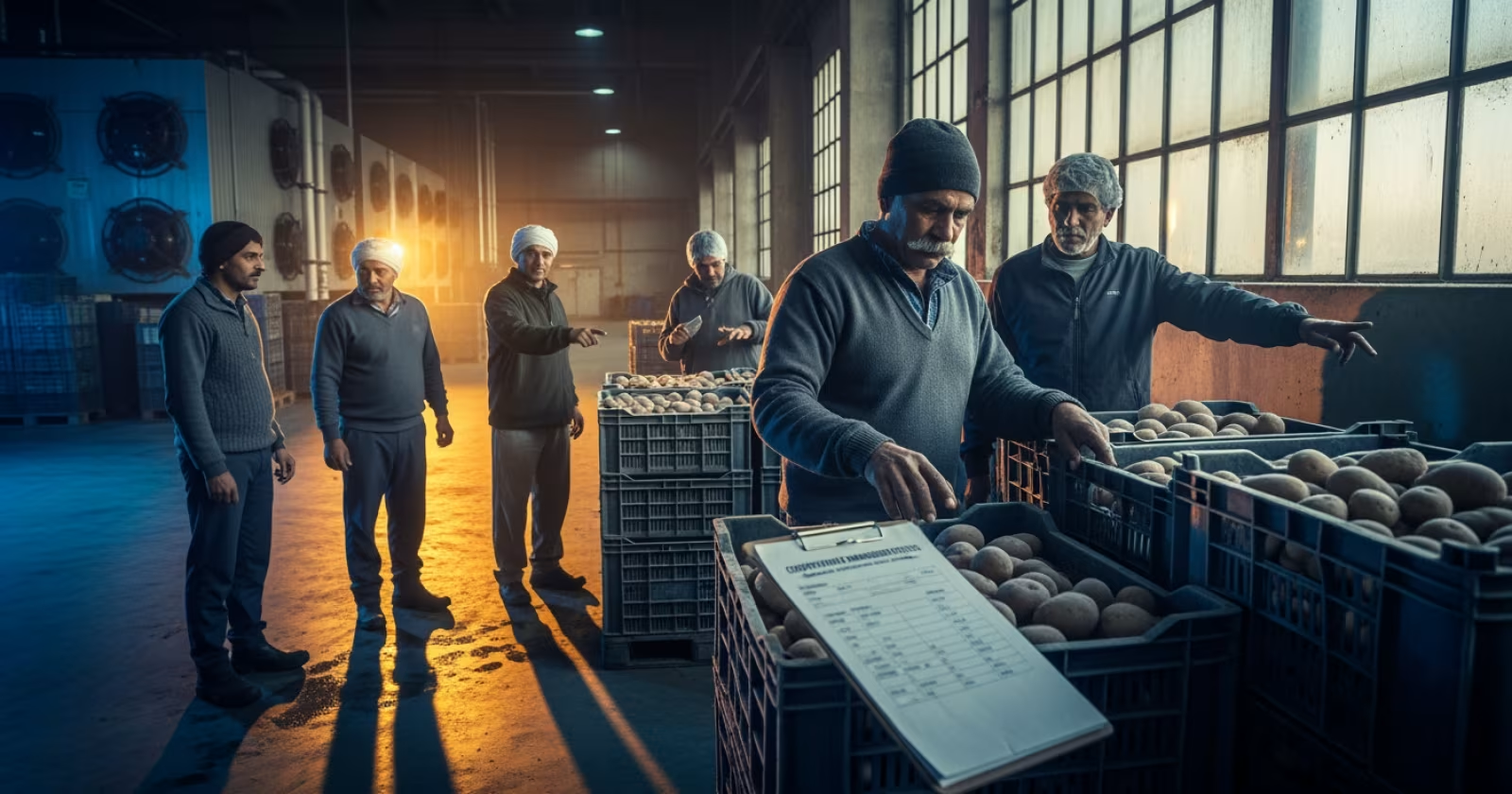
In February 2026, when the wholesale price of potatoes at the Agra mandi crashed to ₹4.20 per kilogram, a farmer named Ramveer in Hathras district did something his father never could — he simply refused to sell. Instead, he drove his tractor-trolley loaded with 80 quintals of freshly harvested potatoes to the nearest cooperative cold storage facility in Sadabad, paid a nominal rent of ₹120 per quintal for six months, and went home. By July, he expects prices to climb past ₹14 per kilo. That single decision, enabled by a cooperative infrastructure most Indians have never heard of, could mean the difference between a ₹33,000 loss and a ₹70,000 profit.
Why UP’s Cooperative Cold Storage Network Matters Nationally
Uttar Pradesh produces roughly 16 million tonnes of potatoes annually — more than one-third of India’s total output. The state also operates the largest network of cooperative cold storages in the country, with over 700 facilities spread across districts like Agra, Farrukhabad, Kannauj, Firozabad, and Aligarh. Without these cooperatives, millions of smallholder potato farmers would be forced into distress sales every harvest season, flooding mandis with perishable produce and watching prices collapse. I’ve been tracking this sector for years, and the sheer scale of what these cooperative cold storages prevent — in terms of post-harvest losses and farmer suicides — is staggering.
The cooperative cold storage model in UP is not glamorous. It doesn’t attract venture capital or make headlines in business newspapers. But it is, quietly, one of the most consequential cooperative interventions in Indian agriculture.
Origins: Born From Crisis in the 1960s
The story begins in the early 1960s, when UP was already emerging as India’s potato belt. Farmers in western UP grew enormous quantities but had nowhere to store them. The entire harvest had to be sold within weeks of digging — and middlemen knew this. Prices would collapse to near-zero during peak arrivals in February-March, then soar four months later when the same potatoes were resold from private godowns.
The National Cooperative Development Corporation (NCDC) stepped in during the late 1960s and early 1970s, providing subsidised loans and technical assistance for building cooperative cold storages. The UP state government matched funds. District cooperative banks served as intermediaries. By 1980, the first generation of cooperative cold storages — typically 5,000-tonne capacity units — dotted the Agra-Mathura-Farrukhabad corridor. The founding principle was simple: if farmers collectively owned the storage, they could collectively resist price manipulation. It worked. By the 1990s, cooperative cold storages had become so embedded in the potato economy that entire cropping patterns were planned around storage availability.
How the System Actually Works in 2026
I visited a cooperative cold storage near Farrukhabad last year, and the mechanics are straightforward but effective. Each facility is registered as a cooperative society under the UP Cooperative Societies Act. Members — typically 500 to 2,000 farmers per society — pay a one-time membership fee (usually ₹500-₹1,000) and an annual storage rent calculated per quintal per month.
The storage rent at cooperative facilities runs approximately ₹100-₹140 per quintal for a six-month season, significantly cheaper than private cold storages, which charge ₹160-₹220 in the same districts. Farmers deposit their potatoes between January and March. Each deposit is documented with a receipt specifying weight, variety, and storage cell number. This receipt doubles as collateral — farmers can take it to the district cooperative bank and secure a Kisan Credit Card loan at 4-7% interest against their stored produce.
That financing mechanism is critical. It means farmers don’t need to sell immediately to pay for the next season’s seeds and fertiliser. They borrow against stored potatoes, fund the next crop cycle, then sell the stored potatoes in June-August when prices are higher, repay the loan, and pocket the difference. It’s a virtuous cycle — when it works.
| Parameter | Cooperative Cold Storage | Private Cold Storage |
|---|---|---|
| Storage Rent (per quintal/season) | ₹100–₹140 | ₹160–₹220 |
| Membership Required | Yes (₹500–₹1,000 one-time) | No |
| Loan Against Receipt | Available via cooperative banks | Limited or informal |
| Farmer Governance Role | Elected board | None |
| Typical Capacity | 5,000–15,000 tonnes | 2,000–10,000 tonnes |
| Avg. Distance from Farm (Western UP) | 8–15 km | 5–25 km |
The Cracks in the Cold Chain
But there are serious problems. Many cooperative cold storages in UP are running on ammonia-based refrigeration systems installed in the 1980s and 1990s — outdated, energy-guzzling, and increasingly unsafe. Several facilities have reported ammonia leaks in recent years. The cost of upgrading to modern freon-based or natural refrigerant systems runs into crores, and most cooperative societies simply don’t have the reserves.
Political interference is another chronic issue. Board elections in many cooperative cold storages have become proxy battles for local political factions. In some districts, the same family has controlled a cooperative’s management committee for decades. Farmers I’ve spoken to in Kannauj and Mainpuri describe a system where storage slots are allocated on patronage rather than first-come-first-served. The cooperative principle of democratic governance exists on paper but crumbles in practice. The Ministry of Cooperation, established in 2021, has pushed for governance reforms, but progress at the ground level remains uneven.
Then there’s climate. Increasingly erratic weather patterns have disrupted potato harvests. A late frost in 2024 damaged crops across Agra division, and farmers who had already booked cold storage slots found themselves with less produce than expected — but still liable for minimum rent charges.
Farrukhabad: A Model That Others Struggle to Replicate
Not all cooperative cold storages are equal. Farrukhabad district, often called the potato capital of UP, operates some of the best-managed cooperative facilities in the state. One society there, with approximately 1,800 members, upgraded its refrigeration system using a NABARD grant combined with member contributions. It now runs a modern 12,000-tonne plant with digital inventory tracking. Spoilage rates dropped from an estimated 8% to under 2%. The society even began offering grading and sorting services, helping members fetch premium prices from exporters. This is what a well-run cooperative cold storage can achieve — but replicating it requires competent management, transparent finances, and access to institutional credit, a combination that remains rare.
What the Next Five Years Look Like
The central government’s push under the Pradhan Mantri Kisan Sampada Yojana includes significant allocations for cold chain modernisation. NCDC has earmarked fresh credit lines specifically for cooperative cold storage upgrades. The UP state government, aware that the potato economy is politically sensitive — millions of farming families vote — has announced plans to add 200 new cooperative cold storage units by 2028.
Technology is also creeping in. Some cooperatives are piloting IoT-based temperature monitoring, which allows real-time alerts if a storage chamber’s temperature drifts. A few are experimenting with solar-assisted cooling to cut electricity bills, which can account for 40% of operating costs. The real question, though, is whether governance will keep pace with infrastructure investment. Shiny new cold storages managed by entrenched local elites won’t deliver the transformative outcomes that policymakers promise.
Back to Ramveer’s Gamble
Ramveer in Hathras is no fool. He’s done this before — stored potatoes in lean months, sold in fat months. His cooperative cold storage receipt sits in his steel almirah alongside his Kisan Credit Card documents. If prices behave as they usually do, he’ll clear a comfortable margin by monsoon. If they don’t — if the government releases buffer stock, or imports spike, or another state floods the market — he’ll still do better than the farmers who sold at ₹4.20 in February. That margin of safety, that ability to wait, is what the cooperative cold storage network gives potato farmers in UP. It’s not a perfect system. It’s riddled with inefficiency, politics, and ageing machinery. But for millions of families growing potatoes in the Gangetic plain, it remains the only system that stands between a dignified income and a devastating loss.
If you’re interested in how cooperative infrastructure shapes rural livelihoods across India, explore more stories on IICTF and consider how these models might apply to your own state or sector. The cooperative cold storage story is far from over — and farmers like Ramveer are proof that it still matters deeply.