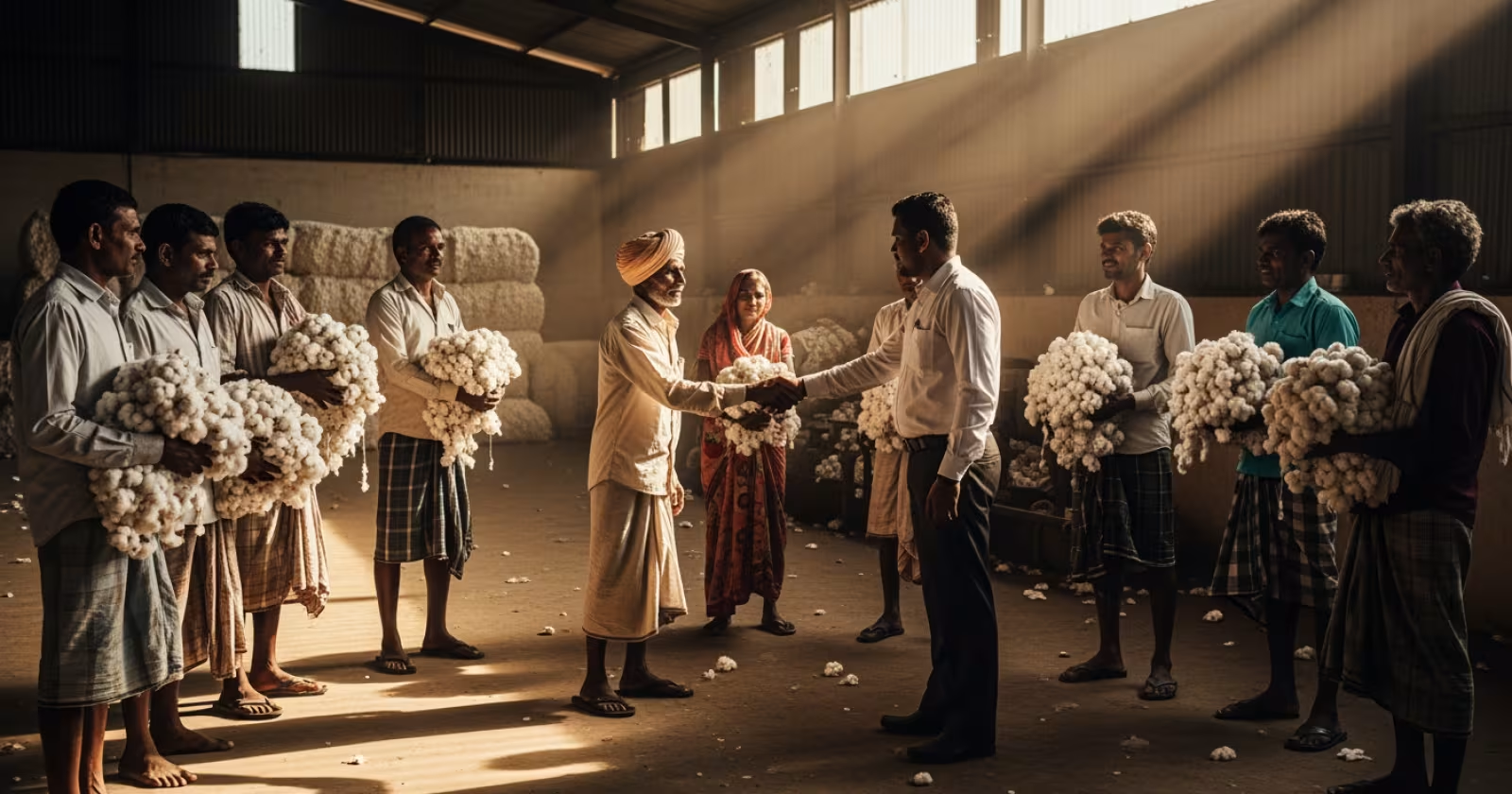
In Adilabad district, a cotton farmer named Ramulu sold his entire kharif harvest last season without once stepping inside the local APMC mandi. He earned approximately ₹7,800 per quintal — nearly ₹1,200 more than what the regulated market yard was offering after commissions and deductions. Ramulu is not an outlier. He is part of a quiet but accelerating shift among Telangana’s cotton cooperative farmers who are finding ways around a system many feel has stopped working for them.
Why This Shift Matters Beyond Telangana
India is the world’s largest cotton-producing country by acreage, and Telangana contributes roughly 10-12% of the national output. The APMC system — designed decades ago to protect farmers from exploitative traders — has increasingly become a chokepoint rather than a safeguard. Commission agents, delayed payments, and grading disputes mean that growers in districts like Adilabad, Warangal, and Khammam routinely receive less than the Minimum Support Price (MSP) in effective terms. What is happening in Telangana’s cotton belt is a grassroots test case for whether cooperatives can genuinely replace or complement the mandi system.
The Roots of Cotton Cooperatives in Telangana
Cotton cooperation in what is now Telangana has a history stretching back to the unified Andhra Pradesh era. The Telangana State Cooperative Cotton Growers Federation, restructured after the state’s formation in 2014, was originally modelled on the success of Gujarat’s cotton cooperatives. The idea was straightforward — pool the harvest from thousands of small and marginal growers, grade it collectively, and negotiate better prices with spinning mills directly.
In the early years, the federation operated largely as a government procurement arm, buying cotton at MSP when market prices crashed. But after 2018, several district-level cooperative societies began experimenting with direct linkages to private spinning mills in Tamil Nadu, Maharashtra, and even export aggregators. The real acceleration came during the pandemic years, when APMC yards were either shut or operating at reduced capacity, and cooperatives stepped in as the only functioning channel for thousands of growers. By 2024, estimates suggest that cooperative-channelled cotton in Telangana had grown to approximately 8-10 lakh quintals annually, a significant jump from the 3-4 lakh quintals recorded five years earlier.
How the Cooperative Bypass Actually Works
I find the mechanics of this bypass fascinating because it is not a dramatic rebellion — it is quiet, incremental, and deeply practical. Here is how it typically unfolds at the village level.
A primary agricultural cooperative society (PACS) in a cotton-growing mandal collects harvested kapas (raw, unginned cotton) from its members. Instead of trucking it to the nearest APMC yard — where the farmer would pay a market fee (typically 1%), commission (up to 2.5%), and bear loading, unloading, and weighing costs — the cooperative aggregates the produce at its own collection centre. Quality grading is done in-house or through empanelled agencies.
The cooperative then negotiates directly with spinning mills or with the Cotton Corporation of India (CCI) for MSP procurement. In many cases, the cooperative has pre-season agreements with mills in Coimbatore or Nagpur, locking in prices that are ₹500-₹1,500 above what the open mandi would offer after deductions. Payment is routed through the cooperative’s bank account, and farmers typically receive their money within 7-15 days — compared to the 30-45 day delays common in APMC transactions.
| Parameter | APMC Mandi Route | Cooperative Direct Route |
|---|---|---|
| Effective price per quintal (2026-26 season) | ₹6,400-₹6,800 | ₹7,500-₹8,000 |
| Commission and fees | 3-4% of sale value | 1-1.5% cooperative service charge |
| Payment timeline | 30-45 days | 7-15 days |
| Quality grading transparency | Often disputed | Pre-agreed standards |
| Transport cost borne by farmer | Full | Shared/subsidised by cooperative |
The numbers speak clearly. A farmer selling 50 quintals through the cooperative route can earn approximately ₹55,000-₹60,000 more per season than through the APMC. For a smallholder farming 5-8 acres, that is the difference between breaking even and actually building savings.
What Could Still Go Wrong
This is not a fairy tale. Several district cooperative societies in Telangana are plagued by the same problems that haunt cooperatives across India — political capture, poor governance, and thin working capital. In Warangal, one cooperative society reportedly delayed payments to farmers for over three months in 2024 because its elected board diverted funds to a different venture. Such incidents erode trust quickly.
There is also the legal grey zone. Telangana has not fully amended its APMC Act to explicitly permit cooperative direct marketing without mandi involvement. Some transactions operate under exemptions or through creative interpretations of the rules. If a future state government decides to tighten APMC enforcement — perhaps under pressure from the powerful commission agent (arthiya) lobby — the cooperative bypass could face serious legal hurdles. Additionally, climate volatility is a looming threat. The 2023 pink bollworm infestation in parts of Adilabad wiped out yields for many growers, and cooperatives had to absorb losses on pre-committed supply contracts.
A District That Got It Right
Khammam district offers perhaps the most encouraging model. The Khammam District Cooperative Cotton Marketing Society has built a network of 45 village-level collection points, installed electronic weighbridges at each, and partnered with NABARD for a cotton value chain financing scheme. In the 2026-26 season, the society marketed approximately 1.2 lakh quintals on behalf of its 12,000-odd members. Crucially, it also began offering input financing — seeds, fertilisers, and pesticides — at subsidised rates, creating a full-cycle relationship with the farmer rather than just a transactional one at harvest time. This integration of credit, input supply, and output marketing is what separates a functioning cooperative from a mere collection agent.
What the Next Five Years Look Like
The Ministry of Cooperation in Delhi has signalled strong intent to modernise PACS into multi-service centres, and cotton-growing states like Telangana stand to benefit significantly. If the proposed national cooperative database is operationalised by 2027, it could give cotton cooperatives real-time market intelligence and direct linkages to commodity exchanges. Telangana’s own state government has been discussing a dedicated cotton cooperative policy, though nothing concrete has been notified yet.
Technology adoption is another frontier. Some cooperatives are already piloting smartphone-based quality assessment apps that use camera imaging to grade cotton fibre length and trash content — replacing the subjective manual grading that causes so many disputes. If scaled, this could make the cooperative route not just cheaper but genuinely more transparent than the APMC system.
Back to Adilabad
Ramulu, the Adilabad farmer I mentioned at the start, told a local reporter last season that the extra ₹1,200 per quintal he earned through his cooperative allowed him to pay off a pending fertiliser loan and buy a drip irrigation kit for the first time. It is a small story. But multiply it across thousands of growers in Telangana’s cotton belt, and you begin to see what cooperative-led market reform looks like when it works — not as grand policy, but as ₹1,200 at a time, one farmer at a time.
If you are a cooperative member, an agriculture professional, or someone who cares about how India’s farmers actually get paid, I would encourage you to follow these developments closely. The Telangana cotton story is far from settled, but it is one of the most instructive experiments in cooperative marketing happening anywhere in India right now. Share it, discuss it, and if you are in a position to — push your own district cooperative to learn from it.