
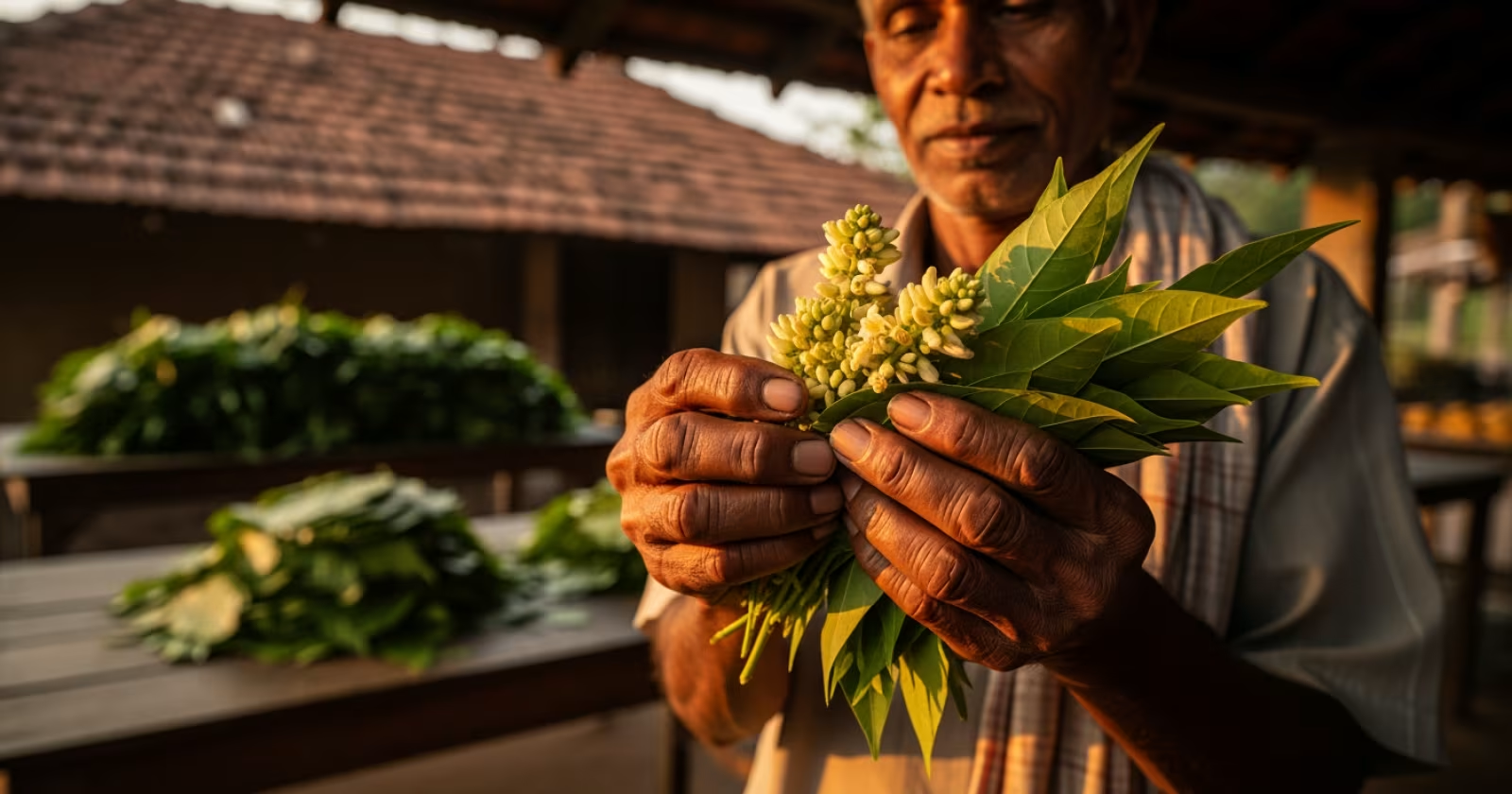
In the dense sal forests outside Ambikapur, Surguja district, a 42-year-old Oraon tribal woman named Kamla Kerketta earned ₹38,000 last season selling dried mahua flowers — roughly three times what the local trader at the weekly haat would have offered her. The difference wasn’t luck. It was structure. A cooperative structure, built over years, that has quietly rewritten the economics of minor forest produce collection for thousands of Adivasi families across Chhattisgarh.
Why This Cooperative Model Matters Beyond Chhattisgarh
India‘s tribal communities depend heavily on minor forest produce (MFP) — mahua, tendu, lac, tamarind, sal seeds — for survival. Estimates suggest that MFP contributes between 20% and 40% of annual income for roughly 100 million forest-dwelling people. Yet for decades, the supply chain has been rigged against collectors. Middlemen buy at rock-bottom prices during peak season, hoard stock, and sell at multiples to processing units. The Chhattisgarh State Minor Forest Produce Cooperative Federation (CGMFP Federation) was designed to break exactly this cycle.
I find it remarkable that despite all the policy noise around tribal welfare, very few models actually deliver consistent above-market prices at scale. This one does — and I think it deserves much closer attention from cooperative planners in other states.
The Origins of Chhattisgarh’s Forest Produce Cooperative
The roots go back to the early 2000s, shortly after Chhattisgarh was carved out of Madhya Pradesh in 2000. The new state inherited vast forest cover — approximately 41% of its land area — and a significant tribal population concentrated in districts like Surguja, Bastar, Korba, Jashpur, and Dantewada. The old MFP procurement system was run through contractors who held near-monopoly purchasing rights, especially for tendu leaves, which are used to roll beedis.
The state government, recognising the extractive nature of this arrangement, gradually empowered cooperative federations to handle MFP procurement directly. The CGMFP Federation, registered under the Chhattisgarh Cooperative Societies Act, became the nodal agency. Its mandate was simple: procure directly from primary collectors through village-level cooperative societies, pay a government-notified minimum support price (MSP), and handle processing, storage, and sale to end buyers.
The Forest Rights Act of 2006 gave this model legal teeth by recognising community rights over MFP, effectively ending the contractor raj in several districts. By 2010, Chhattisgarh had built a functioning network of primary cooperative societies at the village level, feeding into district unions, feeding into the state federation.
How the Cooperative Actually Works in 2026
Let me walk you through the mechanics, because this is where it gets interesting. At the village level, a primary forest produce cooperative society operates as the first point of sale. An Adivasi collector — typically a woman — brings her mahua flowers, tendu leaf bundles, or other MFP to this society. The society weighs the produce, records the transaction, and pays her the MSP on the spot or within days.
The MSP for key items has risen substantially. For tendu leaves, the rate in Chhattisgarh has historically been among the highest in India — reports suggest figures exceeding ₹4,000 per standard bag in recent seasons, compared to ₹1,200-1,500 that private traders offer in neighbouring states. For mahua flowers, the cooperative pays approximately ₹30-35 per kilogram against open market rates of ₹10-12 per kilogram during peak collection when supply floods in.
| Forest Produce | Cooperative MSP (approx.) | Open Market / Trader Rate | Price Advantage |
|---|---|---|---|
| Mahua Flowers (per kg) | ₹30–35 | ₹10–12 | ~3x |
| Tendu Leaves (per bag) | ₹4,000+ | ₹1,200–1,500 | ~2.5–3x |
| Sal Seed (per kg) | ₹22–25 | ₹8–10 | ~2.5x |
| Lac (per kg) | ₹150–200 | ₹80–100 | ~2x |
The federation then aggregates produce across districts, processes where possible (mahua into oil or spirits, sal seed into fat), and sells to bulk buyers or government agencies like TRIFED. The surplus revenue, after operational costs, is distributed back as a bonus to collectors — effectively a second payment on top of the MSP. This bonus system is what pushes the effective rate to nearly three times the unorganised market price for several items.
What Threatens This Model
No cooperative story in India is free of friction, and this one has its share. First, political interference in the appointment of federation leadership remains a chronic issue. When governments change, cooperative boards often get superseded or restructured, disrupting operations during critical collection seasons.
Second, climate variability is hitting mahua yields hard. Mahua trees flower in March-April, and unseasonal rains or heatwaves during this narrow window can slash output by 30-40% in affected districts. Collectors who depend on this single seasonal burst of income are left vulnerable, and the cooperative has limited tools to hedge against weather risk.
Third, there’s the persistent challenge of delayed payments. While the system is designed for prompt payment, ground-level reports from Bastar and Dantewada suggest that some primary societies face cash-flow crunches, forcing collectors to wait weeks. In those gaps, private traders swoop in with instant cash, undermining the cooperative’s credibility. NABARD has extended working capital lines to address this, but coverage remains uneven.
A District-Level Story That Sharpens the Picture
Consider Korba district, where a cluster of Van Dhan Vikas Kendras — set up under the central government’s Van Dhan Vikas Yojana — began processing mahua into value-added products like mahua laddu, mahua oil, and even mahua-based nutritional mixes. These kendras, operated by self-help groups of tribal women linked to the cooperative federation, reportedly increased per-collector income by an additional ₹8,000-12,000 per season compared to selling raw produce alone.
The Korba model demonstrates something I think is critical for the cooperative movement nationwide: procurement alone is not enough. The real margin — and the real empowerment — lies in processing and branding at the community level. When Adivasi women in Korba sell packaged mahua oil with a cooperative label rather than sacks of raw flowers, they capture value that previously leaked entirely to intermediaries.
What the Next Five Years Could Look Like
The Ministry of Cooperation, established in 2021, has signalled a broader push to digitise and strengthen primary cooperative societies across India, including those handling MFP. If Chhattisgarh’s CGMFP Federation can integrate digital payment systems at the village society level — eliminating payment delays — the model becomes significantly more resilient against trader competition.
There’s also growing interest in securing GI Tags for region-specific forest produce, which could open premium domestic and export markets. Bastar’s sal seed butter and Surguja’s mahua products are potential candidates. Technology pilots using mobile apps for real-time MSP updates and collection tracking are underway in select districts, supported by TRIFED.
The next five years will determine whether this remains an isolated Chhattisgarh success or becomes a replicable template for Jharkhand, Odisha, and Madhya Pradesh — states with similar tribal demographics and forest economies.
Back to Ambikapur
Kamla Kerketta used her ₹38,000 from last season’s mahua sale to pay school fees for two children and invest in a small poultry unit. She told a local reporter that before the cooperative, the same quantity of mahua would have fetched her barely ₹12,000 from the village trader. That ₹26,000 difference — multiplied across hundreds of thousands of Adivasi collectors — is the quiet revolution that Chhattisgarh’s forest produce cooperative represents.
If you work in the cooperative sector, study it, or simply believe that fair pricing can change rural lives, I’d encourage you to follow this model closely. It isn’t perfect, but it’s proof that when cooperatives function as intended — as collective bargaining instruments for the most marginalised — the economics shift decisively. And that shift is worth paying attention to.