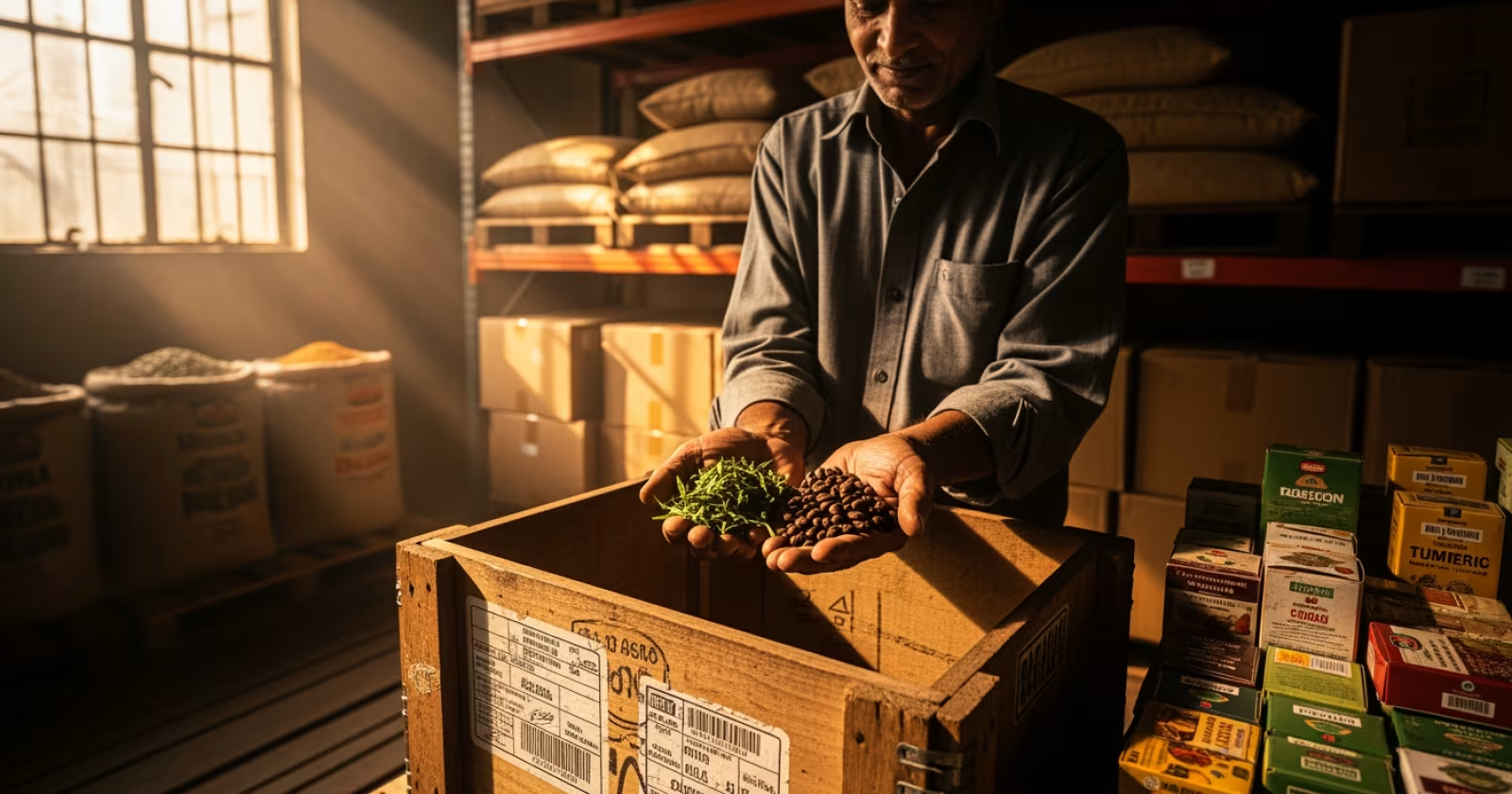
At 6,200 feet above sea level, in the mist-wrapped slopes above Coonoor, a 62-year-old Toda tribal woman named Lakshmi picks the season’s second flush of orthodox tea — two leaves and a bud, repeated hundreds of times before noon. Two decades ago, a private buyer would have paid her roughly ₹8 per kilogram of green leaf. Today, the Nilgiris Cooperative Marketing Society (NCMS) ensures she receives closer to ₹22, and her leaf ends up in specialty tea shops in Germany, Japan, and the UAE. No broker. No auction intermediary. No margin skimmed by a chain of agents between her hillside and the overseas buyer.
Why the Nilgiris Cooperative Model Matters Beyond Tamil Nadu
India is the world’s second-largest tea producer and a significant origin for arabica coffee and cardamom. Yet the farmer’s share in the final export price has historically been dismal — often under 15 per cent. The Nilgiris district, home to over 60,000 small growers cultivating tea, coffee, pepper, and spices across approximately 30,000 hectares, has quietly built one of India’s most effective cooperative export pipelines. What makes this remarkable is scale without corporate structure: a network of primary cooperative societies federated into a district-level marketing body that handles processing, branding, quality certification, and direct export — shipping to 14 countries across Europe, East Asia, and the Middle East.
This isn’t a feel-good village story. It is a replicable commercial model that the Ministry of Cooperation has cited in policy discussions about cooperative-led exports under the new Multi-State Cooperative Societies framework.
Roots in the Blue Mountains: How It All Began
The cooperative movement in the Nilgiris traces back to the 1930s, when British-era tea estates dominated and small tribal cultivators had zero bargaining power. After Independence, the Tamil Nadu government encouraged cooperative tea factories in the district. By the 1960s, several primary societies had formed around Ooty, Coonoor, and Kotagiri, pooling members’ green leaf for collective processing.
The real turning point came in the 1980s when these scattered primaries federated under the NCMS umbrella. The society secured its own processing infrastructure — orthodox tea rollers, CTC lines, coffee pulping units, and spice drying yards. Rather than selling raw produce at the Coonoor tea auction, the cooperative began investing in quality grading and direct buyer relationships. By the early 2000s, NCMS had obtained APEDA registration, ISO certifications, and FSSAI compliance — the trifecta needed to legally export food products from India.
What’s often overlooked is how the cooperative handled spices. Nilgiris pepper and cardamom were traditionally sold through Kerala-based spice traders at thin margins. The cooperative vertically integrated these products into its export catalogue, offering international buyers a single-origin, multi-commodity basket from one verified source.
The Mechanics: From Leaf to Export Container
I find the operational model genuinely impressive in its simplicity. Here is how the value chain works in practice:
| Stage | Who Handles It | Key Detail |
|---|---|---|
| Cultivation | Individual tribal/small farmers | Average holding: 1-3 acres per member |
| Collection | Primary cooperative societies | Daily leaf collection at village centres |
| Processing | Cooperative-owned factories | Orthodox and CTC tea; washed arabica coffee; dried spices |
| Quality Grading | NCMS quality cell | Lab testing for export-grade compliance |
| Branding & Packaging | NCMS marketing division | Private-label and own-brand options |
| Export Logistics | NCMS via Chennai/Cochin ports | Direct FOB contracts — no auction, no broker |
| Payment to Farmer | Primary societies within 15 days | Price includes export premium share |
The membership base is estimated at over 15,000 active grower-members across the district, with a significant proportion being Toda, Badaga, and Irula tribal communities. Revenue flows back in two ways: the procurement price itself (which consistently tracks above private buyer rates) and an annual surplus dividend. In good years, members have reportedly received a surplus share equivalent to 8-10 per cent above the procurement value.
The cooperative’s export portfolio now includes Nilgiri orthodox tea (which carries a GI tag), washed arabica and robusta coffee, black pepper, cardamom, and clove. Buyers span Japan, Germany, Russia, the UAE, South Korea, the UK, Australia, and several Central Asian republics. Approximately 30-35 per cent of total produce is exported, with the rest sold domestically through institutional buyers and the cooperative’s own retail outlets in Tamil Nadu.
What Threatens This Model
For all its success, the Nilgiris cooperative faces real vulnerabilities. Climate change is the most immediate. Erratic rainfall patterns in 2024 and 2026 disrupted both the first and second flush of tea, reducing yields by an estimated 12-15 per cent. Coffee berry borer infestation, linked to rising temperatures, has hit arabica plots hard. The cooperative has begun distributing climate-resilient saplings through a NABARD-supported watershed programme, but adaptation is slow when your average member is a smallholder with less than two acres.
Then there’s the generational problem. Younger members of tribal communities are migrating to Coimbatore and Bengaluru for service-sector jobs. The average age of active tea pluckers in the Nilgiris is now estimated to be above 50. Without fresh membership, the cooperative’s collection volumes will shrink, weakening its export negotiating power.
Political interference is subtler here than in, say, Maharashtra’s sugar cooperatives, but board elections still attract local political interest, and governance reforms recommended by NCDC audits have been slow to implement.
A Lesson from Rwanda — and from Next Door in Wayanad
The Nilgiris model echoes what Rwanda’s coffee cooperatives achieved after 2005 — direct trade relationships that lifted farmers from commodity-grade pricing to specialty-market premiums. In Rwanda, cooperative coffee exports now command prices 40-60 per cent above the commodity benchmark. NCMS is heading in a similar direction with its orthodox tea, which fetches approximately ₹350-500 per kg in export markets compared to ₹180-220 at the Coonoor auction.
Closer to home, Wayanad’s tribal coffee cooperatives in Kerala have tried a similar direct-export model but struggled with fragmented federation and inconsistent quality grading. The Nilgiris cooperative’s advantage is its unified processing and marketing structure — one brand, one quality standard, one export desk. That institutional discipline is what turns a collection of smallholders into a credible international supplier.
What the Next Five Years Could Look Like
Several policy tailwinds are converging. The Ministry of Cooperation’s push to computerise and strengthen Primary Agricultural Credit Societies (PACS) across India includes provisions for cooperative-led export facilitation. APEDA has expanded its subsidy for cooperative branding and international trade fair participation. If NCMS can secure organic and Rainforest Alliance certifications — currently in progress for approximately 2,000 hectares — its export premiums could rise by another 20-25 per cent.
Technology adoption is promising too. The cooperative has piloted a digital leaf-tracking system that records each member’s contribution from collection point to export invoice, enabling full traceability — a feature increasingly demanded by European buyers under the EU Deforestation Regulation. If this rolls out fully by 2027, the Nilgiris cooperative would be among the first Indian farmer-owned organisations to offer blockchain-verified single-origin traceability.
Back on Lakshmi’s Hillside
When I think about what makes this cooperative genuinely different, I return to that image of Lakshmi above Coonoor. She does not know the name of the German buyer purchasing her orthodox tea. She does not need to. What she knows is that her cooperative pays her within 15 days, that her grandson’s school fees are covered by the annual dividend, and that no middleman is extracting a margin from her labour. In a country where approximately 86 per cent of farmers are smallholders and most agricultural cooperatives remain confined to domestic procurement, the Nilgiris model offers something rare: proof that farmer-owned institutions can compete in global markets on their own terms.
If you are involved in the cooperative sector — as a member, a policymaker, or simply someone who cares about equitable trade — I’d encourage you to study this model closely. The Nilgiris blueprint is not magic; it is federation, quality control, and patience compounded over decades. And it is available for replication wherever small farmers are willing to trust a collective over a middleman.